To Mind Without Abiding: How Ancient Craft Shapes Contemporary Vision in Jingdezhen
By Grace Liang
Roughly a three-and-a-half-hour train ride inland from Shanghai sits the unassuming industrial city of Jingdezhen, China. Despite its relatively remote location nestled in the foothills of the Huangshan Mountains, Jingdezhen has held the title of the undisputed porcelain capital of China since the Ming Dynasty. Today, this legacy of technical mastery, industrial collaboration, and artistic vision is carried forward by a new generation of contemporary ceramicists who are reimagining the possibilities and limits of the same ancient materials for our modern world.
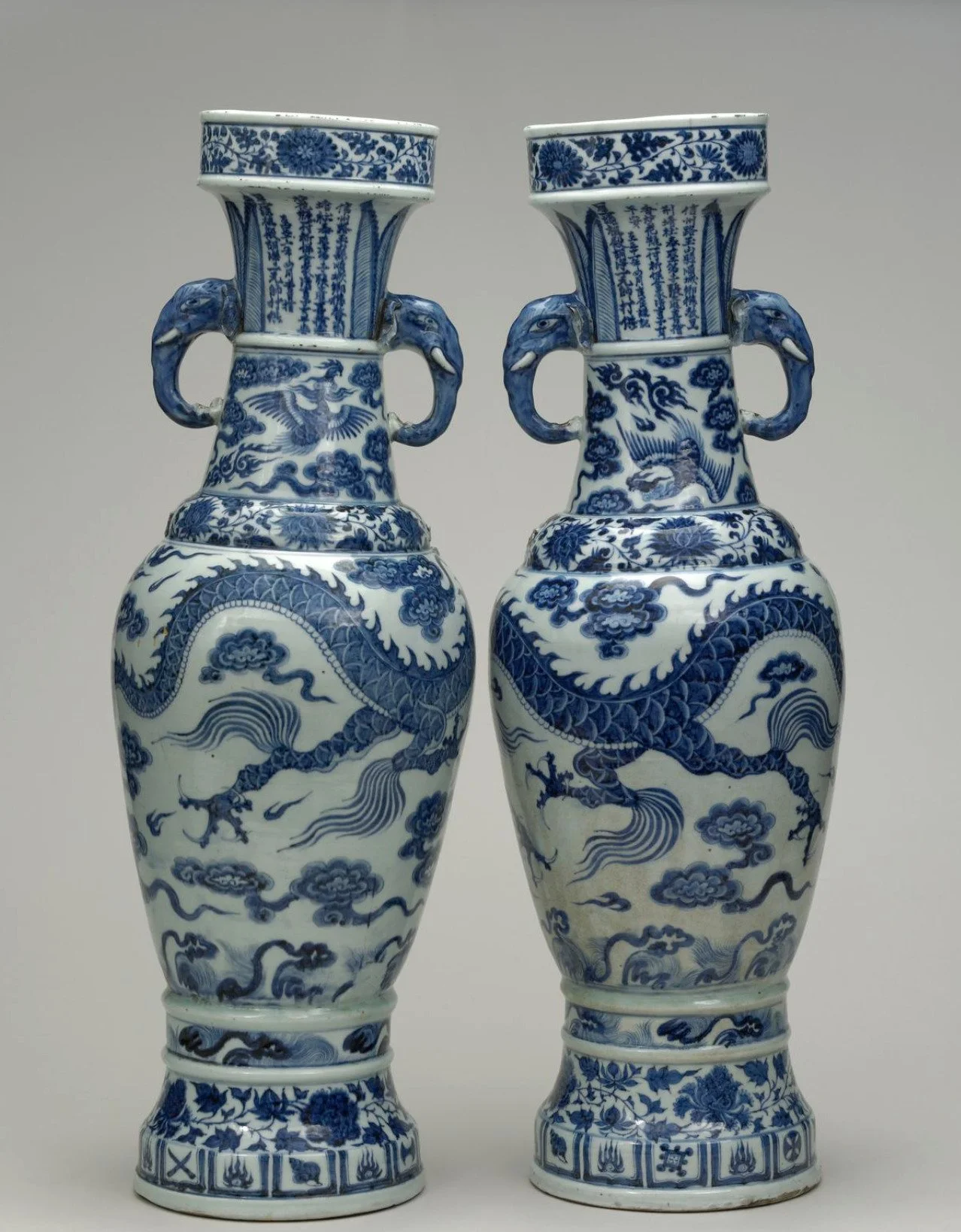
The David Vases, 1351, blue and white underglaze porcelain, 19.6 x 63.8 cm
Image courtesy of the British Museum
Originally serving primarily as a market and official control point for porcelain, Jingdezhen’s transition into a center of porcelain production was fueled by the wealth of natural resources from the surrounding mountains. The landscape was rich in kaolin clay, which gives porcelain its essential structural stability and pure white colour, as well as pine food, whose resin content allows it to burn at the incredibly high temperatures necessary to fire quality porcelain.
Furthermore, Jingdezhen’s position along the Chang River meant finished wares could be easily transported to China's broader water networks and beyond to the global maritime routes. The domestic and international demand was staggering. In the seventeenth century, European maritime expansion caused a meteoric rise in the demand for Chinese exports of porcelain alongside tea and spices prompting private kilns to fire hundreds of thousands of ceramic pieces for export each year. Even before that, imperial kilns had been established in Jingdezhen in the early Ming Dynasty to produce prodigious amounts of porcelain for imperial use; the Court of Imperial Entertainments famously placed an order in 1459 for over 133,000 vessels. The mass production necessary to satisfy this kind of demand moulded Jingdezhen into an industrial powerhouse. Each element of the production process was divided to maximize efficiency, from the laborers throwing standardized vessel shapes on the wheel or using moulds, to decorators who specialised in a single floral motif. As a result, many skilled laborers would have worked on any finished piece of porcelain coming out of Jingdezhen. Moreover, each imperial piece was held to an extraordinarily high standard of quality; if it failed to meet these criteria at any point in the production process, it was summarily destroyed. This practice left behind an expansive graveyard of sherd heaps that bear witness to the scale of Jingdezhen’s historical output.
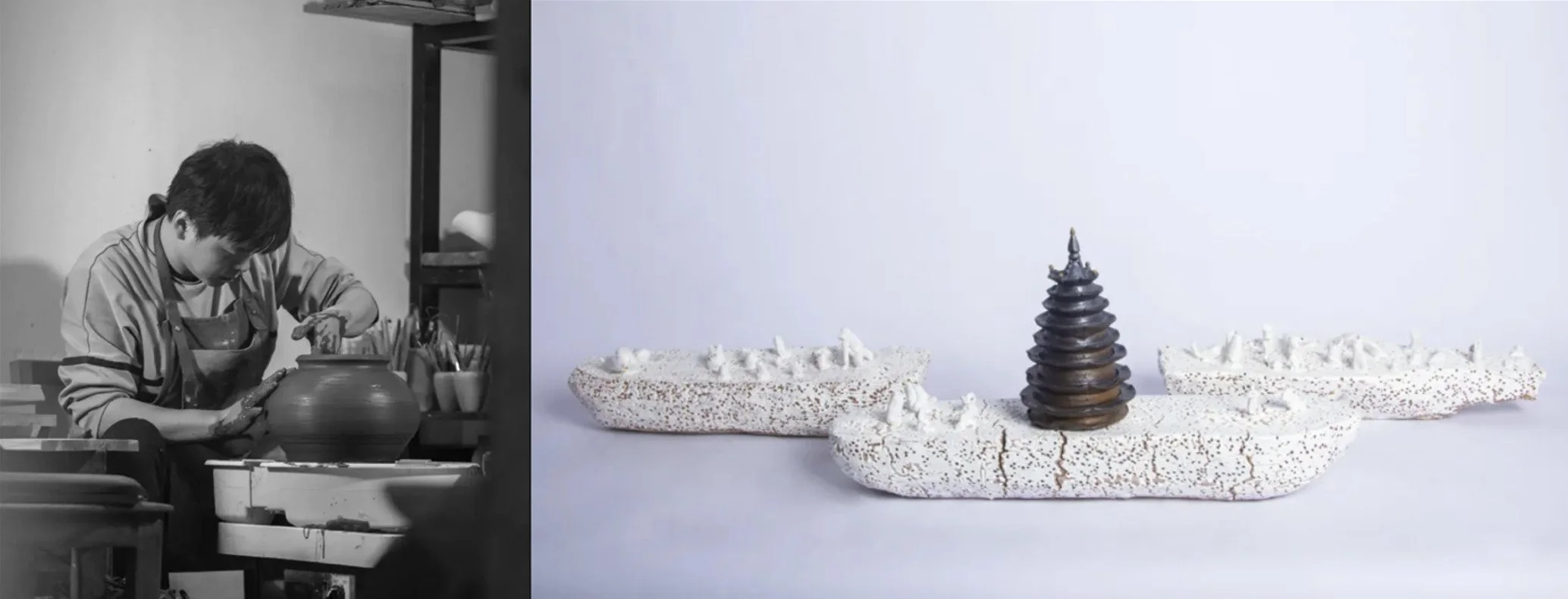
Left: Jinghui Song at the wheel. Right: Song Jing Hui, Awaken the Mind that Abides Nowhere, 2022, Porcelain, 172cm×19cm ×37cm.
Images courtesy of Jinghui Song.
During my time in Jingdezhen, I stayed at the Jinxi Art Museum, founded in 2024 by Jinghui Song, an artist and professor at Jingdezhen Ceramics University. He was born into a Jingdezhen porcelain family, his grandfather owned the Huang Da Da kiln, which had had served as the primary kiln for the Qing Dynasty royal court and regularly worked alongside the famous neighboring Jingdezhen Royal Kiln Factory. Song grew up visiting the kilns, and this early exposure provided him with a profound understanding of the material possibilities and limitations of porcelain. This emphasis upon tactile materiality is evident in his works, where the textures and unpredictability of porcelain are embraced as intentional aesthetic elements. He elevates this interplay of “earth and fire” into a medium for conceptual high art, going beyond the traditional conception of ceramics as an everyday functional material. Song’s work seeks to reexamine Eastern aesthetics through a sophisticated understanding of porcelain and ceramic science. In his work Awaken the Mind that Abides Nowhere (2022), inspired by one of the core tenets of the Vajracchedikā Prajñāpāramitā Sūtra (Diamond Sutra), Song mixed polystyrene into his clay to form three white boats. He then subjected the pieces to impacts to encourage cracking, allowing the kiln’s heat and the nature of the clay to dictate the final textural nuances of the form. These boats are populated with indeterminate paper-pulp clay figures that lose their original shapes during the high-temperature firing, collectively evoking the intangibility and non-attachment of faith. Rising from the center boat, is a contrasting rust-black tower made from a combination of wheel thrown porcelain and coil building. The solidity of colour and form juxtaposed against the formless, cracked shapes of the boats and figures underscores the tower’s status as an anchor within the spirit realm. By employing contemporary techniques and material experiments to explore ancient Buddhist philosophical concepts, Song brings the tradition and material of porcelain into the contemporary art world. Not in the form of a rarefied artifact, but as an expressive sculpture that communicates a lasting universal message about the nature of faith and spirituality.
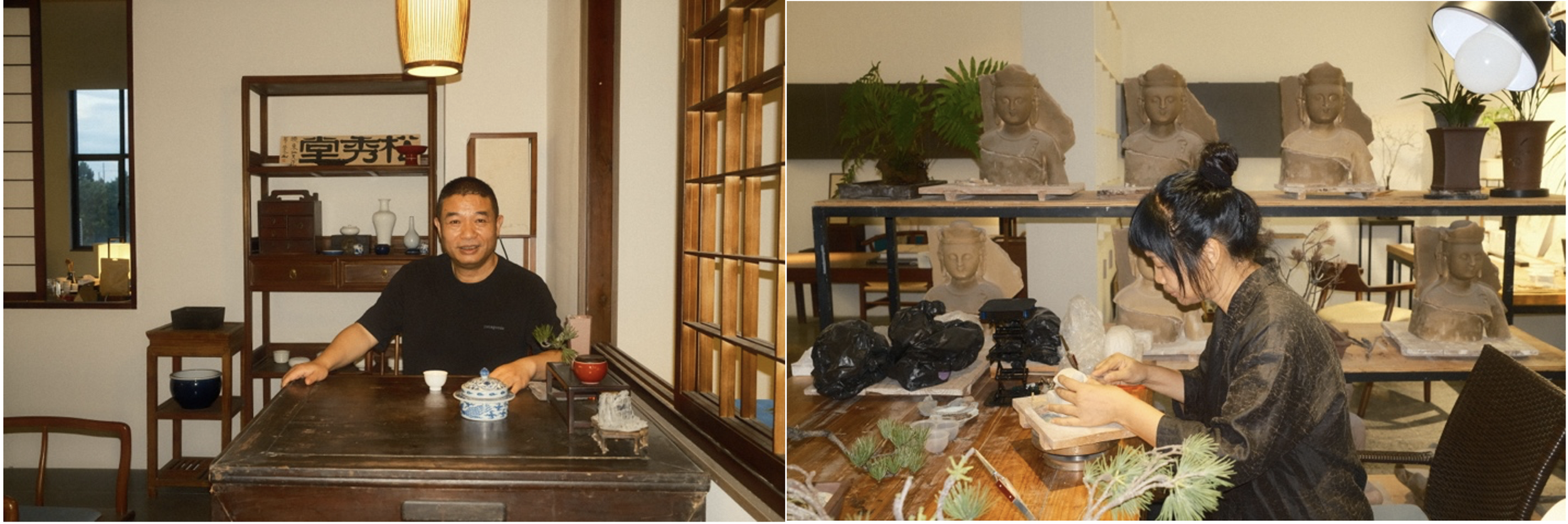
Xiaodong Hu (left) and Linxi Hu (right) in their studios at the Jinxi Art Museum.
Images courtesy of Grace Liang.
Just above Song Jing Hui, occupying the third floor of the Jinxi Art Museum is Xiaodong Hu’s porcelain studio, Songxiu Tang (which translates to Grace of the Pine Studio). Hu’s interest in ceramics began with a childhood fascination with his family’s collection of antique porcelain. After a pivotal visit to Jingdezhen in 2009, he decided to embark on his own journey of ceramic creation. He founded Songxiu Tang to explore the interplay between Chinese culture, in which he was immersed as a child, and Western art. Xiaodong Hu and his longtime friend and business partner, fellow artist Linxi Hu, both describe seeking artistic and spiritual “nourishment” from traditional Chinese arts, which they passionately collect and practice. Linxi Hu’s practice spans the disciplines of calligraphy, ink painting, and porcelain sculpture all rooted in Buddhism and a deep reverence for Chinese cultural traditions. Songxiu Tang is grounded in the philosophies of Confucianism, Buddhism, and Taoism and they strive to preserve ancient porcelain techniques while exploring the “elegant aesthetics of the contemporary literati.”
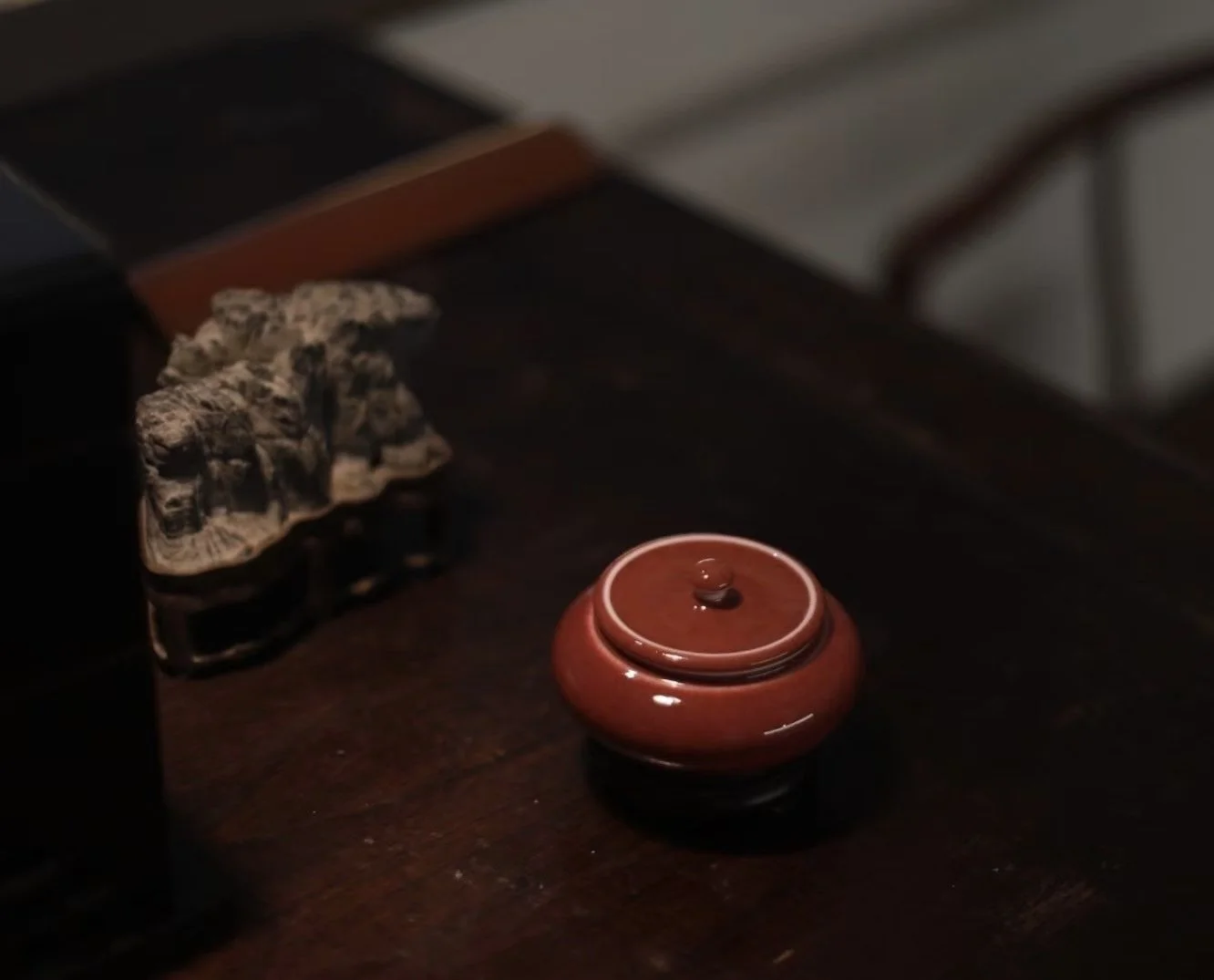
A jihong porcelain vessel by Songxiu Tang.
Image courtesy of Linxi Hu.
The studio mainly produces monochromatic (Dan Se) porcelain in traditional Chinese shapes, meiping vases, gaiwan tea sets, and other classic forms. Despite the deceptive simplicity of these single colours, these traditional glazes are notoriously difficult to master. While the famous classic blue-and-white porcelain (Qinghua) is more heavily decorated, danse glazes are prized solely for their luscious texture and pure, cloudlike colours. For example, jihong (Sacrificial Red) is widely considered one of the most elusive, celebrated, and technically challenging monochrome glazes in the world of porcelain, and serves as Songxiu Tang’s specialty. Originating in Jingdezhen during the Ming Dynasty, jihong porcelain was reserved for imperial ceremonial and sacrificial rites, which gives the glaze its name. The suspension-based glaze is coloured with finely ground copper oxide, meaning that the colour effect is produced through light scattering within the glaze’s structural matrix. This balance must be carefully measured so as not to accidentally produce a pale, pinkish tone or a bloody brown. Due to its higher calcia content, jihong glaze has a tendency to flow downward during the firing process. Though his studio employs several artisans who handle other parts of the production process, Hu still fires these jihong pieces himself, painstakingly tending to the kilns to achieve the desired velvety texture and colour.
The historical endurance of the porcelain tradition directly informs the modern studio practices of artists and artisans like Jinghui Song and Xiaodong Hu. Beyond viewing tradition as a set of rigid technical constraints or mere museum pieces, these contemporary artists treat their ancient materials and heritage as a foundation. Whether through Song’s conceptual exploration of Buddhist philosophy using material experiments with clay composites, or Hu’s painstaking stewardship of the elusive jihong glaze, their work demonstrates that ancient practices are essential to contemporary art making. These ceramicists root their innovations in the legacy of Jingdezhen, its historical forms, and its artistic philosophies to show that contemporary expression does not require severing ties with the past. Instead, the evolving legacy of Jingdezhen continues to prove that ancient craft remains one of the most potent and universal languages for speaking to the modern world.
Bibliography
Huang, Ellen. “An Art of Transformation: Reproducing Yaobian Glazes in Qing-Dynasty Porcelain.” Archives of Asian Art 68, no. 2 (2018): 133–56.
National Museum of Asian Art. “National Museum of Asian Art.” 2017. https://asia.si.edu/explore-art-culture/collections/search/edanmdm:fsg_F2015.2a-b/.
The British Museum. “Altar-Vase | British Museum.” The British Museum. https://www.britishmuseum.org/collection/object/A_PDF-B-614.
Tsui, Denise. “Chinese Ceramics Explained – a Guide for Collectors.” Sothebys.Com. https://www.sothebys.com/en/articles/chinese-ceramics-explained-a-guide-for-collectors.