2026: The Gulf’s New Art Launderette IN, Miami Art Basel OUT
By Aglaïa S. Rozental
My prediction for 2026 is a driving shift in global art investment towards the Gulf.
During the inaugural Art Basel Qatar, Sheikha al-Mayassa, the chair of Qatar Museums and sister to the current Emir of Qatar, unveiled plans concerning artistic developments in her country. This was shared during a conversation moderated by Hans Ulrich Obrist, artistic director of the Serpentine Gallery in London, and Maja Hoffmann, Swiss mecène, entitled ‘Leaders of change: How is patronage shaping new art ecosystems?’
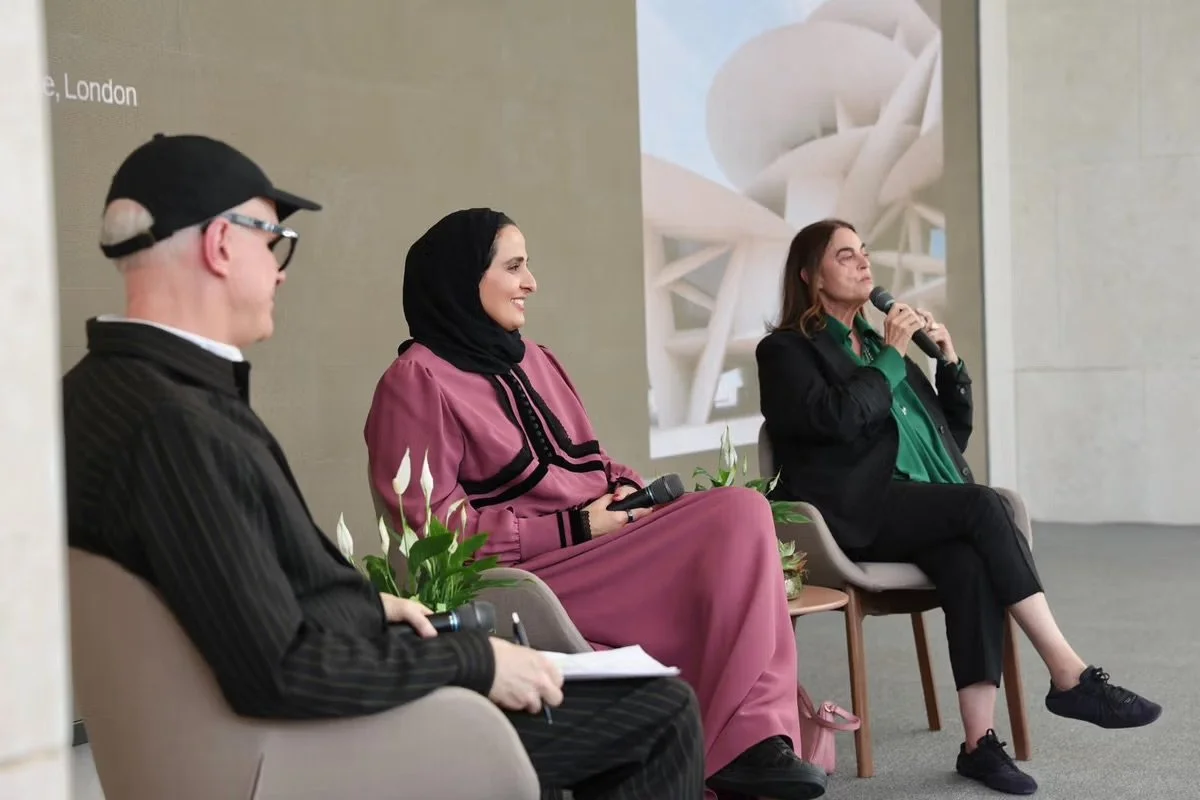
Inauguration talk. Art Basel Qatar.
Image courtesy of Qatar Museums.
Sheikha al-Mayassa mentioned the development of projects across the global stage, such as Qatar’s Pavilion at the Expo 2025 in Osaka, Japan. The Pavilion’s design connects the tradition of dhow boat construction from Qatar with Japan’s heritage of wood joinery – visually fusing the history of maritime connection between the two countries. The chosen title for the Pavilion project, ‘From the Coastline, We Progress’ powerfully expresses the incentive to trace Qatar’s past and share their connectivity with the world.
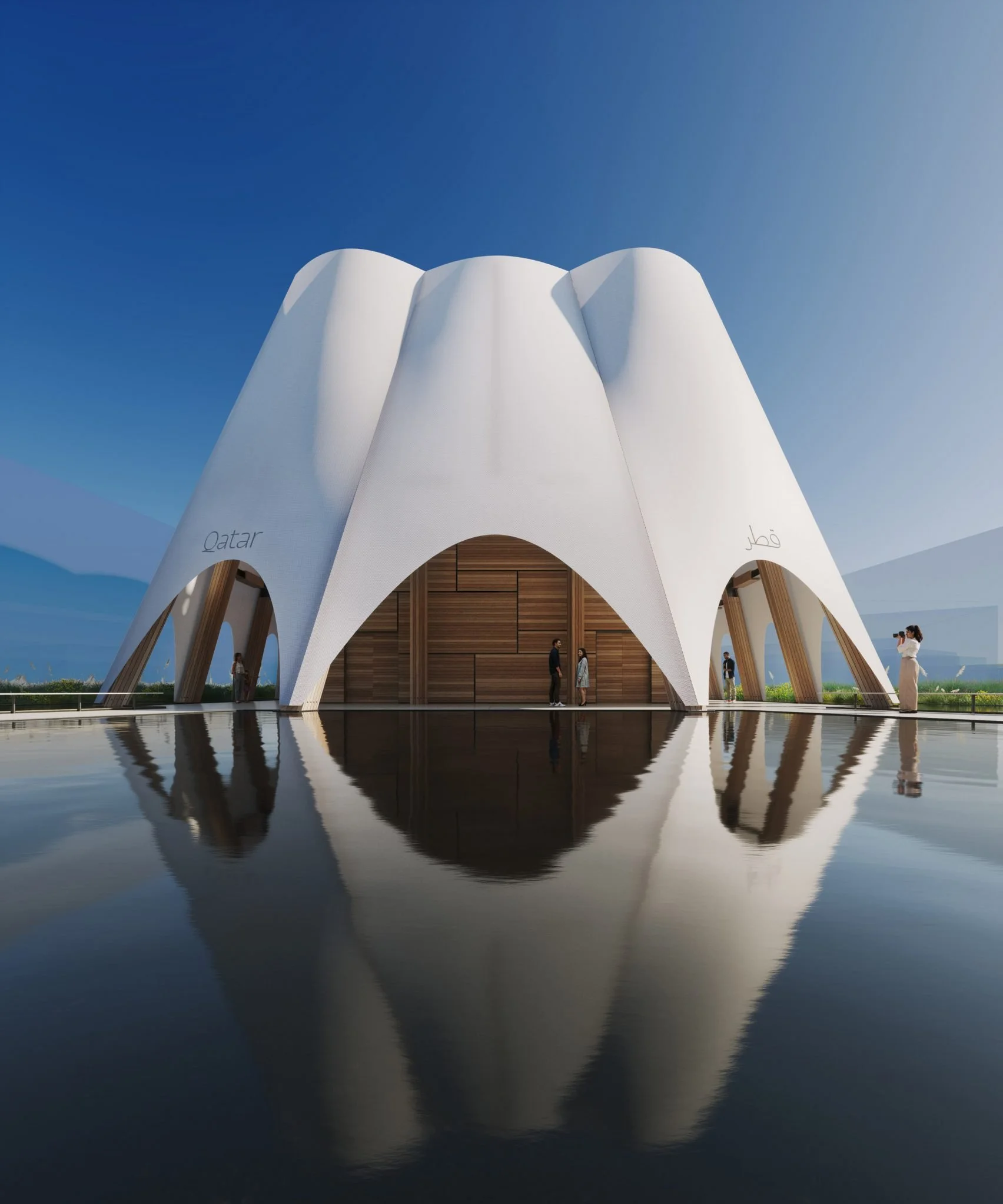
Qatar Pavilion, Expo 2025 Osaka.
Image courtesy of Kengo Kuma & Associates.
Sheika Al-Mayasssa also alluded to a major forthcoming endeavour featuring Gerhard Richter's works. A pavilion of his works will be installed and opened in November 2026, forming part of the Rubaiya Qatar quadrennial. The project has been in discussion for a decade, highlighting the challenges and commitment involved in bringing such a significant installation of Richter's works to Qatar.
These examples represent an initiative that is unfolding on an almost invasive scale with a quite striking rhythm (military metaphor intended). Why such an abundance of capital and why so abruptly?
The patterns are rather evident here. This burgeoning art scene uses a carefully curated lexicon and structural loopholes to attract a highly specific audience: high-net-worth collectors and discreet investors seeking cultural prestige and fiscal optimization. This explains the meteoric rise of interest in the Middle East as the newest epicenter of the contemporary art world.
The strategy rests on several deliberate elements such as resonant invocations of decolonization and cultural restitution, strategic invitations to prominent personalities from the European art world, new infrastructures and the introduction, starting this year, of tailored visa regimes explicitly designated to facilitate creation, display, and trading of art. Together, these measures promise an easy lifestyle and ultimately, exceptionally advantageous tax arrangements.
The United Arab Emirates and Qatar are becoming fast evolving hubs that blend traditional culture with modern innovations. Yet what truly fuels this ascent is an important volume of capital deployment: wealth funds and private patronage pouring resources into museums, fairs, pavilions, and galleries.
The art market remains inherently vulnerable to money laundering worldwide, owing to three main factors: high anonymity (private sales, offshore structures, freeports), subjective valuations (easy to over/under-invoice), and cross-border movement without strict traceability. In this context, the Middle East emerges as a sanctuary for loophole seekers. The UAE and Qatar impose no personal income tax or capital gain tax on art transactions (against 20-48% in much of the rest of the world), maintain a VAT of only 5% (compared to 5-27% in most of the Europe and the US), moderate import duties and extensive freezone storage facilities. These conditions are very attractive for collectors, galleries, and investors - particularly those managing illicit funds and favor discreet dealing. The question that arises is whether we should succumb to this financial allure, or wisely stay clear of the tax haven’s hidden snares?
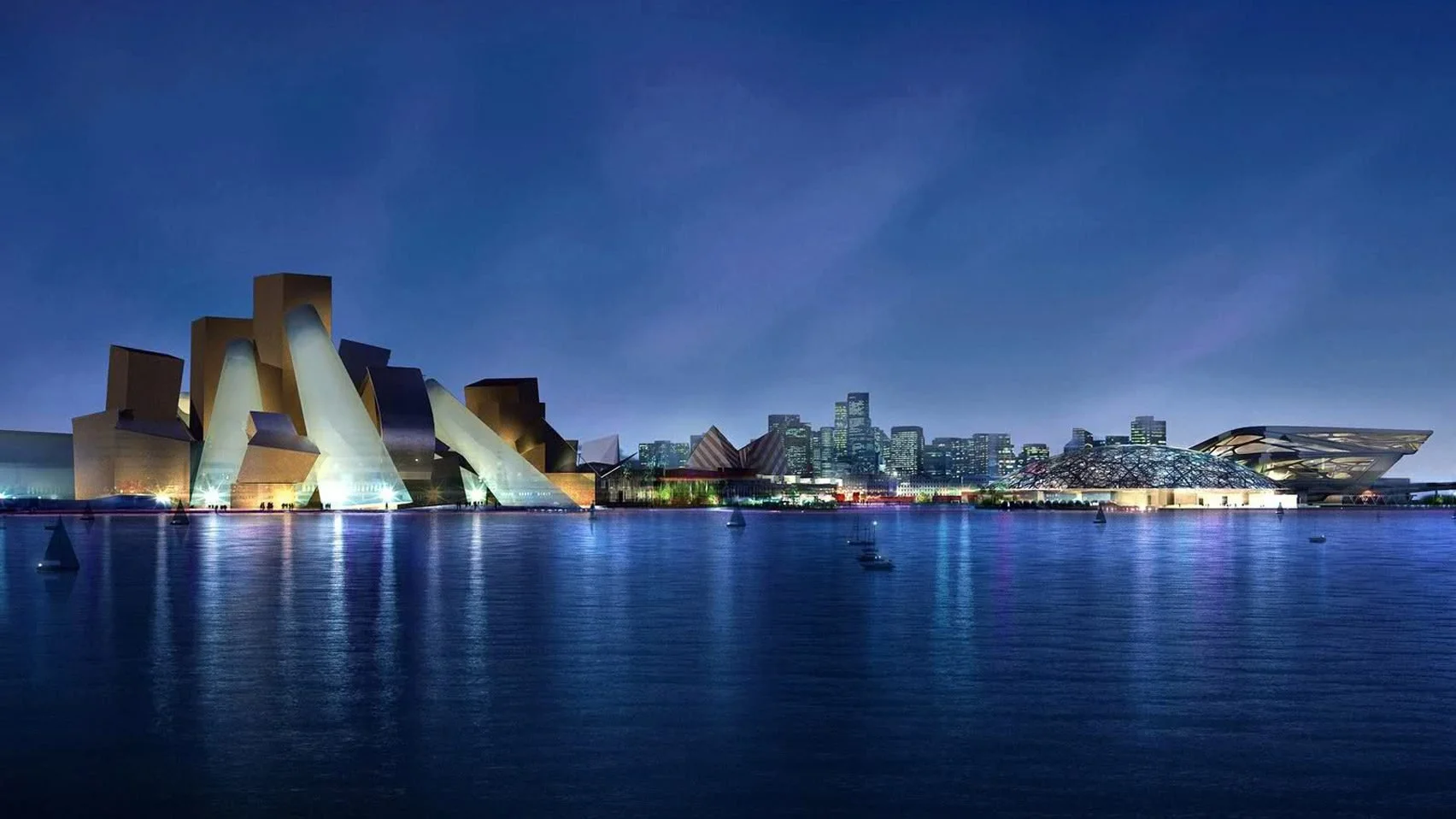
3D Projection of the Guggenheim museum, Abu Dhabi.
Image courtesy of Abu Dhabi Tourism Center.
To circle back and substantiate my prediction for 2026, one need only consider how the UAE is gearing up for a major art boom in 2026 and 2027 - marked by several high-profile museum openings, major fairs, and institutional expansions. Key global players, such as Guggenheim, Frieze, Art Basel, Maddox, and Design Miami are establishing a foothold in the desert with clear intentions of building a lasting presence.
Bibliography
AML UAE. “How Is Art Used to Hide Money Laundering?” AML UAE, n.d. https://amluae.com/how-is-art-used-to-hide-money-laundering/
Arab News. “Sheikha Al-Mayassa Talks Cultural Patronage at Art Basel Qatar Conversations Panel.” Arab News, n.d. https://www.arabnews.com/node/2631718/lifestyle
Art Dubai Group. “About Art Dubai Group.” Accessed February 2026. https://www.artdubai.ae/about-art-dubai-group/
Crook, Lizzie. “Construction Set to Begin on Frank Gehry’s Long-Awaited Guggenheim Abu Dhabi.” Dezeen, May 8, 2019. https://www.dezeen.com/2019/05/08/guggenheim-abu-dhabi-frank-gehry-architecture/
Designboom. “Kengo Kuma Draws from Qatari Ships and Japanese Joinery for Expo 2025 Osaka.”Designboom, July 9, 2024. https://www.designboom.com/architecture/kengo-kuma-qatar-pavilion-expo-2025-osaka-07-09-2024/
Harris, Gareth. “A Gerhard Richter Pavilion and a New Creative Visa—Qatar’s Sheikha Al-Mayassa Reveals Future Plans.” The Art Newspaper, February 5, 2026. https://www.theartnewspaper.com/2026/02/05/a-gerhard-richter-pavilion-and-a-new-creative-visaqatars-sheikha-al-mayassa-reveals-future-plans