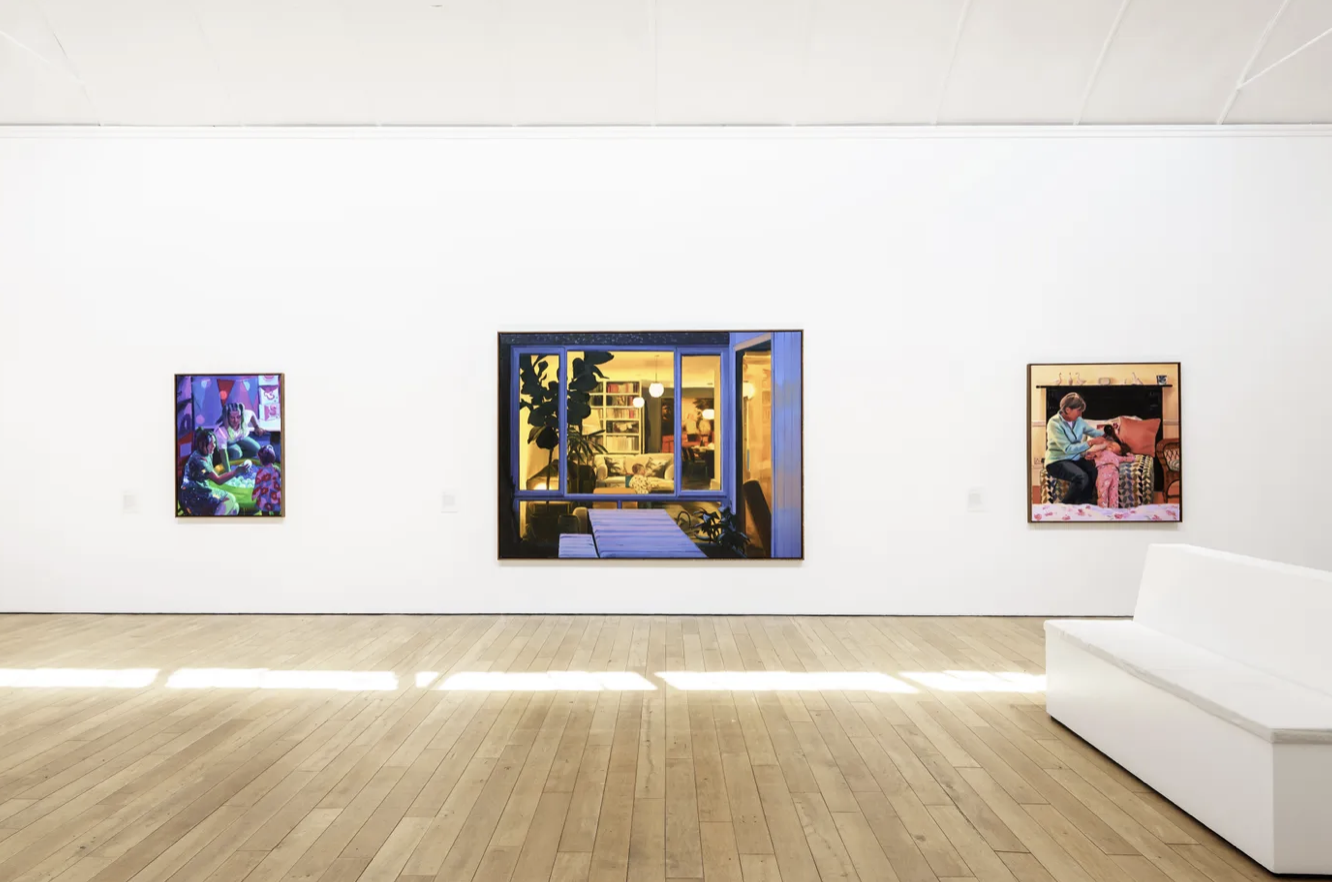
Installation view. Image Courtesy of Nick Cooney for Newlyn Art Gallery & The Exchange
By Erin Marks
Motherhood has long occupied a place in art history, most famously in the immaculate imagery of the Madonna and child. The traditional canon has historically preferred its mothers tidy, symbolic and quiet. Yet lived reality is barely this composed. It is demanding, repetitive, and composed of small acts that often go unnoticed. It is within these spaces that Caroline Walker intervenes. In her exhibition, Mothering, currently on show at the Newlyn Art Gallery & The Exchange, Walker finds significance in the mundane, offering an intimate portrayal of domestic life that is tender and unpolished.
Born in Fife, Walker frequently depicts women in various public and private settings, often highlighting unseen labours. In more recent years, she turns her attention towards motherhood and care, informed by her experiences of motherhood as well as observations of those around her. The exhibition title itself, inspired by Walker overhearing a nursery worker describe “mothering” as a major part of her training, acknowledges the efforts of women by positioning motherhood as an active identity rather than a static one, reflecting the work constantly put in by mothers and carers. The exhibition focuses not only on biological mothers, but also expands to encompass grandmothers, medical professionals and care workers who all enact various forms of care.
By bringing together such a diverse range of figures, Walker’s idea of mothering extends beyond the relationship between mother and child, considering the people who care for others every day, often without much recognition.
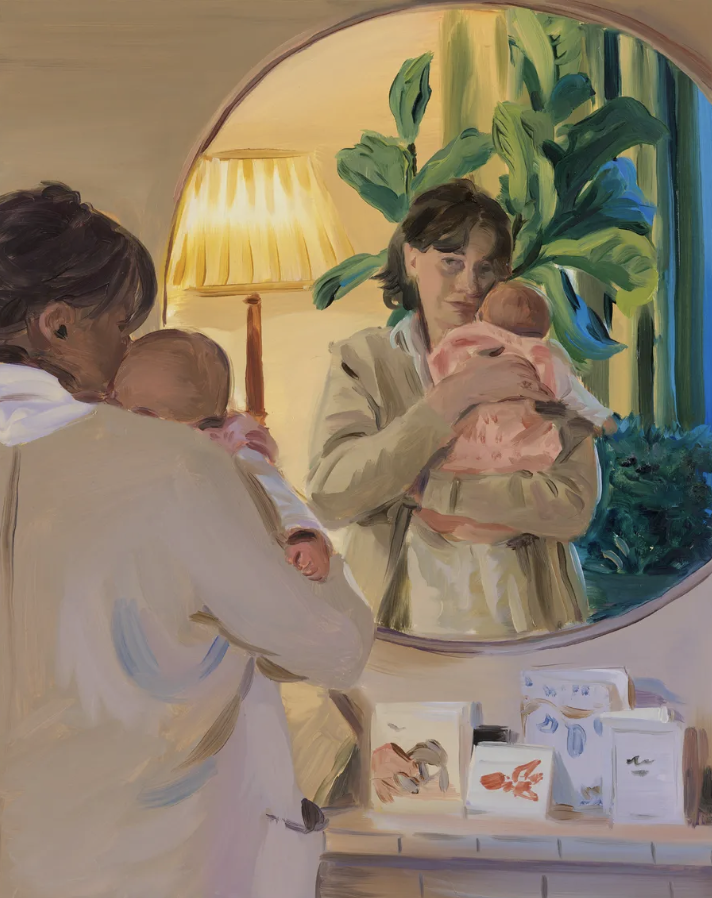
Caroline Walker, Me and Laurie, Six Weeks Old, 2024, Oil on board, 45 x 36 cm. Image Courtesy of Caroline Walker
The exhibition’s most compelling moments are often its most mundane ones. Me and Laurie, Six Weeks Old (2024) is a rare self-portrait from Walker. She cradles her newborn son close whilst looking back at herself through a mirror, capturing an intimate moment of early motherhood. Their faces are visible only in reflection, creating a subtle distance between the viewer and the subjects. As the audience, we are given a glimpse into this quiet, tender moment without being fully drawn in to it. The mirror also introduces an interesting tension between painter and subject as Walker is both experiencing the moment as a mother and observing herself within the moment through the mirror and as a subject of her own painting. By occupying both roles, she offers a deeply personal perspective on motherhood.
There is something about this quiet intimacy that makes me think of my own mum when she would always sit and plait my hair for me. At the time, it was simply an ordinary moment I did not think to question. However, looking back, I recognise the tenderness in these small acts of care and realise how gestures can become so familiar that they almost fade from view. It is often in retrospect that we recognise the time, effort, and affection they require. Walker’s painting reminds us that motherhood is not always expressed through grand gestures, but through the seemingly insignificant acts of care that quietly but surely shape our experience of being loved.
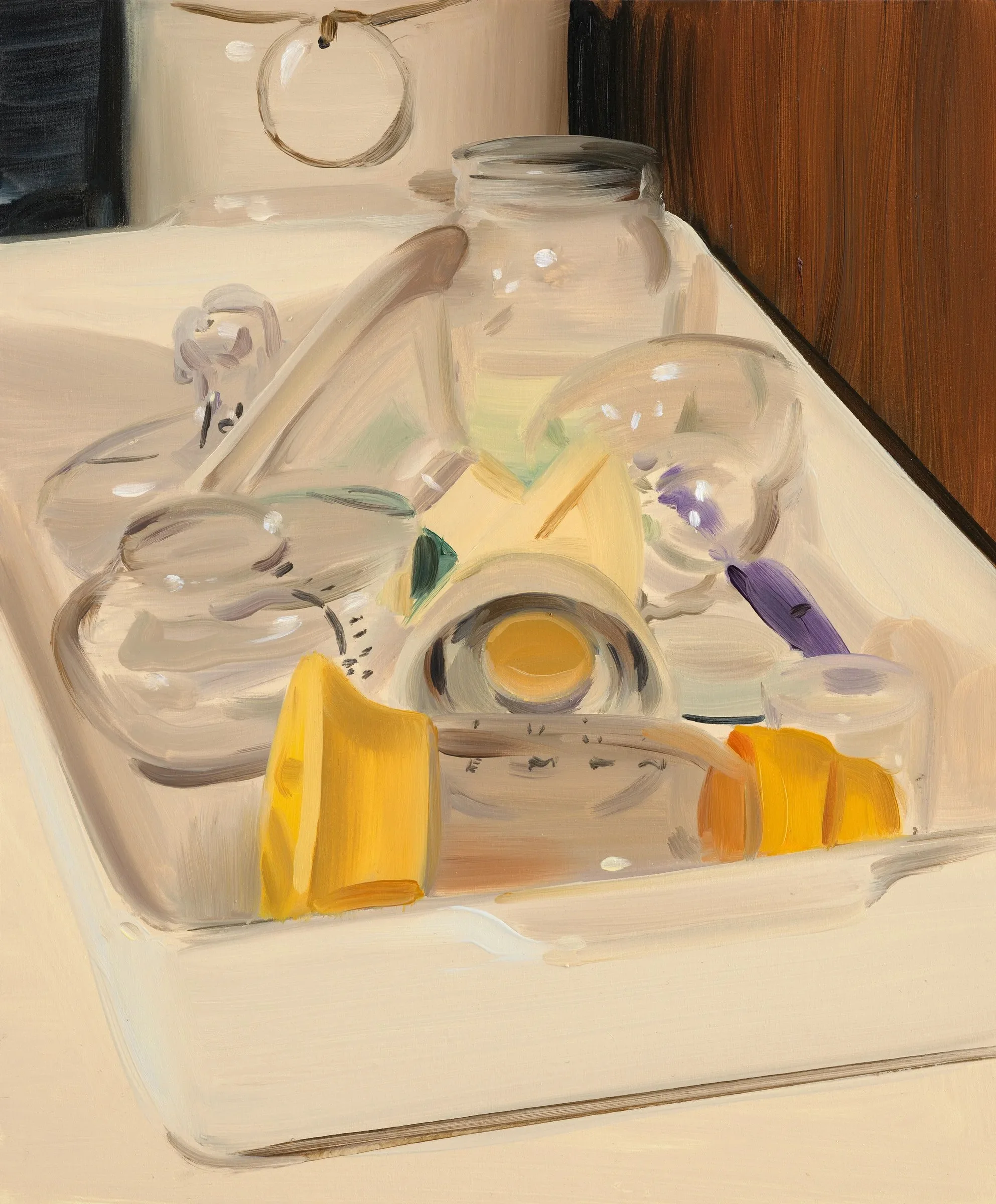
Caroline Walker, Bottles and Pumps, 2022, Oil on board, 36 x 30 cm. Image Courtesy of Caroline Walker
Whilst Me and Laurie, Six Weeks Old captures an intimate interlude, Bottles and Pumps (2022) turns to the practicalities of caring for a baby. A clutter of bottles and pumping equipment sits in a tray, disordered and painted in thick strokes. Here Walker challenges the classical still life by centring unglamourous objects rather than items of luxury. She also exposes the hidden labour and scheduled routines of care by making these objects the subject of a painting about baby feeding when traditionally, baby feeding has been depicted as a romanticised image of mother cradling child. The bottles and pumps are disordered, strewn and jumbled together, with their arrangement visually mimicking the chaos of early parenthood and the endless repetition of the pump-feed-wash-sterilize cycle. By leaving the scene disorderly, Walker resists the urge to sanitise or perfect the scene for the viewers comfort, and we are instead left with a raw, domestic depiction of mothering.
To me, something particularly captivating about Walker’s work is her deliberate use of thick, heavy brushstrokes. Their presence within mothering reminds the audience that these works are not snapshots, or candid photographs, but carefully constructed paintings. They help to assert her presence as the artist and act as a quiet boundary, positioning the viewer as an observer rather than an intruder by transforming what could be seen as prying into a more empathetic and distanced window into the lived experience of real women.
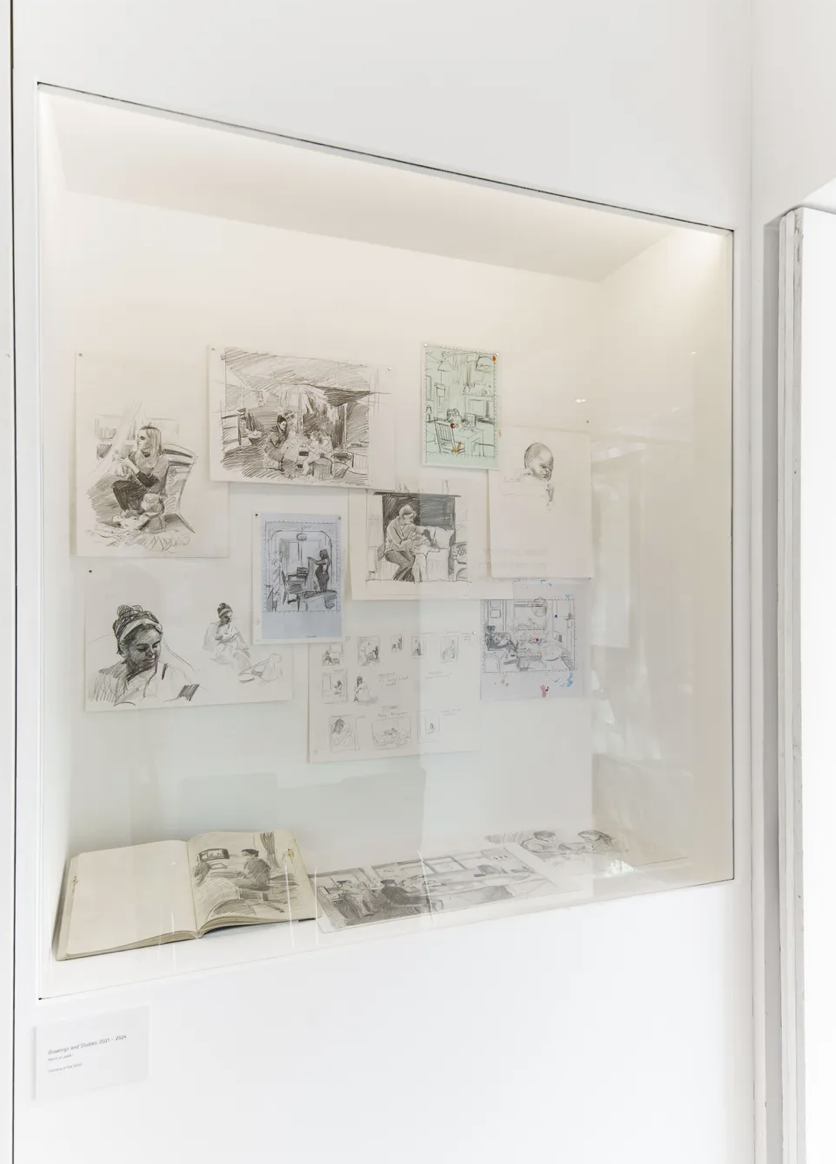
Caroline Walker, Drawings and Sketches, 2021-24. Image courtesy of Caroline Walker.
Alongside finished paintings, the exhibition also houses sketches and watercolours. Their inclusion adds another dimension to the exhibition, offering a glimpse into Walker’s creative process and ideas and drawing attention the act of direct observation that underpins her depictions of mothering. By being presented in the exhibition alongside the finished paintings, these studies encourage visitors to consider not only the act of mothering itself, but how it is perceived and represented.
Ultimately, I think Mothering invites a reconsideration of what we look at, and what we overlook. In bringing unremarkable objects, domestic scenes, and fleeting intimacies into focus, Walker unsettles idealised representations of motherhood. To me, it is within the ordinary that the paintings find their tenderness. Walker makes no attempt to glorify the everyday but attends to it closely enough that its significance becomes undeniable. What emerges is a vision of motherhood that is less concerned with idealisation than the lived experience of care.
Bibliography:
Caroline Waker. “Biography.” Accessed October 23 2026. https://carolinewalker.org/about/biography/
The Hepworth Wakefield. “Caroline Walker: Mothering.” Accessed October 23 2026. https://hepworthwakefield.org/whats-on/caroline-walker/
Newlyn Art Gallery & The Exchange. “Caroline Walker: Mothering.” Accessed October 23 2026. https://newlynartgallery.co.uk/activities/caroline-walker-mothering/
Whitfield, Zoe. “How motherhood is being reframed in art.” CNN, May 27 2025. https://edition.cnn.com/2025/05/27/style/caroline-walker-motherhood-in-art