The St Andrews Chamber Opera presents “Suor Angelica” : Recontextualising a Classic
By Anne Lawton Browder
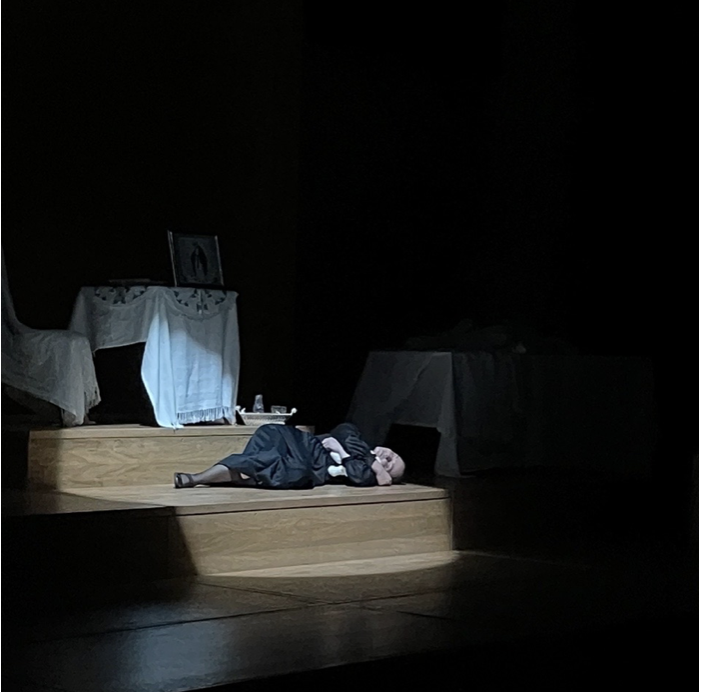
Pavlina Ivanova as Suor Angelica, Suor Angelica (2025), performance still. Photograph by Valentine Salinger. Image courtesy of St Andrews Chamber Opera
Founded in September 2022 by music scholars from the University, the St Andrews Chamber Opera has established itself over the past few years as a rising force in student cultural life, particularly through their updated takes on operatic classics. Past productions include last year’s highly popular Coffee Cantata, adapted for a modern audience and performed at beloved North Street institution Bibi’s Café. Their most recent adaptation of Puccini’s lesser-known one-act tale of love and loss, “Suor Angelica,” however, may well be the company’s most provocative undertaking yet.
Originally premiering at the Metropolitan Opera in New York City in 1918 as the first part of Puccini’s Il Trittico, “Suor Angelica” is traditionally set in a seventeenth-century convent, where the titular character has been cloistered for seven years after giving birth to a child out of wedlock. In this updated production, director Orsolya Mollie Haynes, relocates the opera to one of the many Magdalen Laundries that operated throughout Ireland, Wales, and Scotland well into the late twentieth century. These institutions were ostensibly intended to rehabilitate so-called ‘fallen” women through forced domestic labor and religious rehabilitation, though, in reality, many women were subjected to systemic abuse, exploitation, and social erasure.
For Haynes, directing “Suor Angelica” offered an opportunity to draw attention to the history of these deeply troubling institutions, which first drew her attention after reading Claire Keegan’s novella, “Small Things Like These.” Keegan’s details the horrors of the Magdalene Laundries and exposes the generational trauma inflicted by them.
“I found the themes of ‘Suor Angelica’ fit perfectly with the stolen innocence, foolish hope, and earth-shattering loss I had found in the book and in my further research,” Haynes writes, “I had to at least try to tell the stories of these young women.”
Stories which, as it turns out, are rendered even more affecting through their juxtaposition with the ill-fated figure of Angelica.
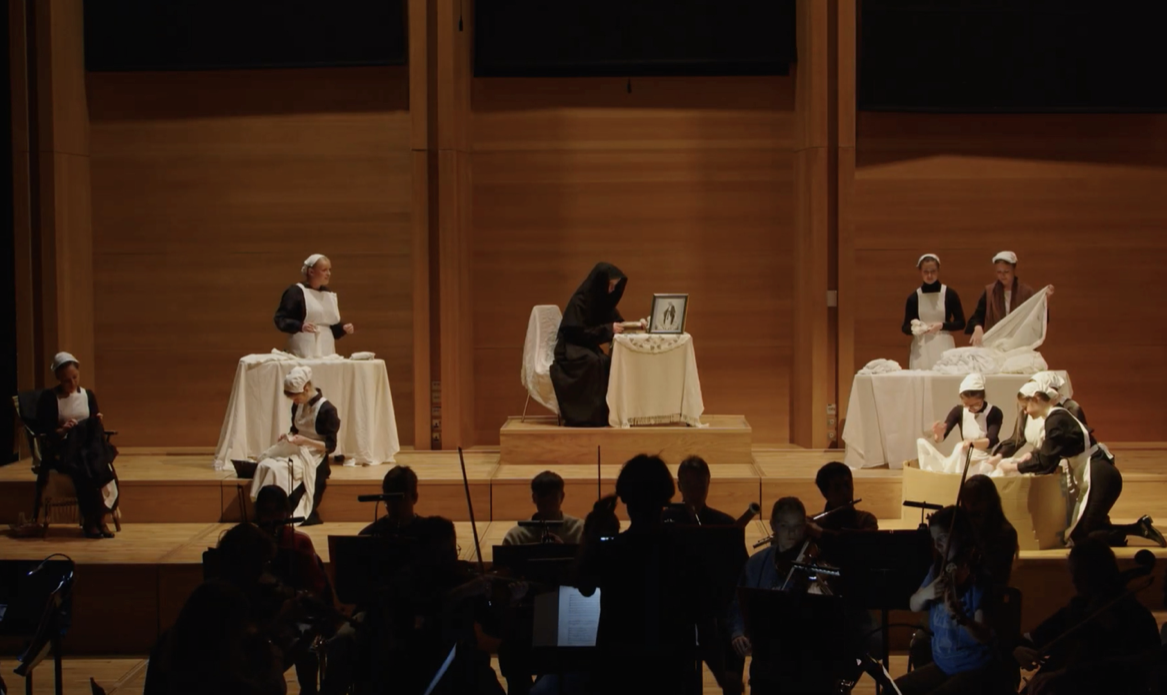
The Cast of Suor Angelica (2025), production still. Photograph by Miller Chetwynd. Image Courtesy of St Andrews Chamber Opera.
When I arrived to attend the production at the Laidlaw Music Centre, I was pleased to find a bustling theatre and hear the gentle strains of the live orchestra, conducted by Ross Donaldson, warming up. Upon entry, I was offered a libretto, which acts as a guide to the action for those unfamiliar with Italian. For Haynes, a newcomer to the Chamber Opera scene, accessibility was a key concern, as she hoped to reach people who, like herself, were “not yet seasoned opera goers,” and to “touch the hearts of anyone who came to watch and make them truly think about what they’d just seen.”
As the lights dimmed and the gentle buzz of conversation came to a halt, the opera opened on a group of young women filing into the space to the sound of a ringing bell, signaling the start of their work day. The titular Angelica arrives late and is admonished by the Monitor, played Heidi Josefsson. The opera’s dramatic turning point comes with the arrival of Angalica’s aunt, the Princess, who arrives to informs her that her child, born before her confinement, has died. The encounter is chillingly transactional, and Angelica is pressed to renounce her inheritance, propelling the opera toward its devastating conclusion.
Although all performers delivered exceptional performances, Pavlina Ivanova’s portrayal of Angelica stood out as particularly compelling, charged with effervescence yet grounded in emotional realism. I am unashamed to admit that her expressive voice deeply moved me during the aria “Senza Mamma,” which hauntingly captures Angelica’s despair upon learning of her young son’s death. Working within the confines of a one act opera, Ivanova nevertheless conveys the full spectrum of grief, guilt, and longing at the heart of her character, leaving a lasting impression on the audience. Giselle Nascimento Dias, as well, deserves recognition for her portrayal of the Princess, Suor Angelica’s wealthy and supercilious aunt, with an air of convincing haughtiness and unfeeling detachment.
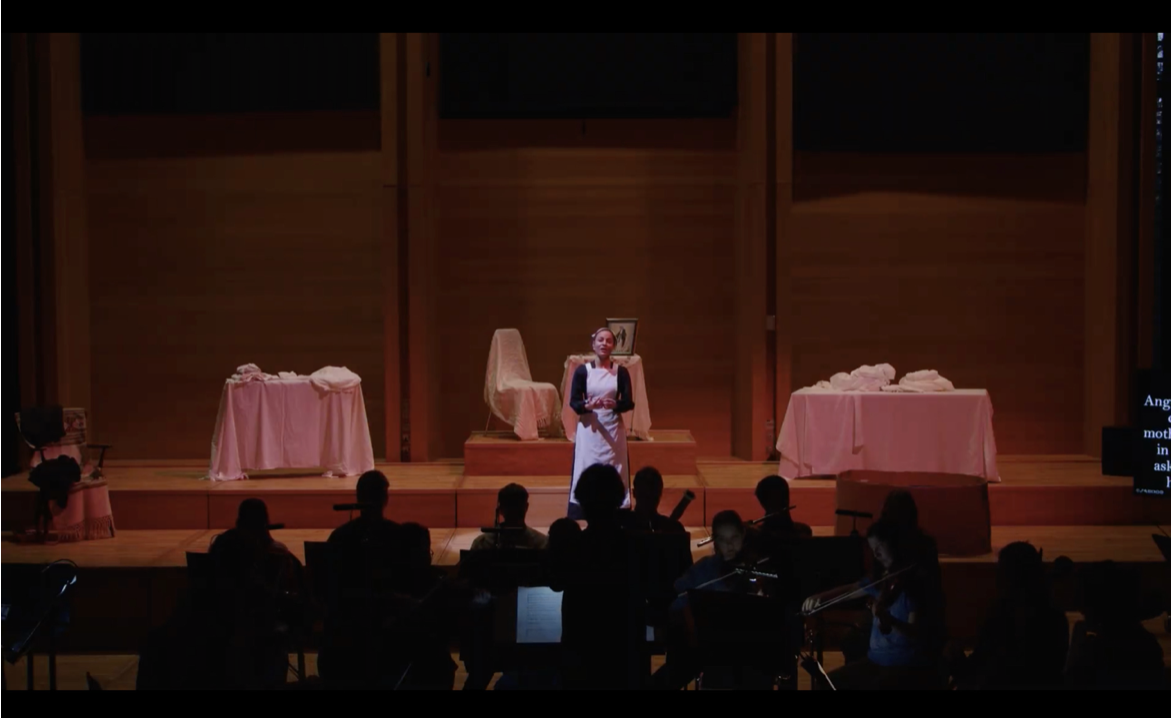
Suor Angelica (2025), production still. Photograph by Miller Chetwynd. Image courtesy of The St Andrews Chamber Opera
While I have always enjoyed attending the opera, I find performances most striking when they ask something of their audience. When we attend a production, willingly or not, we are obliged, to some degree, to step into the story being told. Owing to its live nature, theatre transforms the audience into active rather than passive participants in the drama that unfolds on stage. Because of theatre’s unique ability to foster this reciprocal relationship, it has the ability to humanize abstract social problems and to illuminate historical injustices in a way that commands attention.
Ultimately, the St Andrews Chamber Opera is boldly charting a path into a future of opera as a living, responsive, emotionally resonant art form, unafraid to confront challenging histories. By reminagining Suor Angelica through the lens of the Magdalene Laundries, this production demonstrates the enduring power of theatre, and more specifically opera, to move its audience, compelling them to reflect on the worlds that play out before them.
Suor Angelica. Libretto adapted by Orsolya Mollie Haynes for St Andrews Chamber Opera. Laidlaw Music Centre, St Andrews, 2025.