
A Ceramic Gem in Fife: Wemyss Ware
By Anna Shevetovska
Too often, pottery has been pigeonholed into the decorative sector, rarely given an equally appropriate space for aesthetic appreciation as their so-called ‘high art’ counterparts. However, Wemyss Ware in Fife re-centres artistic practice on ceramics, with unique, hand-painted works.
Based in the village of Ceres, this manufacturing company spans over a hundred-year history. First established in 1817 as ‘Fife Pottery’ in Kirkcaldy, it was later renamed ‘Wemyss Ware’ in 1882, earning the reputation it has today thanks to Robert Heron (a pottery owner) and Karel Nekola (an object decorator). The latter was a talented hand-painter, which helped ensure the enterprise's future success.
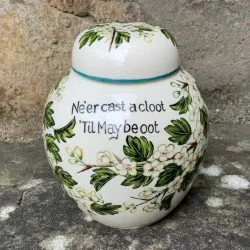
Wemyss Ware Griselda Hill Pottery Ltd, May Cloot Ginger Jar, Pottery, Height 16cm. Image Courtesy of Wemyss Ware Griselda Hill Pottery.
The recognisable visual style of vibrant colour and natural motifs set the Scottish Pottery apart from the other three ceramic factories in Kirkcaldy. At first, the enterprise mostly created ‘domestic pottery’, embellished with floral emblems and British wildlife. Highly popular during the Victorian period, they suited a market that favoured ornamented and decorative display.
Animal ceramics were among the most exclusive items in the Wemyss collection and have been a common subject of ceramic artistry in the nineteenth century. Their naturalistic painting reflects a period that oversaw a cultural shift towards appreciating household pets, which also shaped the ceramic collection founded by brewer Henry Willett where similar cat figurines can be found, but much further south in Brighton. One can here identify how the Fifer potters were participating in the Victorian convention of decorative art on the wider British art scene.
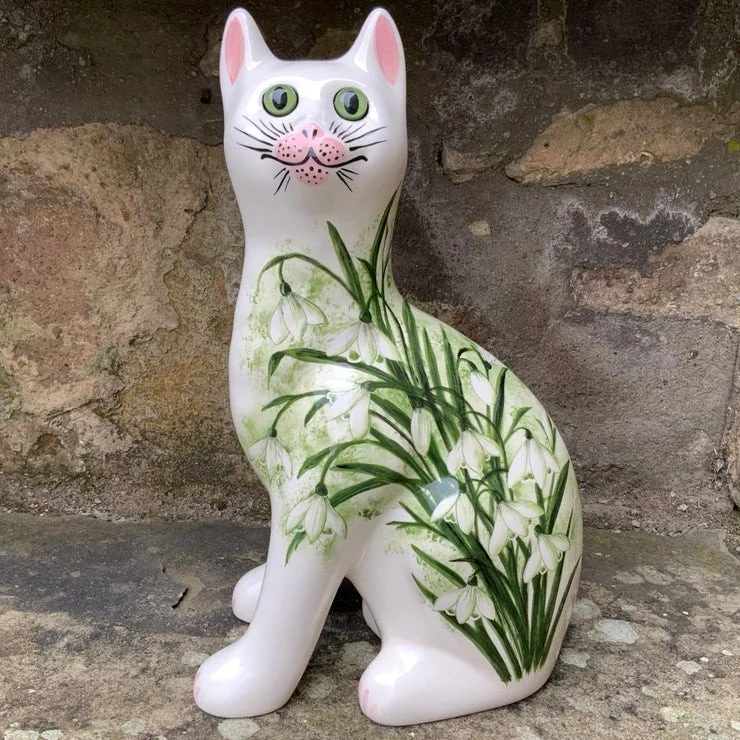
Wemyss Ware Griselda Hill Pottery Ltd, Snowdrop Large Cat, Pottery, Height 33cm. Image Courtesy of Wemyss Ware Griselda Hill Pottery.
One of the most prolific ceramicists of the nineteenth-century Arts and Crafts period, William de Morgan, was renowned for hand-painting tiles in rejection of industrialisation's alienation and uniformity. He was well known for his hare, mole and animal designs alike to the Wemyss collection. Flora and fauna were one of the key inspirations to the movement, which cast its net far and wide. Weymss’ shared the prioritisation of the individual artists’ work as part of the production process. Therefore, while it is likely that the artists of Wemyss Ware were inspired by these designs, they maintained their own visual language through the use of in-house artists.
It was later that Wemyss Ware’s collection expanded into a truly varied assortment of objects. In addition to the traditional tableware, it spanned biscuit jars, comb trays, and ring holders. They were approached with a similarly diverse decorative style, with subjects derived from the Scottish countryside that feature piglets, orchard fruit, and seasonal flowers.
Perhaps it is the timeless character of these forms that has allowed Wemyss Ware to endure for over a century: drawing inspiration from the ordinary, rather than the extraordinary and abstract. This recalls nineteenth-century thinker and educator John Ruskin, one of the biggest proponents of the beauty of nature in art. He was outspoken about his reverence for nature and how the individual artists ought to illustrate its beauty in their oeuvre. Both the ideas of artistic autonomy and mimesis from Ruskin are found in these works, with each object also featuring a distinctive trademark: a painstakingly hand-painted ‘Wemyss’ inscription on each object.
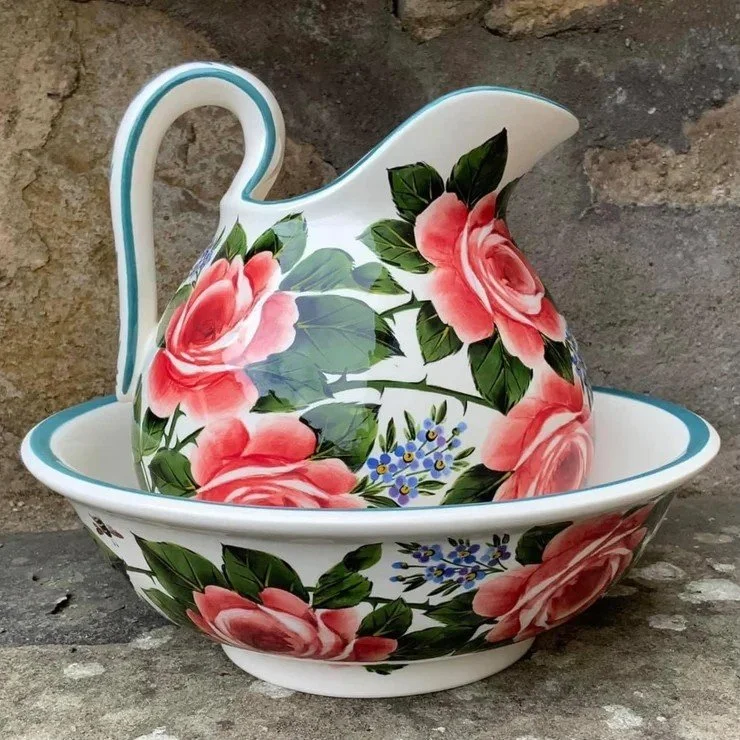
Wemyss Ware Griselda Hill Pottery Ltd, Cabbage Rose and Forget Me Not Ewer, Pottery, Height 18cm. Image Courtesy of Wemyss Ware Griselda Hill Pottery.
Today, ceramic figurines are collected and are prized objects in Scottish households, often displayed on mantelpieces over a fireplace. Contemporary English artist Jon Barnett Danes creates whimsical piglets wearing boots; while an American artist/baker, Jeff Enebeker, took the theme of everyday even further, by creating incredibly life-like donut ceramic sculptures. The latter is inspired by the Pop artists, Claes Oldenburg and Wayne Thiebaud. This tradition continues in Wemyss’ collection, in the stylistic synthesis of vibrant motifs on seemingly ordinary subjects.
Wemyss Ware are still today sought-after ceramic collectibles in Scotland. They could be considered valued heritage objects in the same manner as the Danish Royal Copenhagen and English Wedgewood Pottery. Although more quotidien in style, the result remains: the popularity of Wemyss Ware objects held over the course of one-hundred years.
Bibliography
Bellamy, George. Scottish Wemyss Ware 1882-1930. Acc Art Books, 2019.
Hewison, Robert. ‘Chapter One: Ruskin and Nature’. Victorianweb.Org, 2024. https://www.victorianweb.org/authors/ruskin/hewison/1.html.
The De Morgan Foundation. ‘William De Morgan - the De Morgan Foundation’. The De Morgan Foundation, 2019. https://www.demorgan.org.uk/discover/the-de-morgans/william-de-morgan/.
Victoria and Albert Museum. ‘Popular Pottery · V&A’. Victoria and Albert Museum, V&A, 2024. https://www.vam.ac.uk/articles/popular-pottery.
Victoria and Albert Museum. ‘William De Morgan – an Introduction · V&A’. Victoria and Albert Museum, V&A, 2024. https://www.vam.ac.uk/articles/william-de-morgan-an-introduction.
Wemyss Ware Griselda Hill Pottery Ltd 1985. ‘Wemyss Ware History of Wemyss | Griselda Hill Pottery’. Wemyss Ware, 2020. https://www.wemyssware.co.uk/pages/history-of-wemyss.