By Anna Shevetovska
Sometimes the most obvious gems are hiding in plain sight. Take, for example, Douglas Cocker’s installation Songlines (2019). Although accessible to students and non-students alike, being located in the heart of St Andrews, it is not well known to the broader public.
Displayed in the Laidlaw Music Centre, twenty-four sculptures are arranged in a grid of three, in a manner fitting musical notation. Cocker employs a pleasant ash and muted colour palette of mauve, cadmium and iris yellow, with a periwinkle thread playfully hanging from one of the pieces to create a rhythmic compositional tempo.
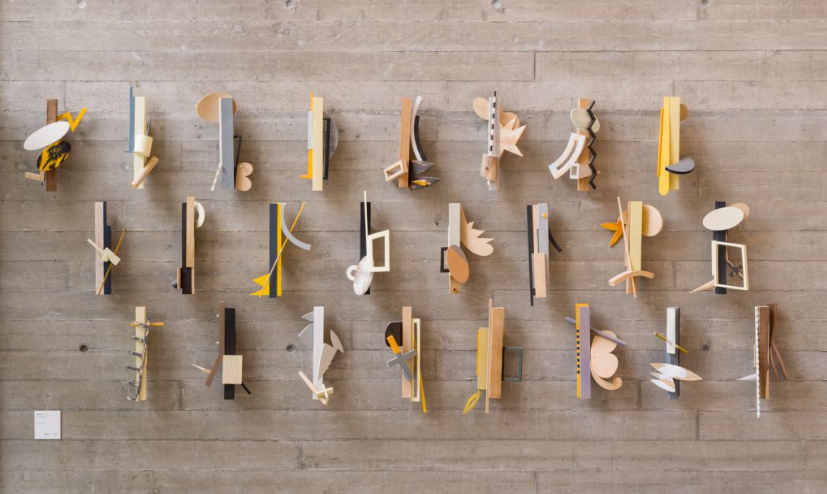
Douglas Cocker, Songlines, 2019, Wood, Laidlaw Music Centre, University of St Andrews. Image courtesy of the artist.
In rudimentary forms, vibrant colour gives way to untreated natural ash, letting the artwork play visually; one can only wonder what music it would yield were each piece translated into note form.
Douglas Cocker RSA is a Scottish artist. He grew up in rural Perthshire, and his family comes from vocations such as farming and blacksmithing. He obtained his degree in sculpture, a not-so-distant practice, from Duncan of Jordanstone College of Art in Dundee (1963-1968).
His early pastoral life, with family undertaking immediate and physical creative practices, informed the nature-based materiality of his decided sculptural method. He would lecture at the University of Edinburgh, Glasgow School of Art and Gray’s School of Art in Aberdeen, before returning to his alma mater to teach the same subject.
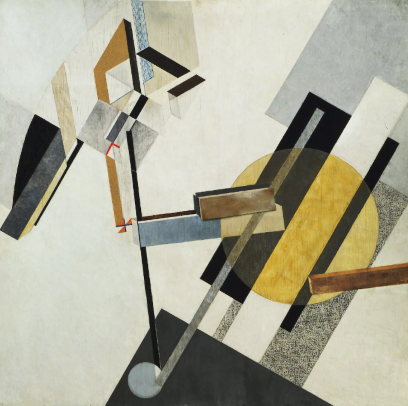
El Lissitzky, Proun 19D, 1920-21, Gesso, oil, varnish, crayon, colored papers, sandpaper, graph paper, cardboard, metallic paint, and metal foil on plywood, 97.5 × 97.2 cm, MoMA, New York. Image courtesy of Katherine S. Dreier.
Always having admired the Constructivist style, Cocker emulates the twentieth-century aesthetic by paring down his forms in a mathematically ordered manner. Although not inspired by music in the traditional sense, looking instead to the mechanical sounds of the modern age, both draw upon environmental rhythms.
The painted wooden geometric figures resemble objects such as abacuses, while simultaneously alluding to musical notes, thereby making the constructivist influence clear. Yet, renowned for his masterful work with wood, Cocker uses mostly locally sourced wooden materials, such as ash, oak, pine and purpleheart, making this constructivist work distinctly Scottish by medium.
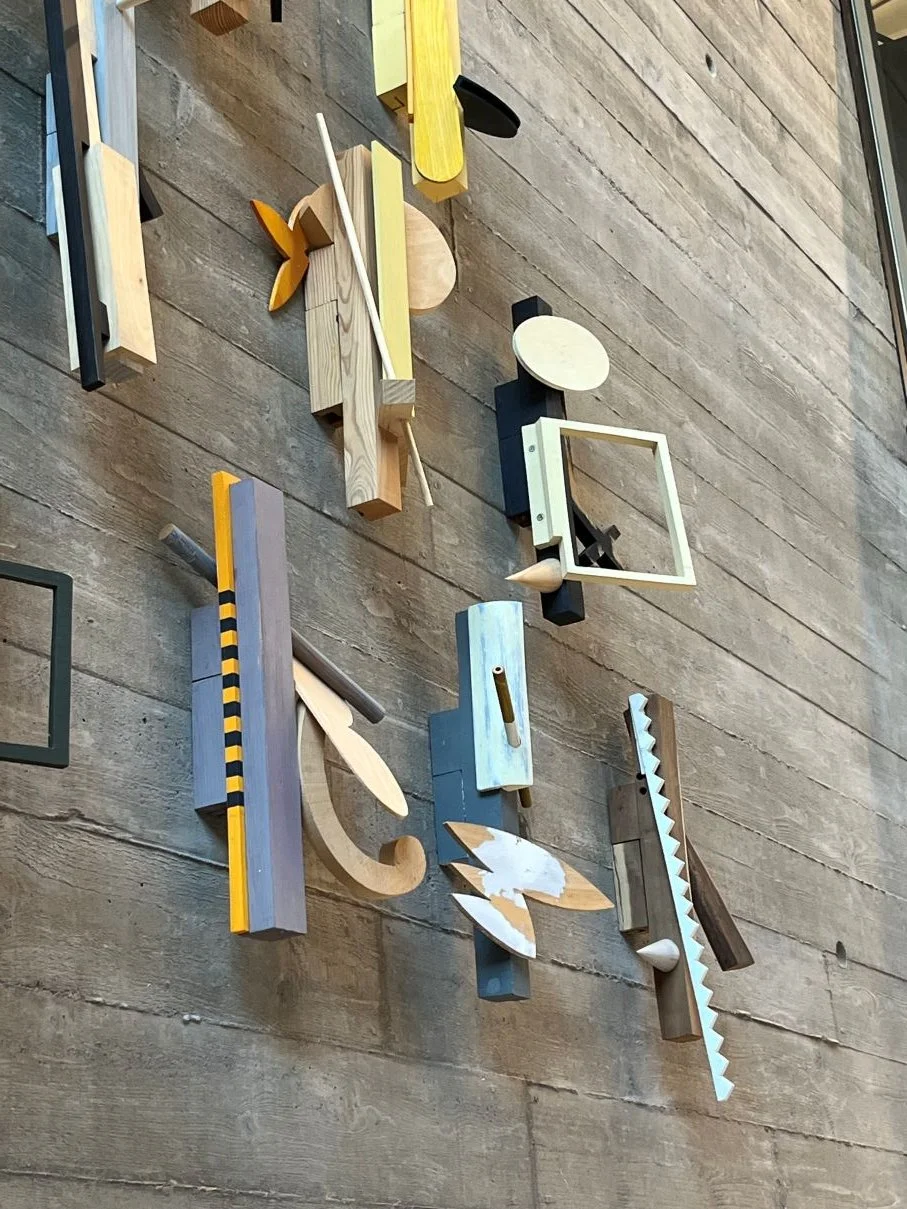
Douglas Cocker, Songlines, 2019, Wood, Laidlaw Music Centre, University of St Andrews. Image courtesy of the artist.
Jagged, amorphous and pencil-like, they are attached to the wall, yet appear to be suspended in air, much like abstract musical notes. In this way, the symbiosis between art and music becomes clear: these sculpted notes, through their formal rhythms, embody a sense of music.
Songlines is a portrayal of music in its essence, inspired by the notions of abstraction in the first half of the twentieth century. Yet Cocker pays homage to Scotland: to the musical work done at St Andrews’ Laidlaw Centre, and to the wider Scottish environment through his choices of material.
Bibliography
Dovecot Studios. ‘Doug Cocker: Threads’. 2025. https://dovecotstudios.com/whats-on/doug-cocker-threads.
Long, Rose-Carol Washton. ‘Kandinsky and Abstraction: The ROLE of the Hidden Image’. Artforum, 1 June 1972. https://www.artforum.com/features/kandinsky-and-abstraction-the-role-of-the-hidden-image-210005/.
Royal Scottish Academy. ‘Doug Cocker RSA - Overview’. Royal Scottish Academy, 2 June 2021. https://www.royalscottishacademy.org/artists/257-doug-cocker-rsa/overview/.
Scottish Gallery. ‘The Scottish Gallery’. 5 October 2026. https://scottish-gallery.co.uk/artists/doug-cocker/.