The Power of Absence in Alison Watt’s Paintings of Textiles
By Natascha Watt
Alison Watt is one of Scotland’s best-known living painters. Born in Greenock in 1965, she studied at the Glasgow School of Art, receiving the National Gallery’s James Player Portrait Award in 1987 while still a student.
Initially recognised for her figurative paintings (usually female nudes either seated or reclining) which showed great attention to detail, Watt moved beyond the human body to textiles. In fact, it is through the body that she first became interested in textiles. She started to notice the folds her models left behind in the white sheets they posed on in her studio. From this moment on, the absence of the figure became key to her works. Although at first still mixing the nude and fabrics, Watt eventually took her experimentation further, entirely doing away with the human body to completely focus on fabric instead.
Her painting Sabine (2000) refers to an 1806 Jean-Auguste-Dominique Ingres portrait of Madame Philibert Rivière, whose first name was Sabine. Watt has always been interested in the art of the past and blends the attention to details of clothing and textiles exhibited in such works with modernist abstraction in her paintings. It was while visiting the National Gallery in London with her father (the artist James Watt) as a child that she first engaged with Ingres’s work through seeing his Portrait of Madame Moitessier (1856). She studied his oeuvre closely and noticed that the fabrics where often depicted more sensually than the bodies themselves.
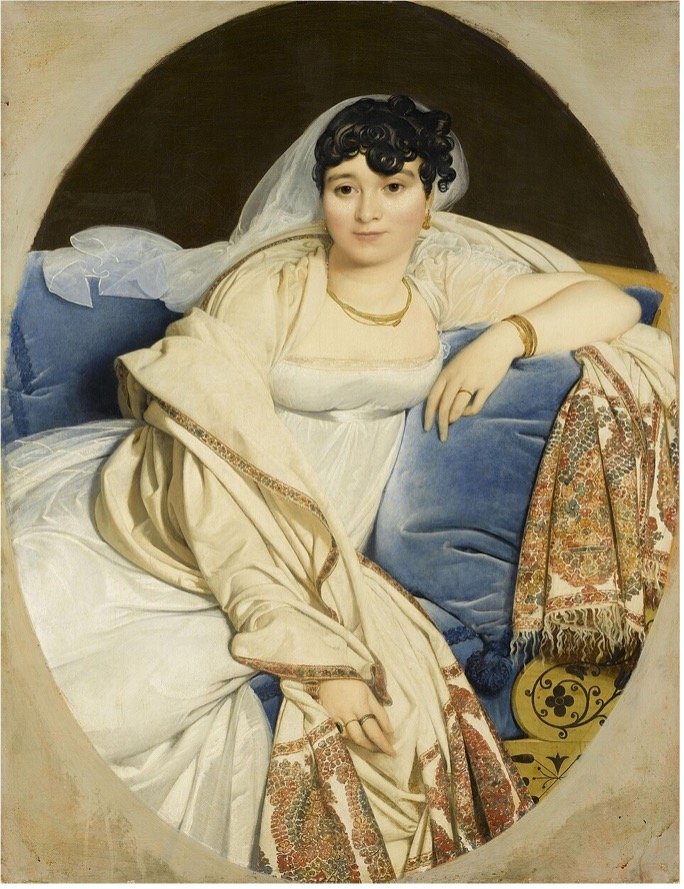
Jean-Auguste-Dominique Ingres, Portrait of Madame Rivière, 1805. Oil on canvas, 115.5 x 90.2 cm, Louvre Museum, Paris. Image courtesy of Wikipedia.
Alison Watt studied Ingres’s body of work as she believes it is important to take inspiration from one’s forebears. Painting is ever-evolving and her own paintings have always been borne out of consideration for art of the past.
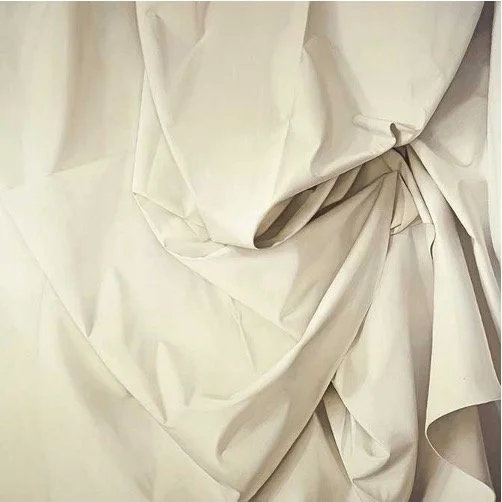
Alison Watt, Sabine, 2000. Oil on canvas, 213.50 x 213.50 cm, National Gallery of Scotland, Edinburgh. Image courtesy of National Galleries of Scotland.
The starting point for Sabine was a nineteenth-century fabric which she chose for its colour and weight. Carefully arranged, it creates a static yet dynamic set of folds in the material. Here, the viewer is denied the sight of the human body but the fabric comes to stand in for it, as its folds awaken one’s senses of touch, hearing and smell.
Similarly, her painting Phantom (2007) evokes the body through textiles, as the folds in the fabric, that offer an opening onto an unknown and unseen space at the centre of the composition, resemble folds in the human body. This painting was inspired by Saint Francis in Meditation (1635-9) by Francisco de Zurbarán, once again manifesting her interest for the art of the past.
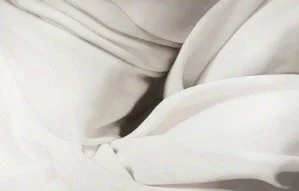
Alison Watt, Phantom, 2007. Oil on canvas, 213.4 x 335.3 cm, Kelvingrove Art Gallery and Musuem, Glasgow. Image courtesy of Art UK.
Engaging with textiles on a material level, Watt collaborated with Dovecot Studios in Edinburgh on the creation of a tapestry. The Scottish Opera commissioned Watt to make this tapestry which hangs over three floors in the Theatre Royal’s foyer in Glasgow. Watt closely collaborated with Master Weaver Naomi Robertson to create the tapestry, choosing its colours and making initial samples for it. It took nine months to complete, with up to four weavers working on it at any one time.
Its design is based on the tragic character of Cio Cio San from Giacomo Puccini’s opera Madama Butterfly. This work is historically important as it was the first and last opera which Sir Alexander Gibson conducted for Scottish Opera, which he founded. Watt wanted to pay homage to this, once again showing how the past is a source of inspiration for her. Watt said she wanted Butterfly (2014) to convey the opera’s powerful emotions. This is done through the rich use of colours such as red, pink, purple and yellow. Her paintings of textiles are similarly bold emotive statements, even though they are painted in more muted tones.

Alison Watt and Dovecot Studios, Butterfly (detail), 2014. Tapestry, handwoven, wool and cotton, 560 x 420 cm. Woven by Naomi Robertson, David Cochrane, Jonathan Cleaver, Rudi Richardson and Freya Sewell. Theatre Royal, Glasgow. Image courtesy of Dovecot Studios.
Alison Watt received an OBE in 2008 and was made a Fellow of the Royal Society of Edinburgh in 2017. More recently, her work has focused on the relationship between portraiture and still life as seen in Anne (2019), one of the sixteen paintings she made in response to the portraiture of eighteenth-century Scottish painter Allan Ramsay for the exhibition Alison Watt | A Portrait Without A Likeness (National Gallery of Scotland, July 2021 – January 2022). A pink bow on an empty background, it depicts an element featured in the dress of Ramsay’s sitters but renders it in the genre of still life, denying it any corporality.
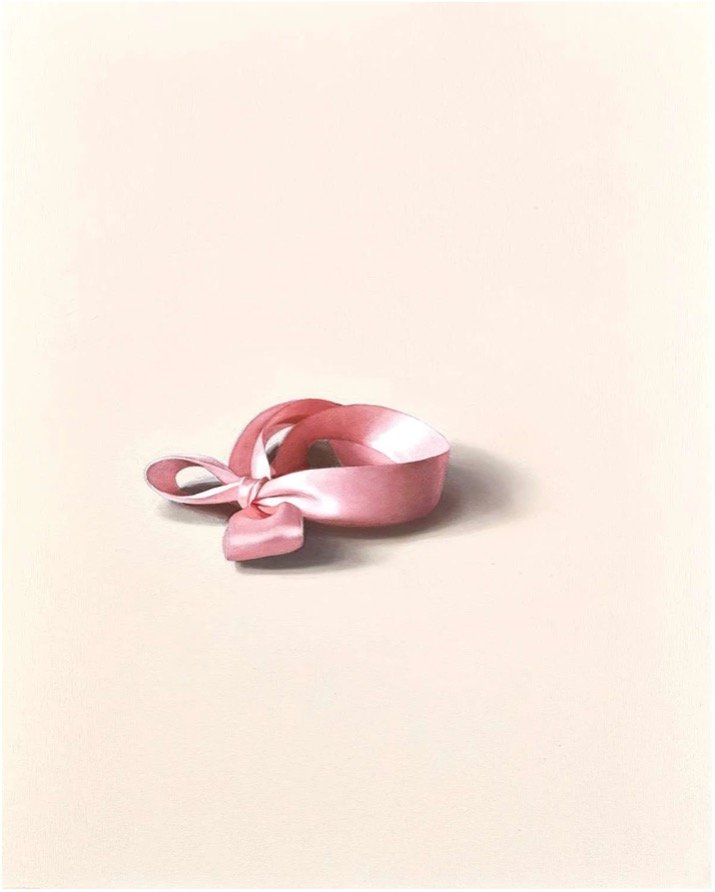
Alison Watt, Anne, 2019. Oil on canvas. Image courtesy of Artmag.
In these works, Alison Watt powerfully evokes human sensuality without every allowing her viewer to glimpse the human form.
Bibliography
Dovecot Studios. “Alison Watt: Butterfly.” Accessed March 7, 2025. https://dovecotstudios.com/tapestry-studio/tapestries-rugs/butterfly.
Dovecot Studios. “Alison Watt Butterfly tapestry.” Accessed March 7, 2025. https://dovecotstudios.com/tapestry-studio/projects/alison-watt-butterfly-tapestry.
Glasgow Theatre Royal. “Alison Watt Tapestry.” Accessed March 7, 2025. http://www.glasgowtheatreroyal.org.uk/buildingthetheatre/tapestry/.
Mansfield, Susan. “A portrait without a likeness: an interview with Alison Watt.” Art UK. Published July 16, 2021. https://artuk.org/discover/stories/a-portrait-without-likeness-an-interview-with-alison-watt.
McNay, Anna. “Alison Watt – interview: ‘I have spent my whole life working from life, so to work from death was a different experience.” Studio International. Published March 11 2025. https://www.studiointernational.com/index.php/alison-watt-from-light-video-interview-pitzhanger-manor-and-gallery-london.
National Galleries. “Alison Watt.” Accessed March 7, 2025. https://www.nationalgalleries.org/art-and-artists/artists/alison-watt.
National Galleries. “Alison Watt: Sabine.” Accessed March 7, 2025. https://www.nationalgalleries.org/art-and-artists/59538.