Arthur Melville's Parisian Advice
By Kasia Middleton
This week I write briefly from Paris. It is the week of Easter, and the sun is bright and at times unforgiving, but a St Andrews student knows never to complain in the face of some vitamin D. The streets of France’s capital are teeming, and my art historical grit and determination to get into the Louvre has been slowly worn down by my aching feet and the promise of sunbathing in the Tuileries. Perhaps next time, I say, making a bee-line to the nearest pain au chocolat.
Luckily, I am not the first to come from Scotland to the City of Lights at a busy time of year, and I certainly won’t be the last. Easter 2026 is, one could argue, relative child’s play in the face of spring 1889. Six million visitors converged in the city for the Exposition Universelle. This was the year of the Eiffel Tower, the middle of the Belle Époque, and the era of the artist. One such artist was Arthur Melville (1855-1904), a Scot who visited the Exposition with the Glasgow Boys.
Born in Angus and raised just outside Edinburgh, Melville was a well-travelled man whose artistic oeuvre demonstrated great variety. Most well-known for his Orientalist compositions, he also dabbled widely across the spectrum of realism and abstraction. He first visited France in 1878, where he learned to work with watercolour. He went on to work both at the Académie Julian and the artist’s colony of Grez-sur-Loing. He took a break from his French travels and explored Egypt in the early 1880s, capturing numerous Orientalising scenes en route. He then visited Baghdad and Constantinople.
In 1882 Melville returned to Scotland, where he connected with the Glasgow Boys, and began to work with more modernist subjects. Throughout the mid to late 1880s, he developed a style of en plain air painting from life which, finally, he brought along with him to the Exposition Universelle in 1889.
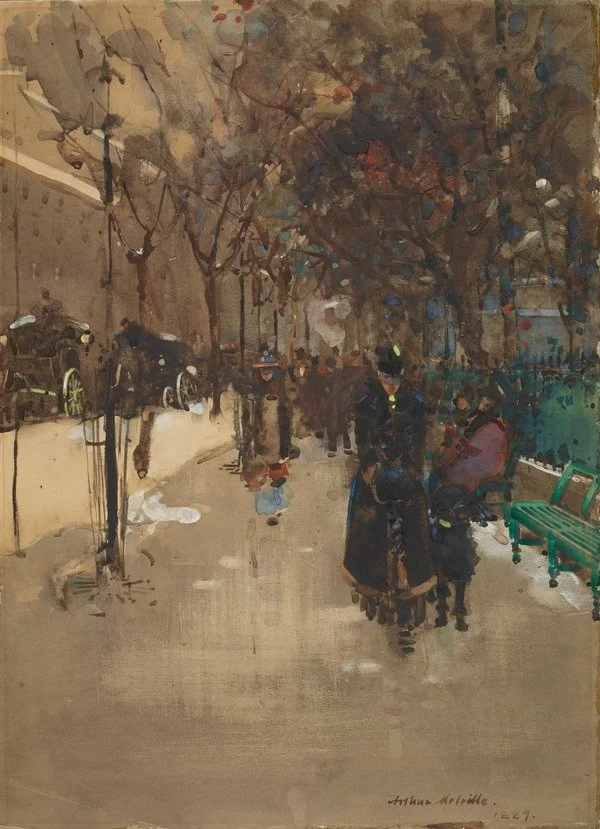
Arthur Melville, A Street Scene in Paris, a Wet Sunday Afternoon, 1889. Watercolour on paper, 48.80 cm x 37.20 cm. Scottish National Gallery of Modern Art. Image courtesy of Scottish National Galleries.
His work from this trip to Paris is dual-faceted. On the one hand there exists a polished, rather Impressionist view of the sophisticated beauty of quotidian Paris, and on the other, there are wild compositions of watercolour wash, splattered with various pigments representing a Luhrmann-esque scene of Moulin Rouge Can-Can dancers. These were captured on the dance floor itself. After this trip, Melville continued travelling in Europe, stopping off in Spain and Italy. He continued to paint until his premature death in 1904.
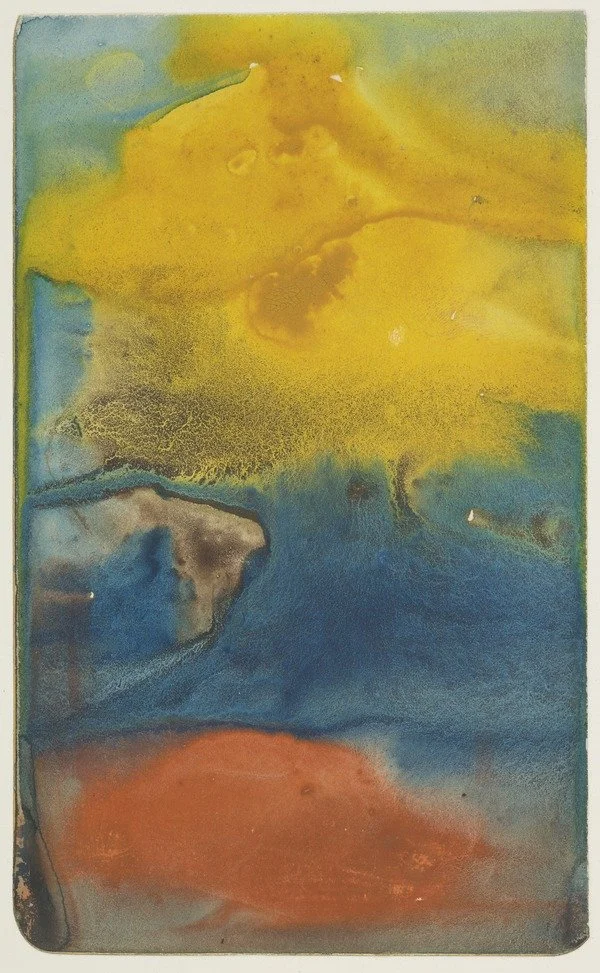
Arthur Melville, Dancers at the Moulin Rouge, 1889. Watercolour on aper, 9.40 cm x 15.50 cm. Scottish National Gallery of Modern Art. Image courtesy of Scottish National Galleries.
Tomorrow while I wander the rues, I will think about Melville. Perhaps his work is proof that Paris can be experienced in multiple ways. One can choose to engage with it in the classic sense, or in the most abstract way possible. As I guiltily scurry past the Louvre and Musée d’Orsay in pursuit of my next indulgent snack and sunbathe, I’ll make sure to convince myself that’s true.
Bibliography
National Galleries of Scotland. “Arthur Melville.” 3rd February 2026. https://www.nationalgalleries.org/art-and-artists/features/arthur-melville