Scottish Nostalgia in Kettle’s Yard, Cambridge
By Anna Barlow
A short walk from Cambridge's busy town centre, one can retreat to the Kettle's Yard house, converted and curated as a haven for the creative mind. It was a place I sought refuge in one afternoon, amid the heat wave that suffocated my local city this summer.
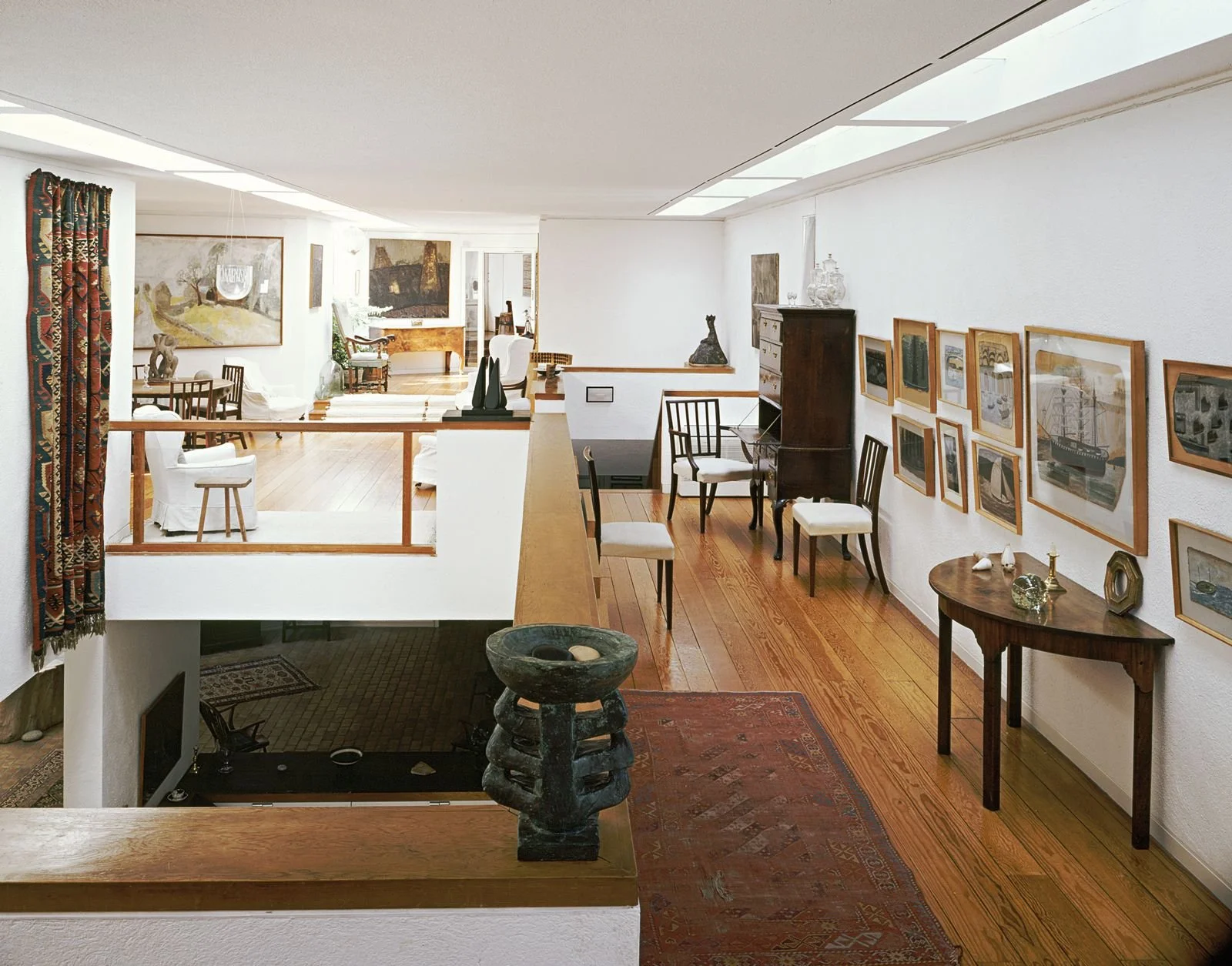
First Floor view of the Kettle’s Yard House, 2018. Image Courtesy of University of Cambridge.
Owned by the aesthetes Helen and Jim Ede, before being donated to the University of Cambridge, the house is a picture of masterful curation. An immersive place where artworks and natural forms are thoughtfully assembled for the contemplation of visual beauty. Any trace of the house as a functioning dwelling is erased. No cups sit in the sink to be washed, nor clothes drape over chairs. It has a pure and uninterrupted purpose: to provide an unpretentious place where people can enjoy modern art as an integrated part of everyday life, one “unhampered by the greater austerity of the museum” as Jim Ede stated.
Although situated in England and thought out by English minds, I could not help but feel something nostalgically Scottish about Kettle's Yard upon my visit. Sure enough, Helen studied at the Edinburgh College of Art in the early 1910s, where she met Jim Ede.
The College's pedagogy encompassed John Ruskin's philosophy and the influence of the Victorian Arts and Crafts movement, and the Kettle's Yard pair had an education shaped by it. This gave them strict principles about what art should be: an autonomous, democratic practice, introspective of one's soul, and reverent of the beauty of nature.
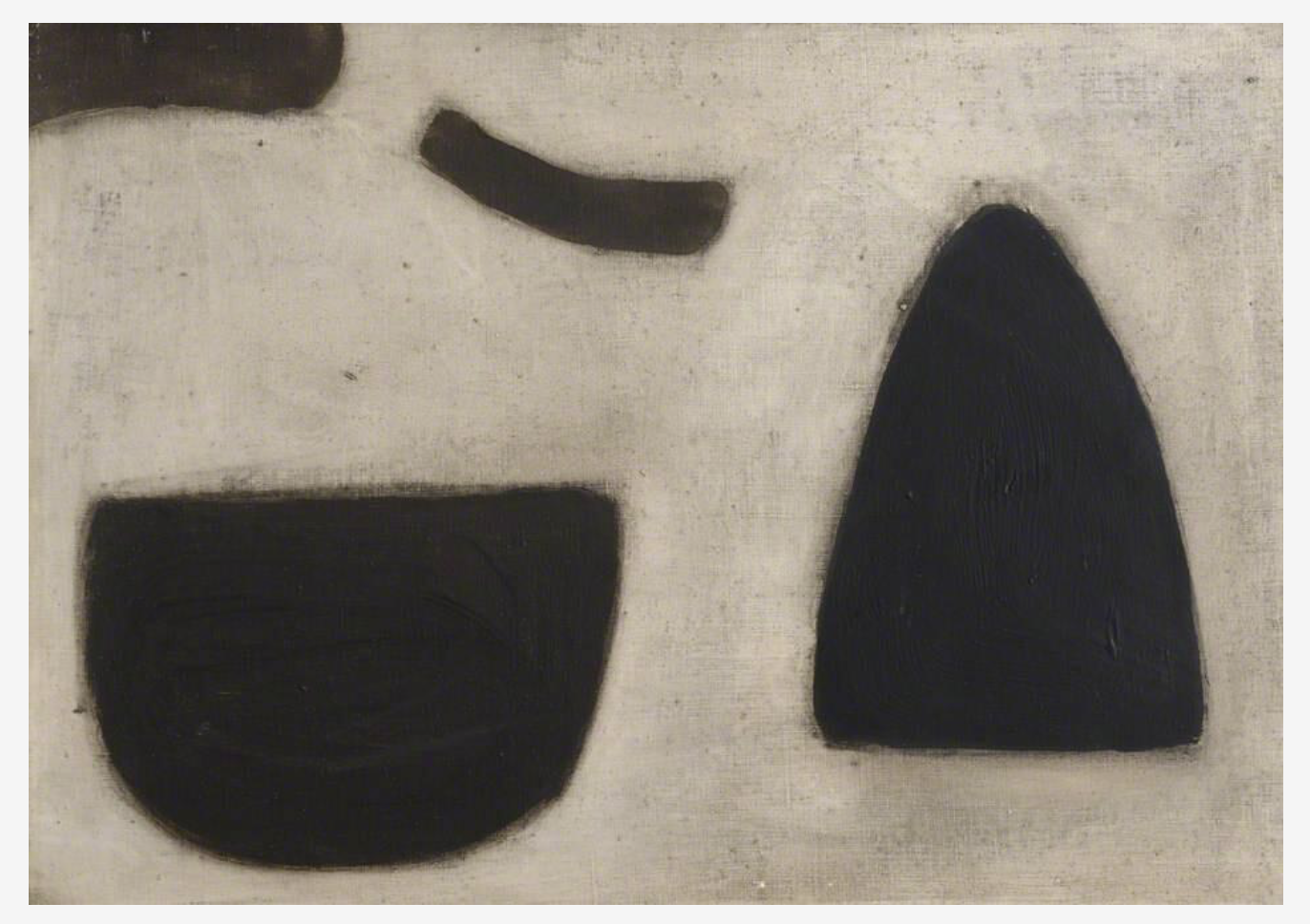
William Scott, Message Obscure I, 1965, Oil on canvas, 370 x 570mm. Kettle’s Yard, Cambridge. Image courtesy of Kettle’s Yard.
Although abstract works, that Ruskin most definitely would have condemned, can be spotted through the room, such as Message Obscure I (1965) by Scottish artist William Scott, this artistic space adheres to Ruskinian school of thought: free to enter, littered with organic forms glorified by sunlight, and arranged in natural juxtapositions without hierarchy. There are neither captions on the walls, nor ornate frames.
While we see a Scottish education playing a role in Kettle's Yard's philosophy, one can also see how this quietly manifests into subtle Scottish conventions. Most poignant to me was the significant presence of pebbles.
Ruskin too, often turned to Scotland's landscapes as a means for art to manifest his personal philosophy, appreciating their light and sites for geological study. This same admiration for stone reappears in the pebble assemblages in Kettle’s Yard.
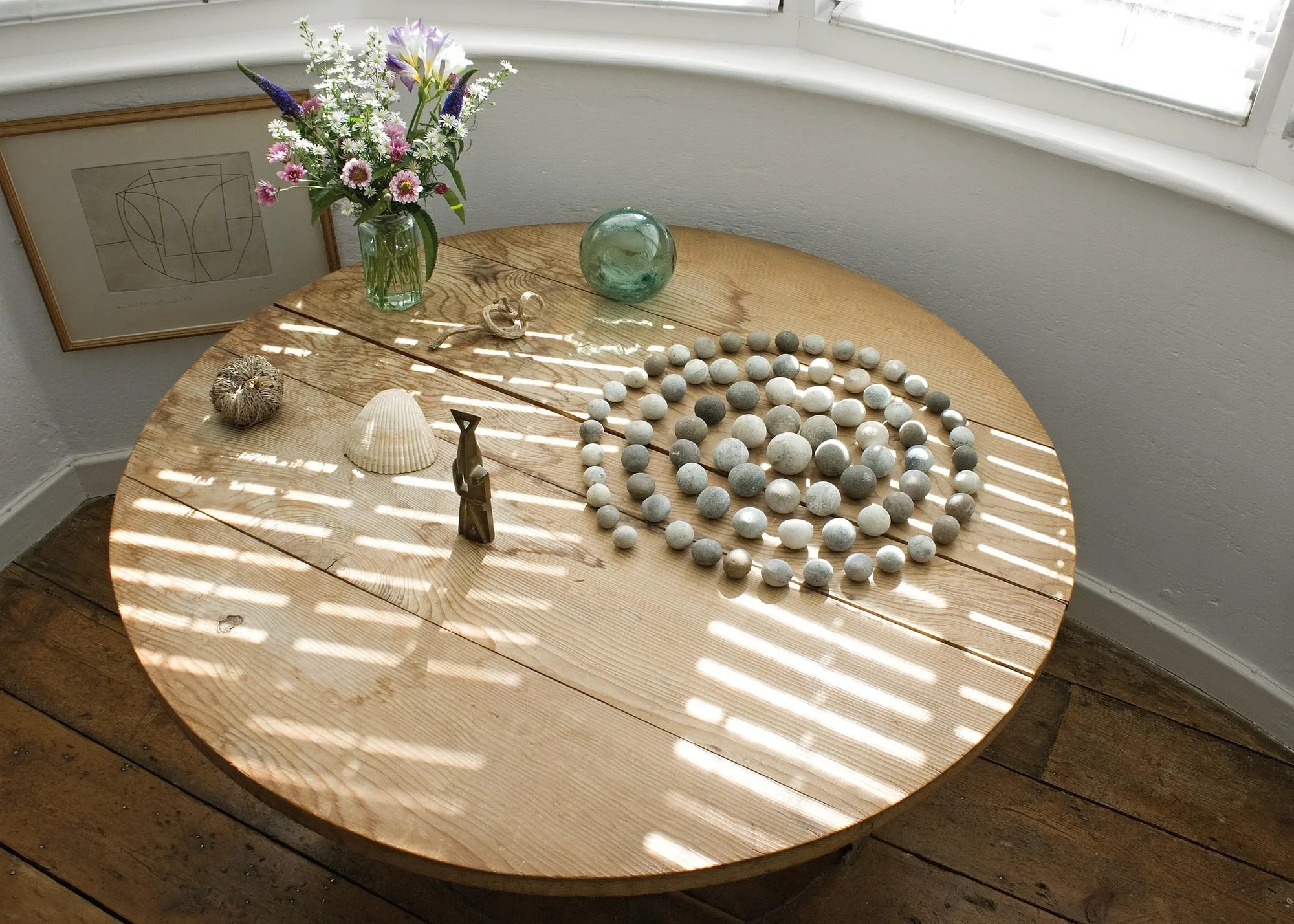
Jim Ede (the creator of Kettle’s Yard), Spiral of Stones, c.1958, 76 Limestone pebbles found on the beaches of Norfolk, approximately 30 x 30 cm. Kettle’s Yard, Cambridge. Image Courtesy of Kettle’s Yard.
Arranged in spirals and tonal gradients, these standout collections on the ground floor embody the Kettle's Yard mission. The pebbles were gathered from Norfolk as part of Jim Ede's obsession with finding the perfectly round, ‘bullet-ball-esque’ stone. Their remarkable regularity and balanced spherical form are best appreciated up-close, sitting down in one of the many chairs placed throughout Kettle's Yard. Here, the appreciation of nature becomes a live, intimate experience.
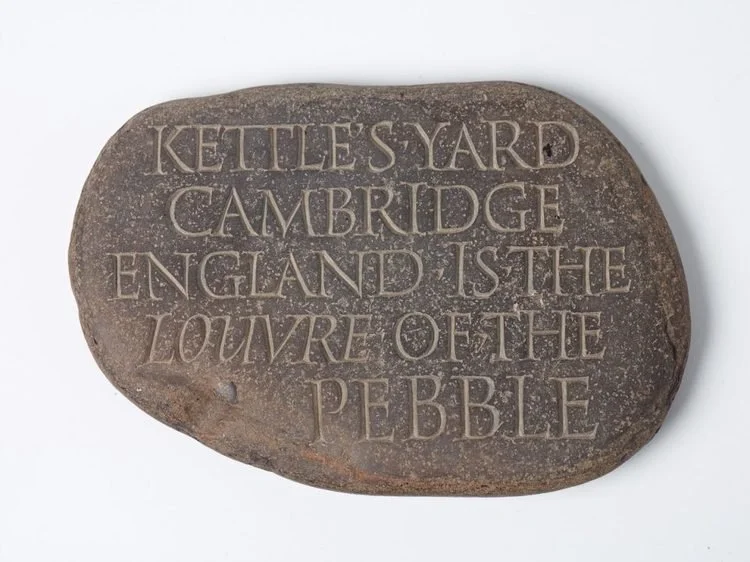
Ian Hamilton Finlay, KETTLE’S YARD CAMBRIDGE ENGLAND IS THE LOUVRE OF THE PEBBLE, 1995, Inscribed stone, 97 x 145 x 14 mm, Kettle’s Yard, Cambridge. Image courtesy of Jo Walton.
Featuring in the collection is a pebble carved by Scotland-based artist/poet Ian Hamilton Finlay, inscribed with the aphorism ‘Kettle's Yard Cambridge England is the Louvre of the Pebble’ (1995). Finlay is best known for his sculptures – concrete poetry expressed in actual concrete, arranged in and around his house in the Pentland Hills near Edinburgh. Despite this reputation, his relationship with Jim was tense: Ede did not appreciate or understand Ian's concrete craft.
Even with their differences, the artwork still features within the collection, merging an avant-garde artistic practice with a natural form. Art and reality are synthesised in this singular Scottish artwork, but in doing so pokes fun at Kettle's Yard, comparing their ‘down-with-establishment’ anti-gallery to one of the most prestigious galleries in Europe.
Perhaps, in Finlay’s mind, in the couple's staunch project to create somewhere so ‘strictly’ free, open, and completive they had, antithetically, created their own exclusive hierarchy.
The Edes came full circle and retired to Edinburgh in 1973, and this summer I confirmed my suspicions about these Caledonophiles in Cambridge.
Bibliography
Art Fund. ‘Kettle’s Yard’. Artfund.Org, 2018. https://www.artfund.org/explore/museums-and-galleries/kettles-yard.
Art UK. ‘Message Obscure I’. Artuk.Org, Art UK, 2026. https://artuk.org/discover/artworks/message-obscure-i-139736.
Coldwell, Paul, Paul Coldwell, and Ruth M. Morgan. ‘Picturing the Invisible in Site-Responsive Art Practice’. In Picturing the Invisible. UCL Press, 2022. https://www.jstor.org/stable/j.ctv1v090jc.10.
Hood, Katy Lewis. ‘Kettle’s Yard: The Louvre of the Pebble’. Varsity Online, September 2026. https://www.varsity.co.uk/culture/8055.
Jones, Jonathan. ‘Kettle’s Yard: How Britain’s Avant Garde Found a Cosy Home in Cambridge’. The Guardian, The Guardian, 16 May 2023. https://www.theguardian.com/artanddesign/2023/may/16/kettles-yard-how-britains-avant-garde-found-a-cosy-home-in-cambridge.
Kettlesyard. ‘Timeline | Kettle’s Yard’. 2026. https://www.kettlesyard.cam.ac.uk/timeline/.
Lawrie, Scott J. ‘The Edinburgh College of Art (1904-1969: A Study in Institutional History.’. M.Phil Thesis, Edinburgh College of Art, 1996. https://era.ed.ac.uk/server/api/core/bitstreams/d6d758a8-15b1-44ac-ae43-575feb6b03f8/content.
RIBAJ. ‘Beauty and Revolution: Ian Hamilton Finlay at Kettle’s Yard’. Ribaj.Com, 18 December 2014. https://www.ribaj.com/culture/beauty-and-revolution-ian-hamilton-finlay-at-kettle-s-yard/.
Ruskin, John. Modern Painters: Their Superiority in the Art of Landscape Painting to All the Ancient Masters, Proved by Examples of the True, the Beautiful, and the Intellectual From the Works of Modern Artists, Especially From Those of J. M. W. Turner: Ruskin, John, 1819-1900 : Free Download, Borrow, and Streaming: Internet Archive. 1st edn. Elder Smith, 1843. https://archive.org/details/gri_33125010813760.
Walton, Jo. ‘Kettle’s Yard | Jo Walton’. Jo Walton | Lecturer and Art Historian, June 2018. https://jowalton.com/kettles-yard-the-louvre-of-the-pebble/.