A Tour of James McNeill Whistler at Tate Britain
By Sadie McGraw
The notorious nomad of the late nineteenth century, James McNeill Whistler, is finding refuge at the Tate Britain at the end of September. This will be Whistler’s first major European retrospective in thirty years, exhibiting some of his most popular paintings alongside those never seen before.
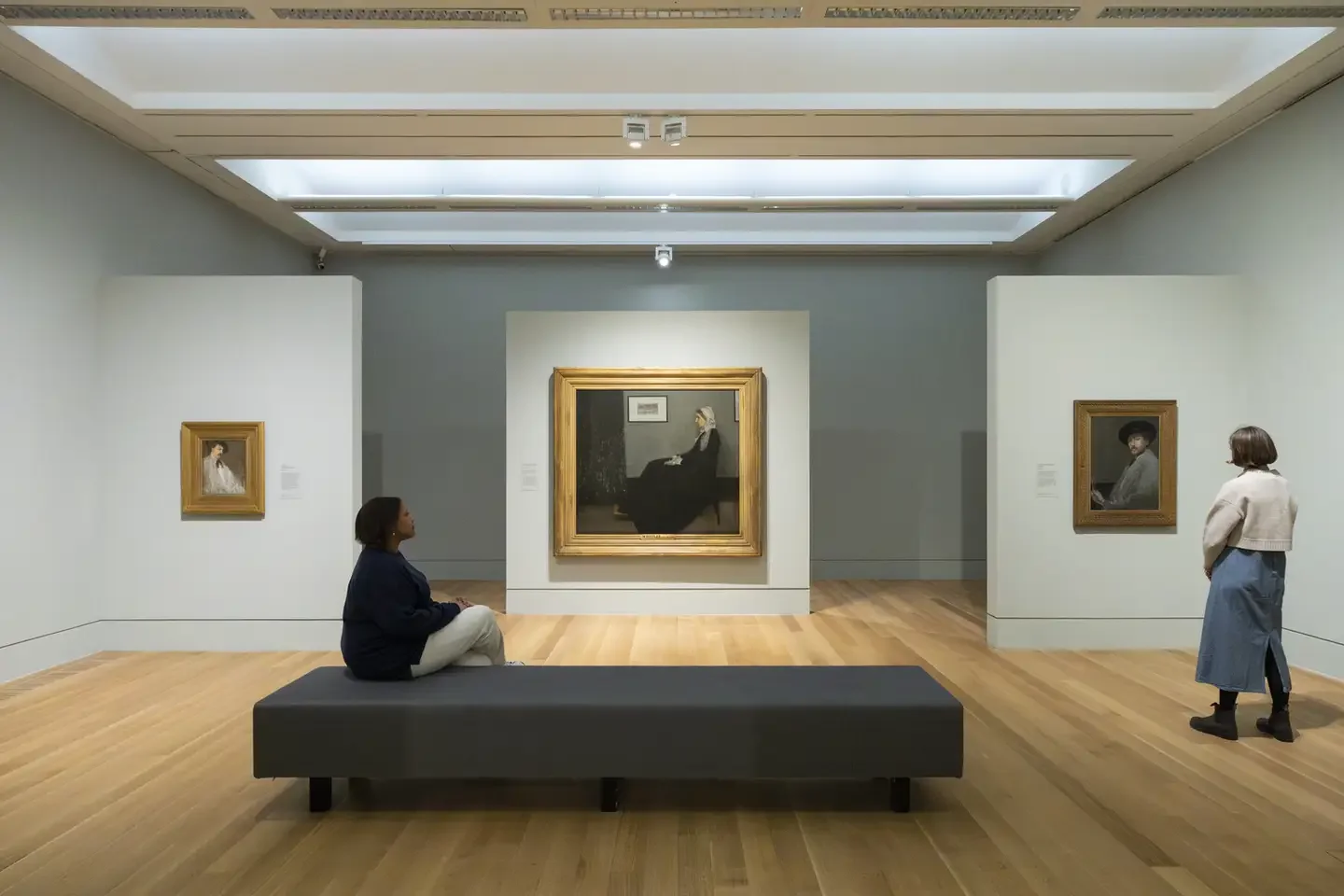
View of the Exhibition. Photo courtesy of Larina Fernandes for Tate Britain
Whistler has a unique globality, which may explain his ingenuity and avant-garde nature of his work. He was born in the United States but spent significant time in Saint Petersburg, Russia as a child. As an adult, Whistler studied in Paris at École Imperial et Spéciale de Dessin where Monet and Renoir would also be pupils a few years later. During this time, his work was heavily influenced by and responded to Dutch and Spanish masters such as Rembrandt, Vermeer, and Velazquez. However, being in the nucleus of artistic innovation, Whistler could not escape the influence of his contemporaries, especially the iconic Realist Gustave Courbet. Whilst Whistler ran in this circle of Realists during his time in Paris, his work expanded past the genre and started reaching into Post-Impressionism in the mid 1860s.
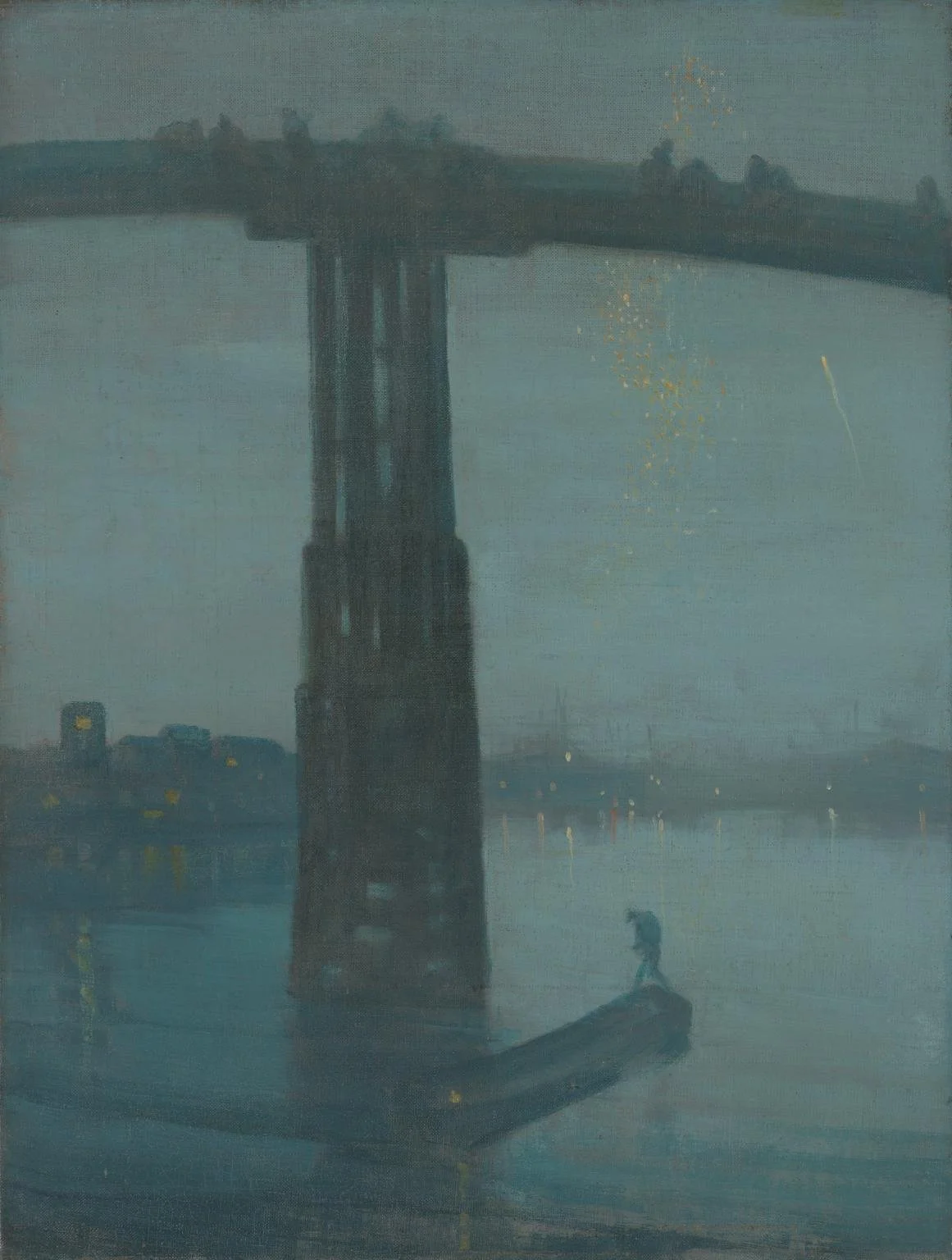
James McNeill Whistler, Nocturne: Blue and Gold - Old Battersea Bridge, oil on canvas, c.1872–5, 68.3 × 51.2 cm. Courtesy of the Tate Britain.
Eventually, Whistler would tire of Paris and relocate to London where he worked with Pre-Raphaelites like John Everett Millais and Dante Gabriel Rossetti. In London, he started to experiment within nocturnes, exploring the beauty and, often, melancholia of the city after hours. Take for example, one of his most renowned pieces, Nocturne: Blue and Gold- Old Battersea Bridge (1872-5). The influence of his time in Paris is obvious in the loose brushstrokes and sparse but standout highlights on the horizon. The lone person in the foreground bears the brunt of the emotional weight that this painting delivers; there is an intense feeling of solitude in the figure who is depicted, hunched over, striding along the moor. The restrained colour palette of muted blues and greys only adds to the sense of seclusion that Whistler conveys in this scene.
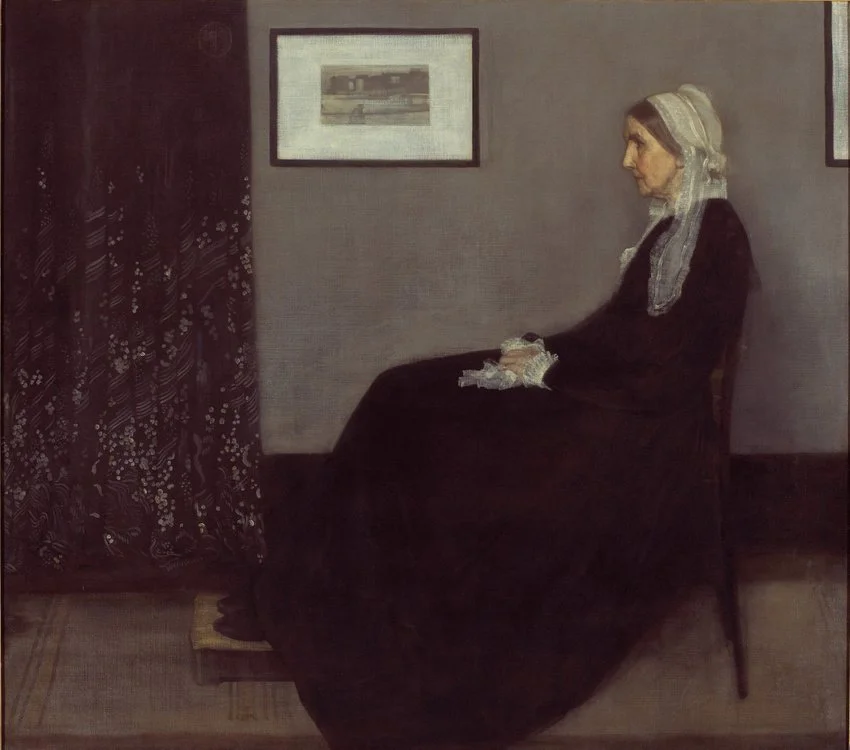
James McNeill Whistler, Arrangement in Grey and Black No.1, 1871, Oil on canvas, 144.3×163cm. Courtesy of Tate Britain.
Perhaps the highlight of this exhibition are Whistler’s domestic scenes, most notably including the portrait of his mother (Arrangement in Grey and Black No.1,1871). Whistler depicts his mother in simple dress with a solemn expression in a sparse interior. Her black dress compliments the dark curtains, while illuminating her pale skin and white bonnet, emphasizing her long, swooping contours and strong silhouette. This portrait of Whistler’s mother is not glorifying, nor idealizing in any sense. She is painted with the attention and reverence that only a child can give to a portrait of his mother. The subdued palette and reserved expression exemplify Whistler’s frequent tone of melancholy seen throughout his work.
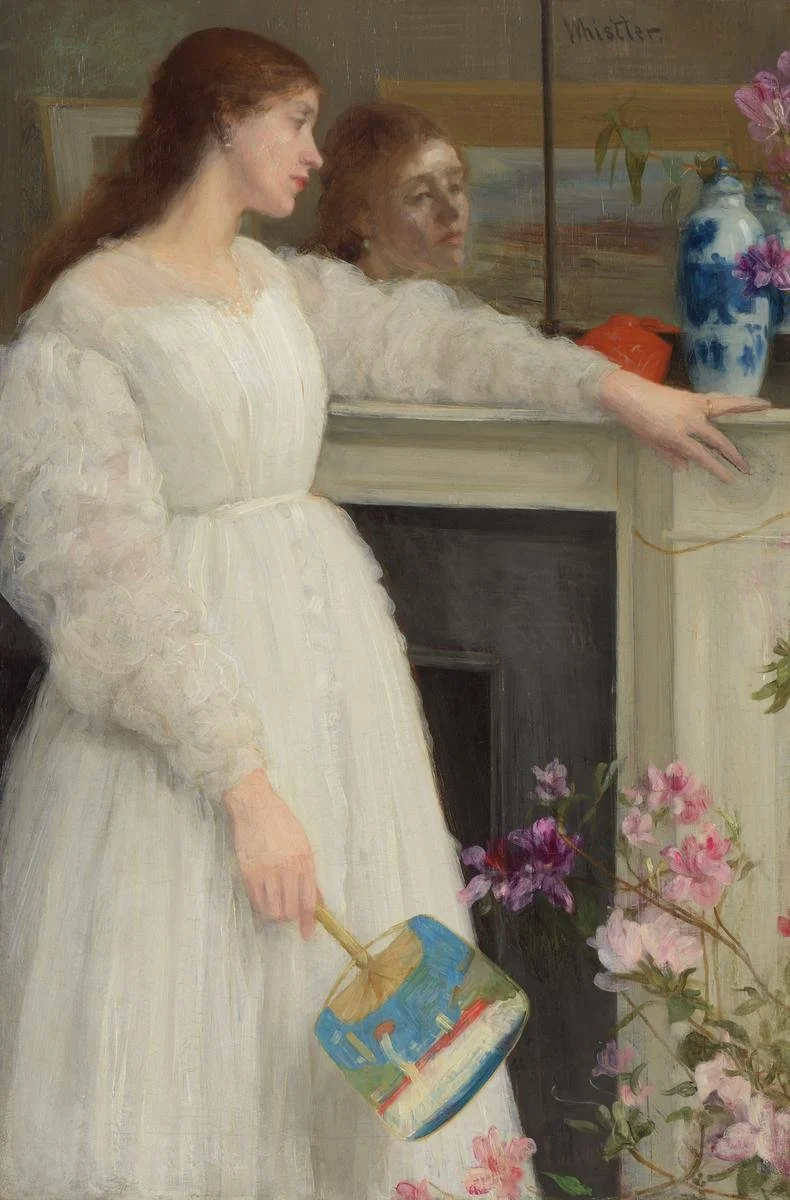
James McNeill Whistler, Symphony in White, No.2: The Little White Girl, 1864, Oil on canvas, 76.5×51.1cm . Courtesy of the Tate Britain.
The single figure portraits by Whistler are arguably his most emotionally charged and poignant pieces. Whistler expertly conveys a deep sense of somberness through the figures’ expressions while often juxtaposing their surroundings. When looking at Symphony in White, No.2: The Little White Girl (1864), there is a sense of almost Rococo lightness in the loose brush work, delicate flowers, and elegant dress of the girl. But despite this lightness, there is an overwhelming feeling of despair. The young woman’s expression is ridden with sadness, and the mirror reflects an even more grief-stricken visage. This contrast makes the piece striking and is a testament to Whistler’s technical ability and ultimately what cements his legacy in art history. Overall, while Whistler resides temporarily in London, this exhibition is a must-see for Realist and Post-Impressionist admirers alike.
Bibliography
Tate. 2025. “James McNeill Whistler | Tate Britain.” Tate. https://www.tate.org.uk/whats-on/tate-britain/whistler.
Weinberg, H. Barbara. 2010. “James McNeill Whistler (1834–1903) - the Metropolitan Museum of Art.” The Met Museum. https://www.metmuseum.org/essays/james-mcneill-whistler-1834-1903.