A Bar, A Cab, and Salman Toor at The Courtauld
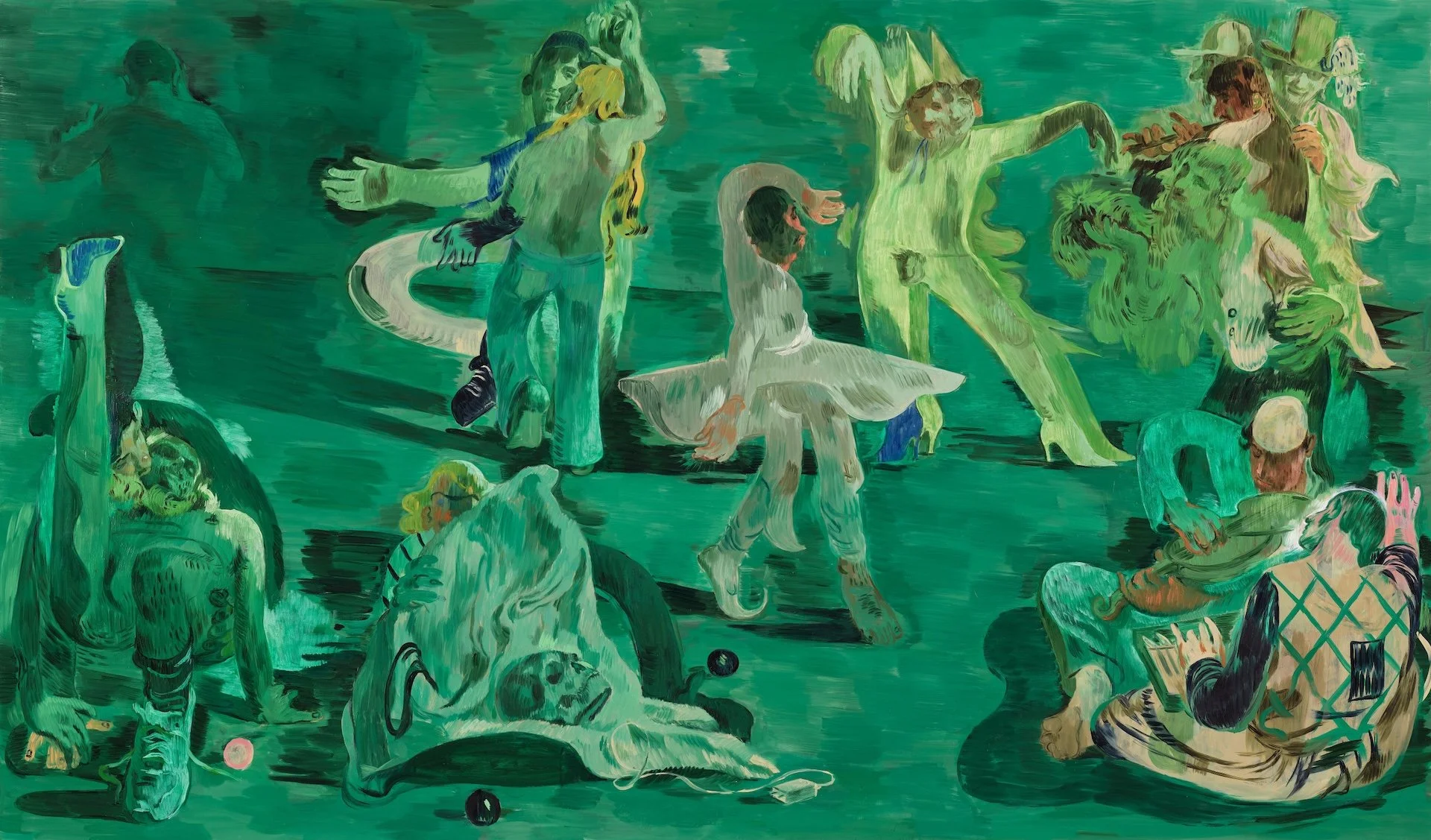
Salman Toor, Ghost Ball, 2023. Image courtesy of The Courtauld.
By Sadie McGraw
Salman Toor understands human connection and interaction on a deeper level than most and we are lucky enough as an audience that he expresses these concepts adequately in his new exhibition, Someone Like You, at The Courtauld in London this October. This is Toor’s first European solo exhibition, but he is no stranger to the international art world. His first institutional exhibition took place at the Whitney Museum of American Art, New York (2020-21) and he recently participated in the 60th International Art Exhibition of La Biennale di Venezia (2024).
Toor was born in Pakistan, now based in New York, and both places are a frequent setting for his work, as Toor paints loosely drawn from his own experiences. Queer figures and people of color are the central focus of all of his oeuvre, and Toor sees painting as a mode of liberation, giving the spotlight to often unexplored and overlooked diasporas. Toor tells The Courtauld about the intersectionality of his identity, as both queer and South-East Asian, that his work, “depict[s] queer and immigrant lives that straddle different cultures and inhabit the tension between intimacy and exposure, belonging and estrangement. What it means to find a community, but also the daily costs associated with visibility”. Below, I have selected two pieces that highlight this intersectionality and are arguably the most renowned works from the exhibition, The Bar on East 13th (2019) and Three Friends in a Cab (2021).
The Bar on East 13th
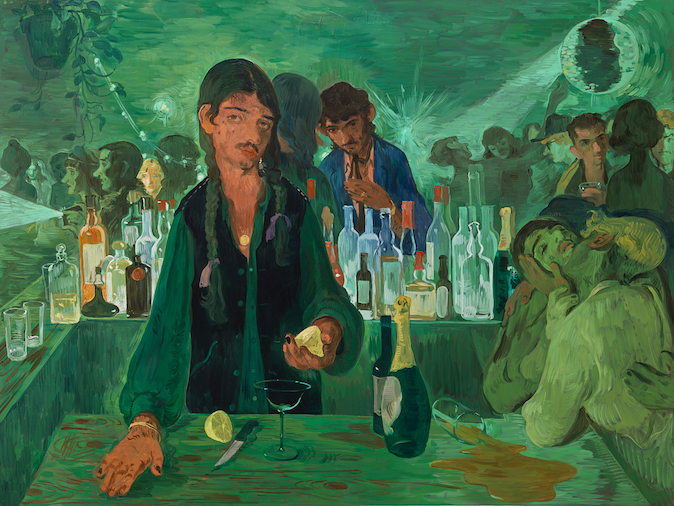
Salman Toor, The Bar on East 13th, 2019. Image courtesy of The Courtauld.
In this exhibition, Toor expertly blends two worlds together: that of the contemporary present and the Impressionist past. The Bar on East 13th engages with Edouard Manet’s piece, A Bar at the Folies Bergere (1882), coincidentally also housed in the Courtauld . A pig-tailed, mustachioed bartender takes the place of the young blonde featured in Manet’s piece with an extended hand, holding a lime, an invite. To his left, a queer couple engulfs themselves in each other, either not noticing or not caring about the spilled glass next to them, an indication of the seeming urgency of the moment. The bottle of champagne sitting beside them again harken back to Manet while just beyond it lies an array of liquor bottles, illuminate as the brightest points of the piece. They’re enchanting, captivating us, whispering to us to join the figures in the background who talk, dance, swing each other around in the Gatsby-Esque green light of the bar. This green light holds a tension, a sensation of allure depicted through glowing bottles, joyous figures melting into each other, but one of unease as well. Figures are shadowy and the dancefloor is hard to make out, not to mention the man resembling Ringo Starr looking directly at the viewer with a furrowed brow. The Bar on East 13th emulates pure New York; where else would you find two queer guys recreating Klimt’s The Kiss in a dive bar?
Three Friends in a Cab
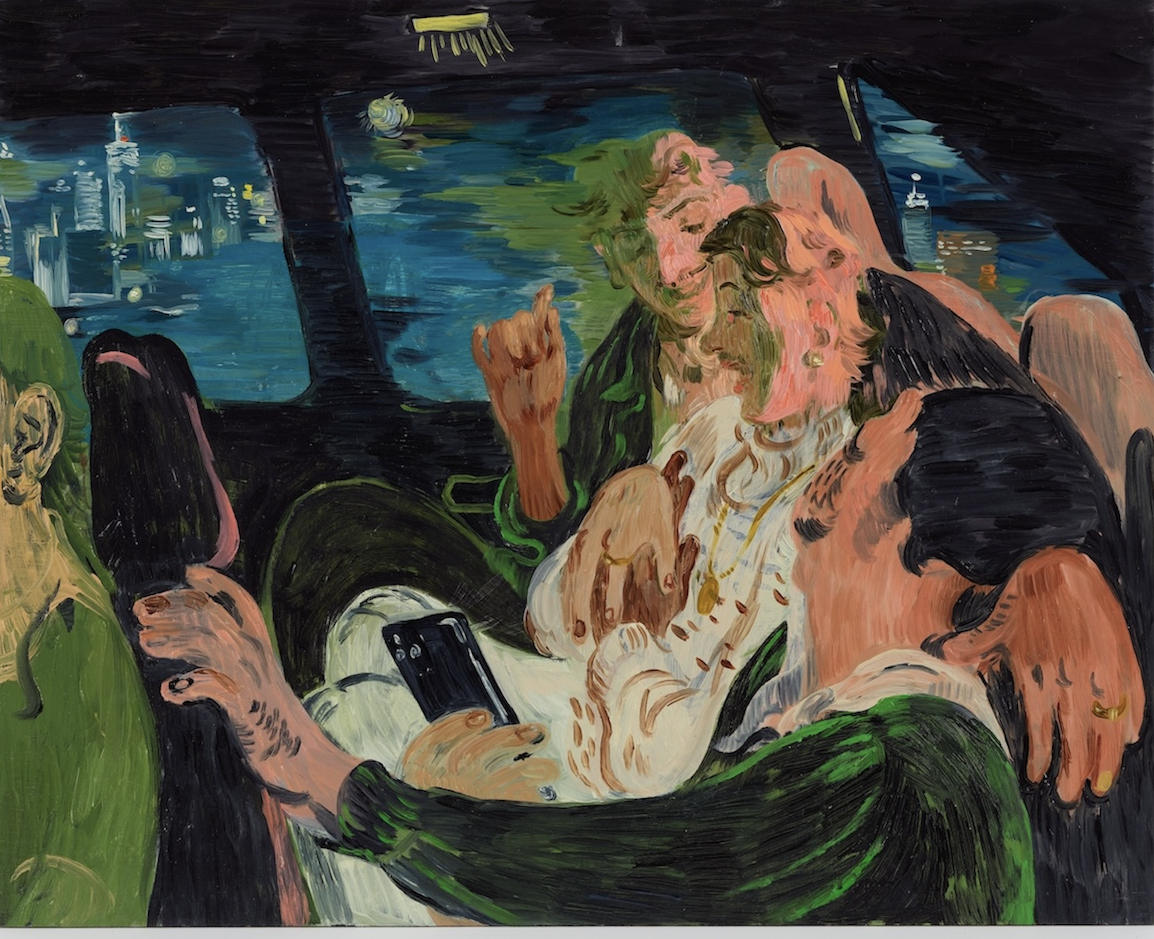
Salman Toor, Three Friends in a Cab, 2021. Image courtesy of The Courtauld.
A slight break from the saturation of Toor’s signature green in this exhibit, Three Friends in a Cab provides us with a slightly more intimate scene. As the title suggests, three friends fold over each other and Toor’s quick brushstrokes create little distinction between the bodies. Diving deeper into the piece, the three figures are not proportionally correct. One figure’s outstretched arm reaches forward too long, while another’s hand takes up approximately half of a car seat. Even with the disregard for the classical elements he so admires, Toor’s Baroque influences shine through. The contrast between light and dark in this piece is much more stark compared to the rest of the works in the exhibition. A light salmon color acts as a highlight, perfectly imitating the effect of a fast cab illuminated under streetlamps. The piece as a whole is indicative of Toor’s focus as a painter, that of human interaction, desire for connection, and the intersectionality of New York. Three Friends in a Cab evokes a sense of freedom. The swooping gestures of the bodies give the work an airless sensation, not unlike that of operating a Lime Scooter while under the influence. To me, this piece represents quintessential early adulthood, slightly cartoonish, slightly dreamlike, but persistently authentic.
These pieces feel intimate; I feel like I slipped past the bouncers at Berghain, now let into a highly mysterious, personal secret. Toor’s pieces are undeniably electric with vivid colors and enchanting figures, but there is a sense of underlying melancholy in nearly every composition. The green hue seems to act as a gild over something deeper and existential. However, it is a cathartic melancholy; this is not sadness for sadness’ sake. The anguish is being glazed over by bright lights and radiant tones and Toor is using these pieces an absolution. Someone Like You makes you feel like everything can be exonerated in the back of a cab or on a fluorescent lime green dancefloor. For young adults or nostalgic boomers, this exhibition transports us all to youth again, in all of its glorious mess.
Works Cited:
“Salman Toor: Someone Like You.” 2026. Courtauld. February 11, 2026. https://courtauld.ac.uk/whats-on/exh-salman-toor-someone-like-you/.
Trasi, Ambika. n.d. “The Self as Cipher: Salman Toor’s Narrative Paintings.” Whitney.Org. Accessed September 24, 2026. https://whitney.org/essays/salman-toor-self-as-cipher.
Meer, Malik. 2026. “‘Brown Men Are Fearless, Funny and Sexy’: Salman Toor on Clubbing, Queerness and New York’s Muslim Moment.” The Guardian. The Guardian. September 21, 2026. https://www.theguardian.com/artanddesign/2026/sep/21/salman-toor-artist-interview-clubbing-queerness-new-york-muslim-moment.