By Mili Medwed
A sun-bleached deer skull sits high above the desert landscape behind it, its antlers framing the distant peak of Cerro Pedernal, a flat-topped mesa in the New Mexican desert. In her 1936 work Deer’s Skull with Pedernal, Georgia O’Keeffe transforms the reverie of death into an image of befitting beauty, capturing the stark and surreal character of the American Southwest. The painting reflects O’Keeffe’s fascination with the natural world, a relationship that would come to define much of her career.
O’Keeffe was born in Wisconsin in 1887. After graduating from high school in 1905, she would go on to study at the Art Institute of Chicago. She disliked learning traditional painting techniques and was frustrated by the limitations of formal artistic training. During a summer course at the University of Virginia in 1912, her teacher introduced her to the work of the artist Arthur Wesley Dow. Dow was heavily influenced by Post-Impressionist artists, as well as Japanese prints.
Around the same time, O’Keeffe became familiar with the works of European modernists. She created some charcoal sketches and sent them to a friend in New York, who took them to a gallery owned by Alfred Stieglitz, whom she would later marry. She later had her first solo show at Stieglitz’s gallery, in 1917.
By the mid-1920s, O’Keeffe had developed a personal style that made her one of America’s most influential artists. In 1929, she made her first trip to New Mexico. The brutal, arid landscape became a major inspiration for her artwork, and after many years of travelling back and forth, she made it her permanent home in 1949.
Her floral scenes are undoubtedly the most revered in her oeuvre, and though these works paintings were celebrated for their use of colour and abstraction, they attracted controversy because of their perceived associations with femininity and sexuality. Samuel Kootz writes in his 1930 book Modern American Painters that ‘much of her earlier work showed a womanly preoccupation with sex, an uneasy selection of phallic symbols in her flowers, a delight in their nascent qualities. O’Keeffe was being a woman and only secondarily an artist.’ Evidently, O’Keeffe’s critical reception was largely defined by her sex. Nevertheless she rejected the such readings of her works, while critics ‘steadfastly insist[ed] that her visual imagery [was] blatantly sexual’.
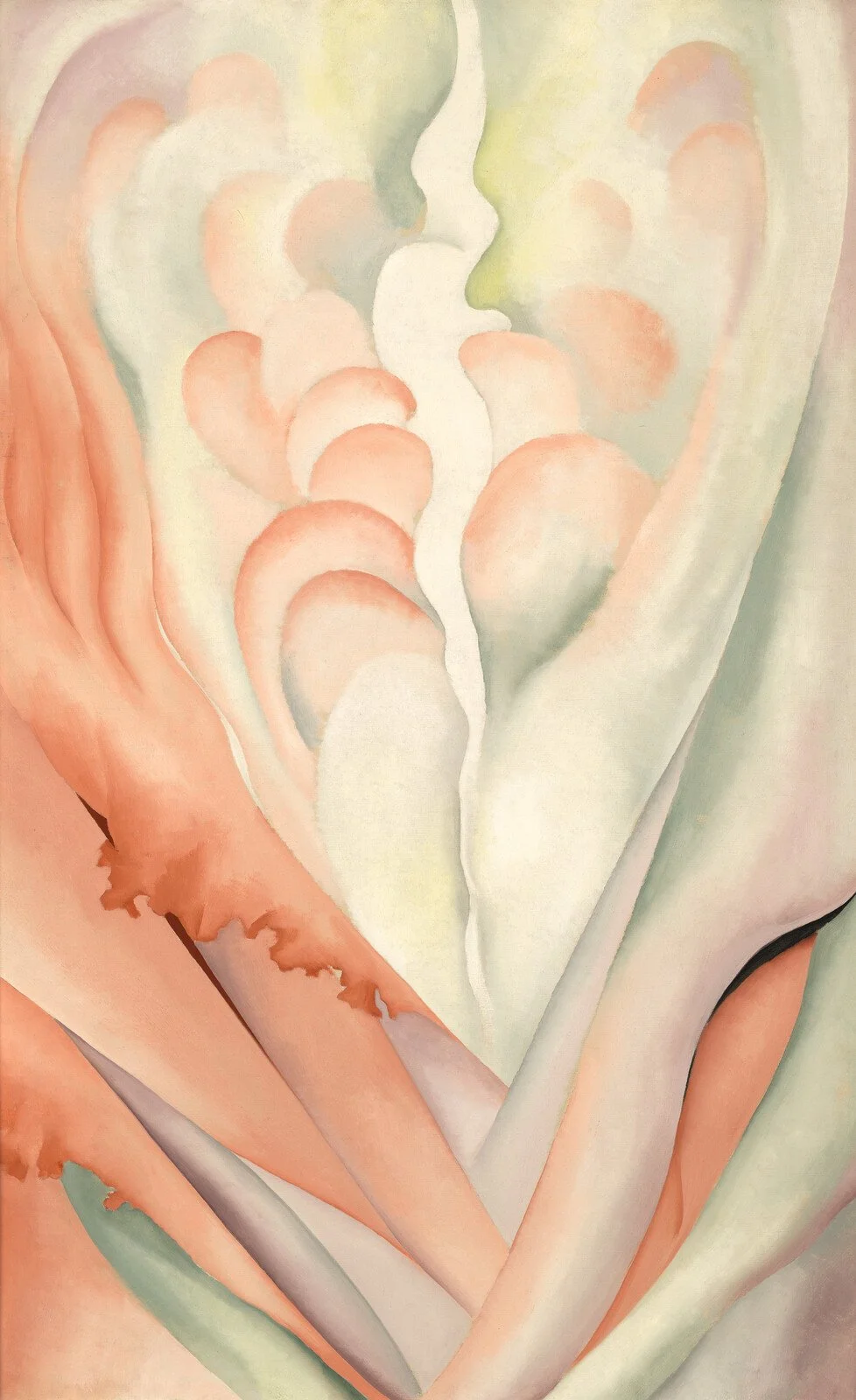
Georgia O’Keeffe, Flower Abstraction (1924) Oil on canvas, 122.2 × 76.2 cm. Whitney Museum of American Art.
An example of the sort of work that Kootz would have been reacting to is O’Keeffe’s Flower Abstraction (1924). In this work she magnifies the organic form of the flower until it is almost unrecognisable. Rather than favoring a Realist depiction in her approach she instead emphasises form, colour, texture and scale, while rendering the flora. It is this which we can understand as an attempt to subvert centuries old depictions of naturalia, by distorting their scale, they are transformed, becoming a landscape or . As Kootz noted earlier, these soft, rounded forms have often been likened to female genitalia, insisting that ‘assertion of sex can only impede the talents of an artist, for it is an act of defiance, of grievance, in which the consciousness of these qualities retards the natural assertions of the painter’. In this way, O’Keeffe becomes defined by her gender rather than her artistic talent. Perceptions of her art were therefore shaped not only by her artistic choices but also by the expectations imposed upon her as a woman. Rather than examining her use of colour, form, and abstraction, critics like Kootz examined her paintings primarily through their supposed sexual symbolism. In doing so, they diminished her artistic achievements, reducing her work to an expression of femininity rather than recognising it as an important contribution to American modernism.
However, O’Keeffe’s artistic practice extended far beyond the flowers for which she became famous. In New Mexico, she found inspiration in the vast desert landscape, often collecting animal bones and incorporating them into her paintings. Returning to Deer’s Skull with Pedernal, the skull is isolated and enlarged against the background of the distant mountains, much like the flowers in her earlier works. Although the subject matter differs, both works demonstrate her ability to transform familiar natural forms into unique and striking compositions through abstraction and perspective.
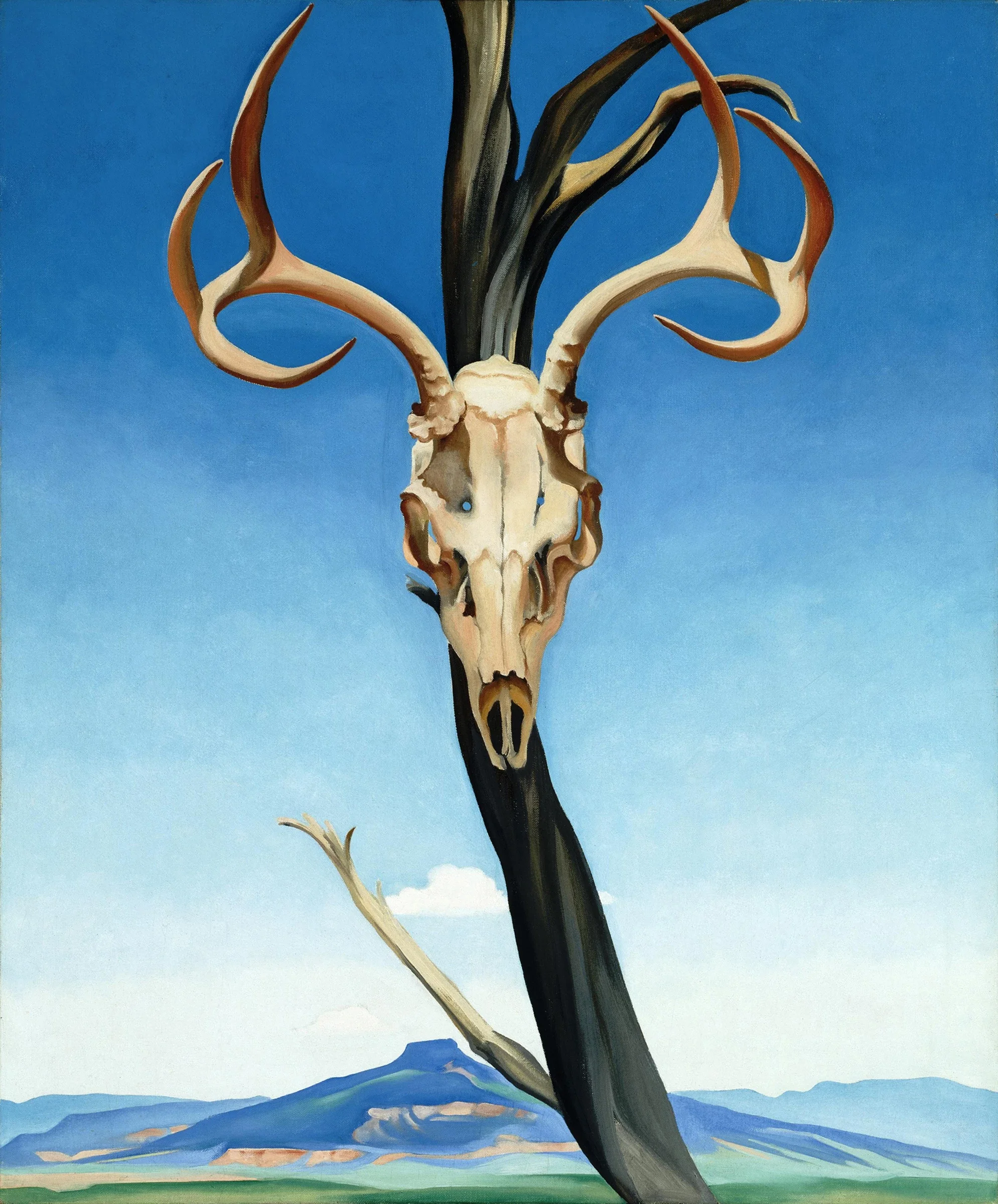
Georgia O’Keeffe, Deer’s Skull with Pedernal (1936) Oil on canvas, 91.4 × 76.5 cm. Museum of Fine Arts, Boston.
O’Keeffe continued painting throughout her later life, becoming one of the most celebrated figures in twentieth-century American art. She died in 1986, aged 98, leaving behind an artistic legacy that challenged traditional approaches of representation in her very own abstractist method. Her fascination with the natural world, which defined so much of her career, is best understood through her words. Reflecting on the bleached bones of the New Mexican desert, O’Keeffe wrote in 1943:
‘To me they are as beautiful as anything I know. To me they are strangely more living than the animals walking around—hair, eyes and all with their tails switching. The bones seem to cut sharply to the center of something that is keenly alive on the desert even though it is vast and empty and untouchable—and knows no kindness with all its beauty.’
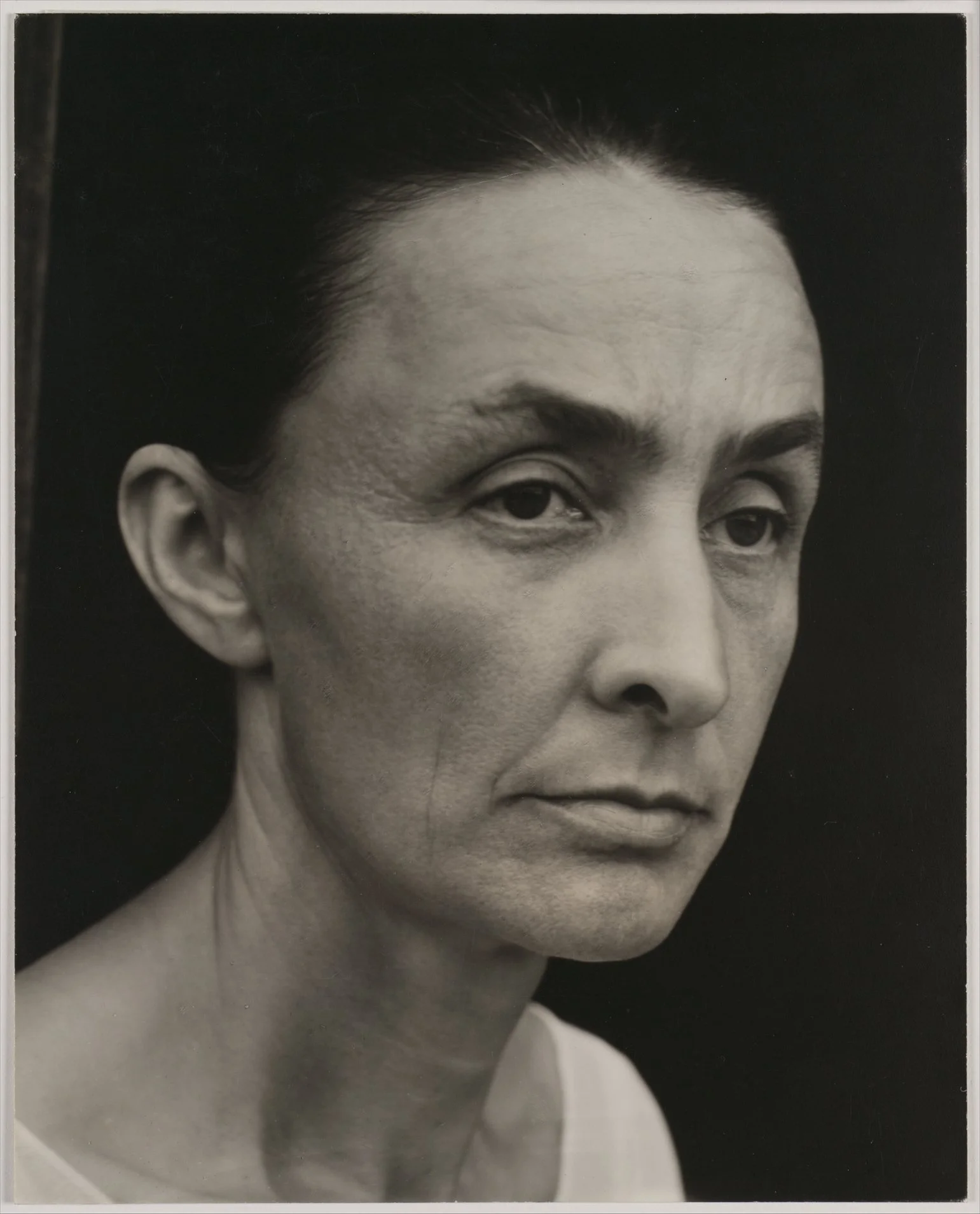
O'Keeffe in 1932, photograph by Alfred Stieglitz
Bibliography
Christie’s. “10 Things to Know About Georgia O’Keeffe.” November 7, 2025. https://www.christies.com/en/stories/georgia-o-keeffe-10-things-to-know-b6f544e05d89453b8669e355b53db274.
Georgia O’Keeffe Museum. “About Georgia O’Keeffe.” Accessed November 13, 2026. https://www.okeeffemuseum.org/about-georgia-okeeffe/.
Georgia O’Keeffe Museum. “The Natural World.” Exhibition, November 8, 2019–August 16, 2022. https://www.okeeffemuseum.org/exhibitions/the-natural-world/.
Kootz, Samuel M. Modern American Painters. New York: Brewer & Warren, 1930. https://dn760001.eu.archive.org/0/items/modernamer00koot/modernamer00koot.pdf