By Adamantia Selekou
William Blake was born on 28 November 1757 in Soho, London, to a hosier. He never went to school, and at ten he was sent to Henry Pars’ drawing school in the Strand, where he copied plaster casts of antique sculptures. Famous today mostly for his poetry, Blake was also known as an illustrator who brought his intricate, articulate imagination to life through vivid images. His Gothic style was influenced by his apprenticeship with the engraver James Basire, where he spent seven years sketching the tombs and effigies of Westminster Abbey – a close encounter with Gothic form that never left him. His subsequent studies at the Royal Academy Schools (from 1779), where he bristled at Sir Joshua Reynolds’s preference for colour and generalisation over firm outline, laid the foundations for an artistic practice marked by visionary conviction, fierce independence, and an insistence on the primacy of line.
Fusing word and image, Blake built a private mythology through which he staged the struggle between reason and energy. Described as a madman, he brought the visual language of his times to its climax, depicting the fight between law and liberty that he saw convulsing an age of revolution.
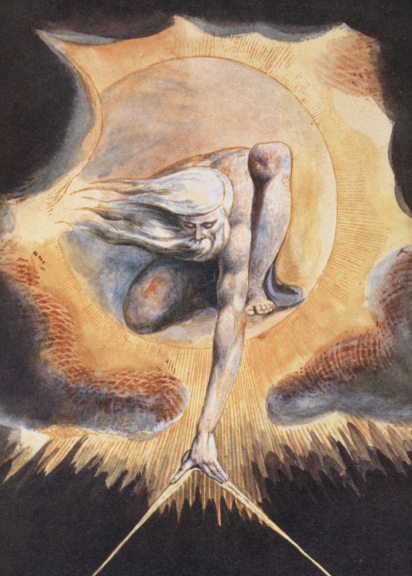
William Blake, The Ancient of Days, frontispiece to Europe a Prophecy, Colour-printed relief etching with hand colouring, approx. 234 x 168 mm, British Museum (1794)
This early image reveals the cosmic ambition of Blake’s work while showcasing relief etching, a method he developed in 1788. His practice was driven by the celestial: Blake claimed that his dead brother Robert had revealed in a vision that he could print text and image together from a single copper plate. His spirituality influenced his problem-solving, technique, and the aesthetics of his work. Urizen, Blake’s figure of law and limiting reason, crouches within a blazing sphere, reaching into the darkness with a pair of compasses. The image is deliberately ambiguous, presenting creation as an act of measurement and constraint. It would come to be regarded as the work most reflective of his thematic inquiries. Some speculate that, days before his passing, he was still colouring this design.
Blake was considered eccentric and belonged to no school in his lifetime. He did, however, move in a lively circle of London artists and thinkers. The sculptor John Flaxman and the painter Henry Fuseli were close friends of Blake. As a working illustrator, Blake was employed as an engraver by the radical publisher Joseph Johnson, who championed religious Dissenters and revolutionaries such as Thomas Paine and Mary Wollstonecraft. Few shared Blake’s visionary faith, but their world of dissent, revolution, and the sublime sharpened his attacks on Church, State, and industry.
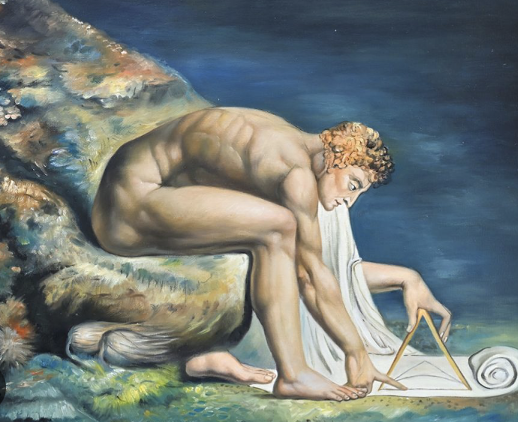
Blake, Newton, Colour print finished in ink and watercolour on paper, 460 x 600 mm, Tate (1795–c.1805)
This second image belongs to the twelve Large Colour Prints. Made by painting thick, tacky pigment onto a board, pressing paper against it, and finishing each impression by hand in pen and watercolour, this print is significant, as it marks the maturation of Blake’s lexicon. The compasses of Urizen return, now in the hand of the most celebrated scientist of the age. Newton sits naked on a rock at the bottom of the sea; he is depicted as utterly absorbed and blind to the richly mottled rock behind him, which almost seems alive with colour.
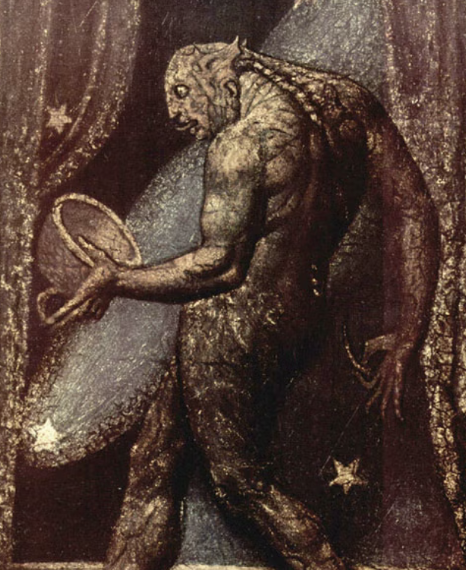
Blake, The Ghost of a Flea, Tempera heightened with gold on mahogany, 214 x 162 mm, Tate (c.1819–20)
From 1819, the painter and astrologer John Varley held late-night sessions where Blake drew the ‘Visionary Heads’ of historical and spirit sitters who visited him once more in visions. The small tempera that followed turns the sketch into theatre, depicting the Ghost of a Flea walking between parted curtains: a muscular, scaled character with its tongue darting. The figure is holding a thorn and a bowl of blood, while a shooting star crosses the sky behind. The flea, Blake told Varley, was drunk on the souls of bloodthirsty men. Barely the size of a page, it is one of his smallest and most haunting works.
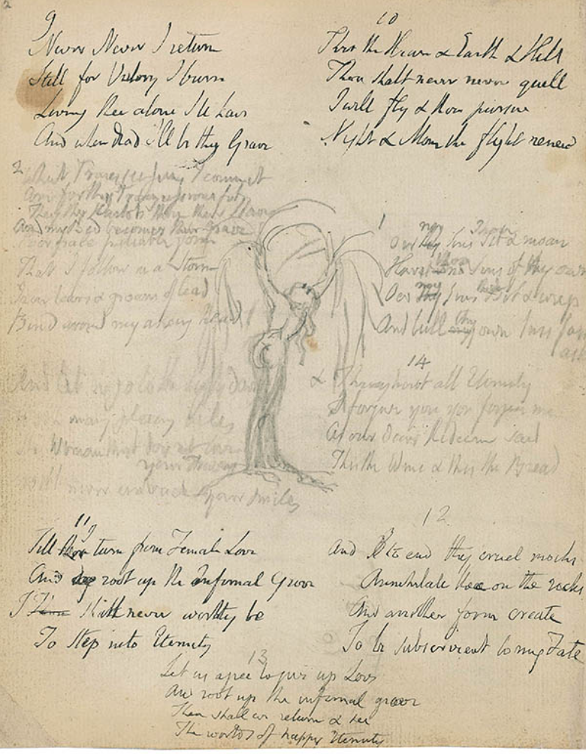
Blake, Notebook (the ‘Rossetti Manuscript’), Pencil, ink and wash on paper, 58 leaves, British Library, Add MS 49460 (c.1787–1818)
Blake’s sketching practice is best seen in his Notebook, which was originally owned by Robert, his favourite younger brother and pupil. Blake continued to use it for about thirty years. Its pages are crowded with pencil sketches of falling, flying and embracing figures. Here, image and word are not yet separated, and readers can see the visual and his thoughts merging. The book itself became a source for the Pre-Raphaelites, who rediscovered Blake. It is even more interesting because the Notebook spans the most troubled years of Blake’s life.
Blake died on 12 August 1827, reportedly singing. His grave at Bunhill Fields was unmarked and he was largely forgotten at his death. Alexander Gilchrist’s Life of William Blake (1863) restored Blake to view; after Gilchrist’s death, his widow Anne completed it with help from Dante Gabriel and William Michael Rossetti, and Blake has since been regarded as a leading figure of British Romanticism.