Mona Hatoum (1952-Present)
By Daphne Richard
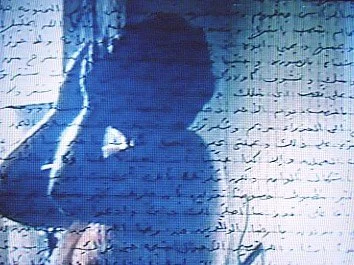
Mona Hatoum, Measures of Distance, 1988, video (image still), 15 minutes and 26 seconds.
Image courtesy of Mona Hatoum.
It is dangerous and limiting to find ways of categorising identity in an increasingly connected world—at least that is what British Palestinian artist Mona Hatoum says. Born 11 February 1952 in Lebanon to a Palestinian refugee family, Hatoum’s life and identity is full of complex contradictions which she attempts to capture in her works.
Although Hatoum was born in Lebanon, her family was never eligible for Lebanese Identity Cards. She reflects on Beirut as the place that she was raised, though she does not identify a Lebanese, rather choosing to connect with her Palestinian identity. Hatoum was enrolled at Beirut University College for two years and later worked in advertising, a career she found unsatisfying.
In 1975, whilst on a family holiday in London, the Lebanese Civil War broke out, meaning they could not return. Hatoum and her family managed to remain in London. She describes the feeling of forced displacement as ‘dislocating’ and creating a disjunction-effect within her art.
In museum spaces, where presence and aura dominate form, Hatoum’s viscerally engaging works are overwhelming. She takes on uncomfortable forms of bodies, like cheese graters and cages, whilst touching on domestic forms such as hair. Hatoum draws on Surrealist, Minimalist, and Conceptual forms whilst engaging with her identity and the ways it has been challenged.
Measures of Distance (1988) is an artwork that Hatoum and I find to be an integral representation of the complexities of the self and identity. This fifteen-minute video shows her mother showering overlayed with Arabic text. Hatoum intermittently orates the text, which are deeply personal letters translated into English; dotted between these translations are candid conversations between Hatoum and her mother. The film works to link her identity as it is and how it is presented. Whilst Hatoum finds Arabic more beautiful, she is forced to translate the text for her Western audience. Her identity has been displaced and shifted and her artworks attempt to capture the complex feelings around longing for home.
Hatoum is deeply aware of the complexities around configuring her identity into an artwork. When discussing Measures of Distance, she notes the fascination with bodies. To her, Arab culture presents a stronger sense of openness whereas British culture is more self-conscious. The choice of her mother’s body contextualises her feeling of displacement and political strife into a specific person. In doing so, Hatoum addresses global conflict through the personal lens of loss and longing.
The artist’s work is collected and exhibited internationally, with an exhibition currently on view at the Fondazione Prada in Venice. She resides in London and, I would imagine, still attempting curate and reconcile her feelings of loss and displacement into her work.
Bibliography
White Cube. “Mona Hatoum at Fondazione Prada | White Cube,” December 8, 2025. https://www.whitecube.com/news/mona-hatoum-at-fondazione-prada.
New Art Publications. “BOMB Magazine | Mona Hatoum by Janine Antoni.” BOMB Magazine, January 24, 2024. https://bombmagazine.org/articles/1998/04/01/mona-hatoum/.
Tate. “‘Measures of Distance‘, Mona Hatoum, 1988 | Tate,” n.d. https://www.tate.org.uk/art/artworks/hatoum-measures-of-distance-t07538.
—. “Who Is Mona Hatoum? | Tate,” n.d. https://www.tate.org.uk/art/artists/mona-hatoum-2365/who-is-mona-hatoum.