By Sophie Thompson
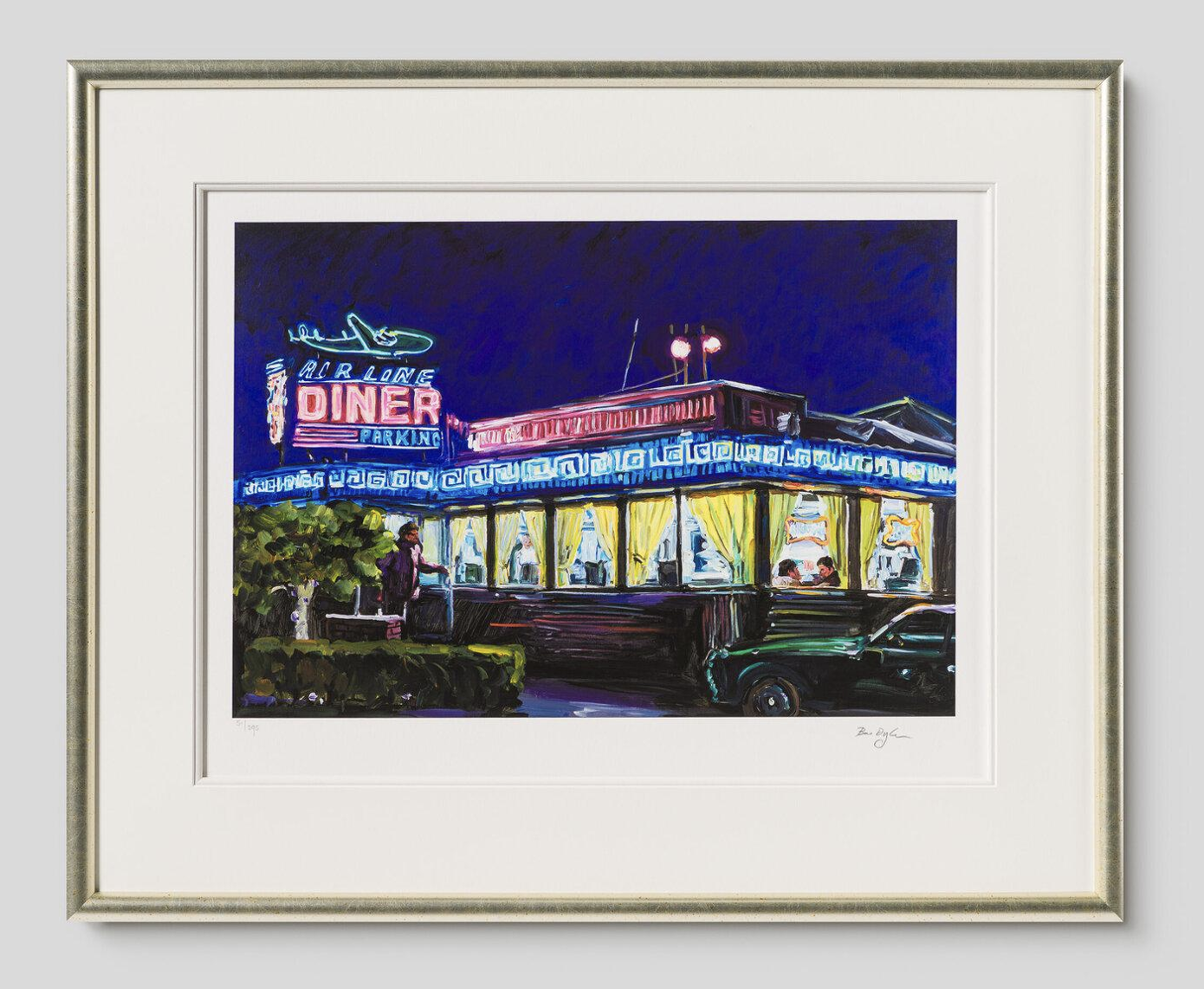
Bob Dylan, Airline Diner, 2026, Acrylic on canvas, 91 x 122 cm.
Image courtesy of Castle Fine Art.
There is a peculiar irony in the fact that one of America's most celebrated songwriters has spent much of his artistic career looking away from the extraordinary. Bob Dylan is an artist associated with political upheaval, cultural revolution, and the reinvention of popular music. Yet, in his visual work, his attention frequently settles on something considerably quieter: an empty roadside diner, a railway crossing, a deserted street or an unremarkable stretch of American countryside. These are not the images one might expect from a cultural icon whose songs helped define an entire generation, but perhaps that is what makes them so compelling.
Dylan's The Beaten Path series, most recently extended through a collection released in 2026, offers an opportunity to reconsider his contribution to contemporary art. Rather than simply illustrating the America he has spent decades making music about, Dylan constructs a visual portrait of the country through its overlooked spaces. In doing so, he raises a question that feels particularly relevant today: in a culture increasingly preoccupied with spectacle, visibility and the production of attention, what happens when an artist chooses to look at what everybody else overlooks?
Dylan's reputation as a musician can sometimes obscure the breadth of his artistic practice. Born in Minnesota in 1941, he emerged from New York's Greenwich Village folk scene in the early 1960s, becoming a defining voice of the decade's political and cultural transformations. His songwriting challenged conventional ideas about popular music, combining political protest, literary allusion and surrealist imagery. In 2016, he became the first musician to receive the Nobel Prize in Literature, recognised for creating new poetic expressions within the American song tradition. Yet his visual practice is not an entirely separate undertaking. Dylan has described drawing as a means of bringing order to the chaos around him, and his interest in visual art dates back to the beginning of his musical career.
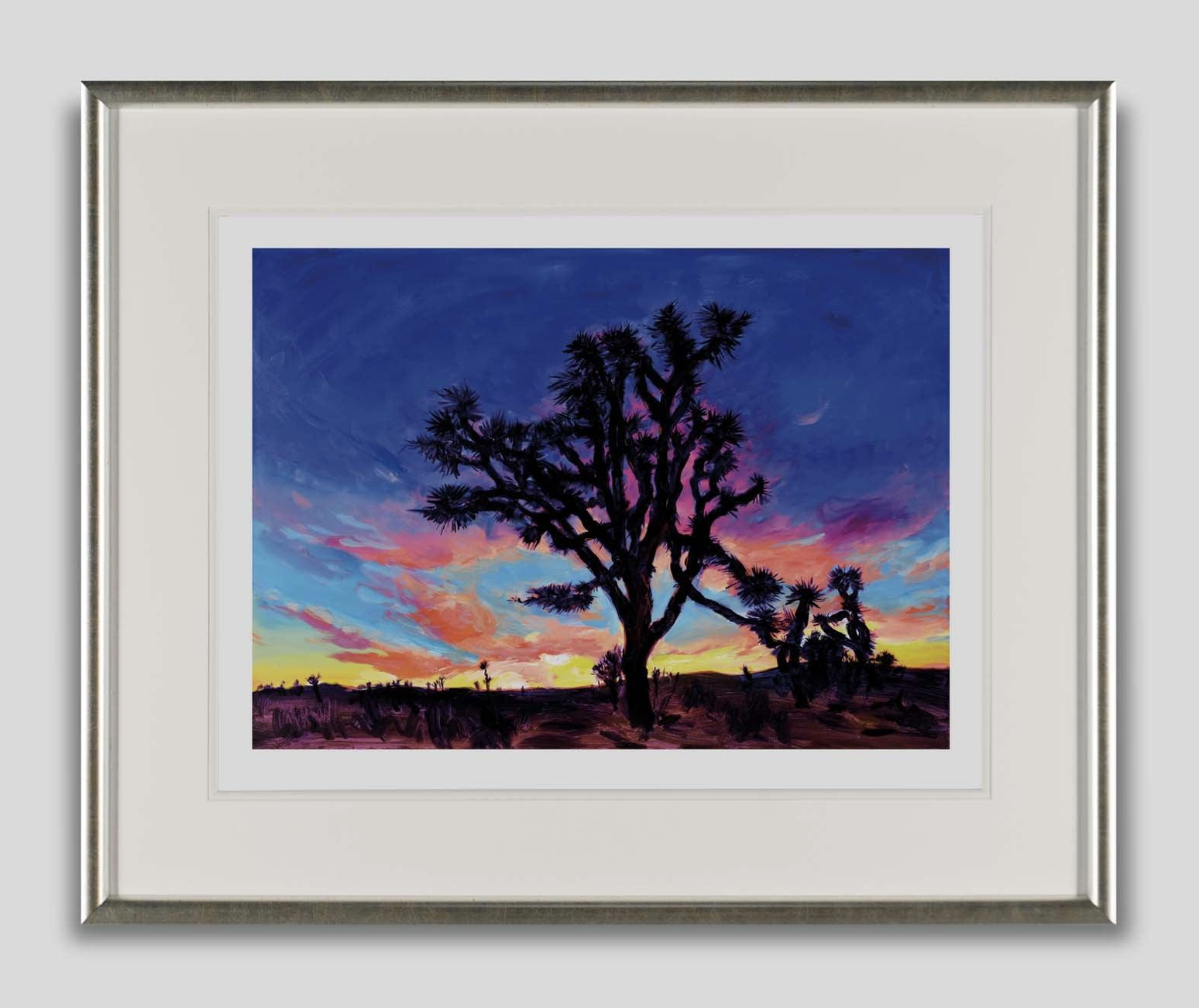
Bob Dylan, Joshua Tree, 2026.
Image courtesy of Castle Fine Art.
His visual journey is particularly evident in The Beaten Path, first launched in 2016 as a continuation of his earlier Drawn Blank series. Across paintings, drawings and prints, Dylan turns his attention towards the American landscape, travelling beyond recognisable landmarks and metropolitan centres to depict the backstreets, country roads and roadside establishments that constitute everyday life. The 2026 collection continues this exploration that constitute everyday life. The 2026 collection continues this exploration through six hand-signed, limited-edition artworks, including Airline Diner, Joshua Tree, Sunrise, Liquor Store, Night Train, Switching Station and History Will Absolve Me.
The collection's significance lies partly in its refusal to romanticise American identity through its most familiar symbols. There are no grand declarations of national achievement or monumental representations of historical events. Instead, Dylan's America is comprised of unremarkable, nearly invisible sites; neon-lit buildings, railway tracks and open roads become subjects worthy of sustained attention. The ordinary is elevated without being transformed into something unrecognisable.
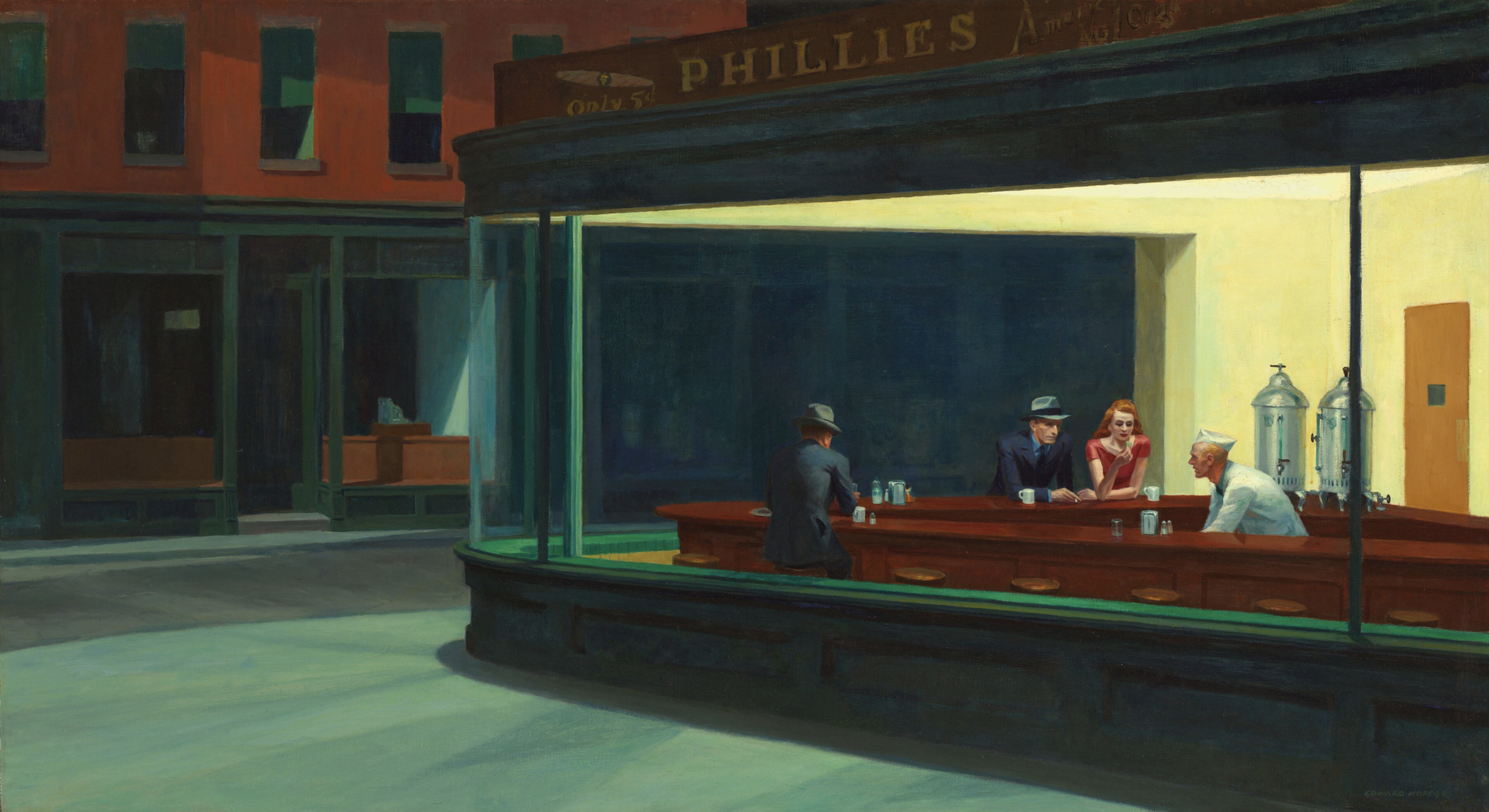
Edward Hopper, Nighthawks, 1942, Oil on canvas, 84.1 × 152.4 cm, Art Institute of Chicago.
Image courtesy of Encyclopedia Britannica
This approach has an interesting art-historical precedent in the tradition of American Realism. Artists such as Edward Hopper similarly found extraordinary emotional possibilities in apparently mundane environments. Hopper's Nighthawks (1942), for example, transforms an illuminated urban diner into an image of modern isolation, its occupants separated despite their physical proximity. Dylan's roadside imagery invites a comparable consideration of the emotional lives embedded within ordinary American spaces. Both artists recognise that a seemingly unremarkable location can communicate something much larger about the it inhabits.
There is, however, an important distinction. Where Hopper often presents the American landscape through stillness and psychological isolation, Dylan's imagery is frequently characterised by movement. Roads, railways and passing buildings suggest journeys that have no clearly defined destination. His landscapes are not places to inhabit; they are places to move through. The title The Beaten Path itself carries this dual meaning. It suggests both familiarity and repetition, but also the freedom of travelling beyond established routes.
Dylan's own description of the series reinforces this interest in shared experience. He has argued that viewers should be able to recognise the actual objects represented in his paintings, rather than having to question whether they belong to reality or imagination. He describes this recognisability as something that unites us. It is a striking proposition from an artist whose songwriting has so often been celebrated for its ambiguity and surrealism. Here, the significance of an image lies not in its obscurity but in its accessibility. A diner, a railway station or an empty road requires no specialist knowledge to understand, yet each carries associations shaped by individual experience.
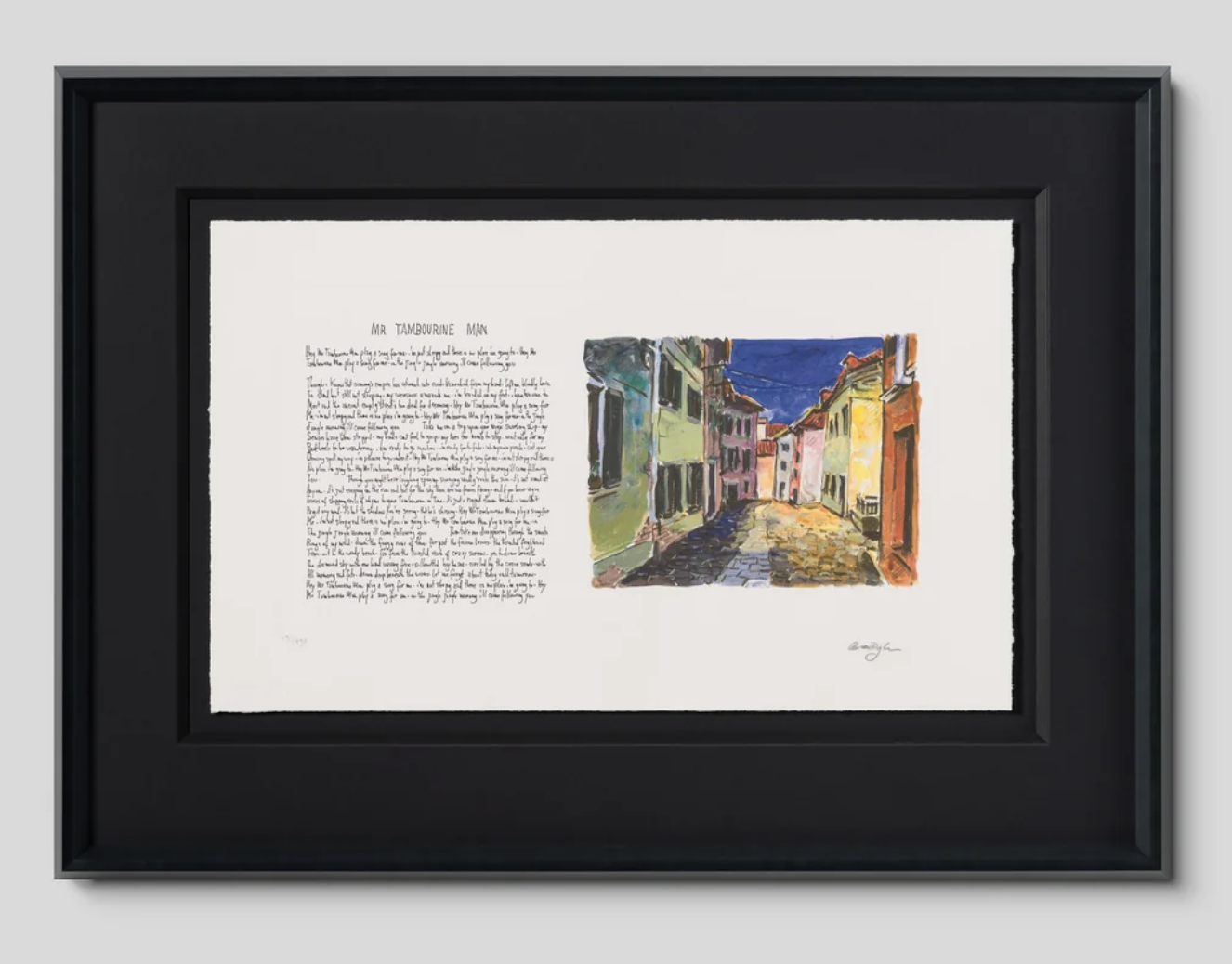
Bob Dylan, Mr Tambourine Man, 2026, Hand-coloured lithograph, 102.87 x 74.93 cm.
Image courtesy of Castle Fine Art.
This relationship between image and memory becomes particularly interesting when considered alongside Mondo Scripto, another major project in Dylan's visual practice. First exhibited in 2018, the series pairs handwritten lyrics from some of his most celebrated songs with accompanying drawings. A 2026 collection revisits six songs from the period between 1964 and 1974, including The Times They Are A-Changin', Mr. Tambourine Man, Like a Rolling Stone, All Along the Watchtower, Lay, Lady, Lady, and Forever Young. Dylan's decision to illustrate his own songwriting creates an unusual dialogue between two artistic languages, allowing familiar lyrics to acquire new visual associations.
In Mr. Tambourine Man, for instance, an empty cobbled street beneath a deep blue sky translates the song's dreamlike atmosphere into an architectual landscape. Meanwhile, his illustration accompanying Like a Rolling Stone draws upon Paul Delaroche's depiction of Napoleon after his abdication in 1840. The fallen emperor becomes a visual counterpart to the song's exploration of social displacement and lost grandeur. Such references demonstrate that Dylan's visual practice is not simply an extension of his musical celebrity. It is an ongoing process of reinterpretation, in which literature, art history, personal memory and popular culture continually inform one another.
Perhaps this is where Dylan's work becomes most relevant to the present. We inhabit a visual culture in which images are produced, circulated and discarded at extraordinary speed. Social media platforms reward immediacy, spectacle and constant novelty, often leaving little room for sustained observation. Against this backdrop, Dylan's attention to ordinary environments feels quietly radical. His paintings do not demand that viewers recognise a particular political message or decode an elaborate symbolic system. They merely ask us to look.
This does not mean that his work is detached from the political dimensions of American life. The landscapes of The Beaten Path inevitably carry traces of the country's social and cultural history. Railway lines suggest industrial development and migration; roadside businesses evoke the changing fortunes of local communities; empty roads imply both possibility and abandonment. The American landscape becomes a record of collective experience, even when the people who inhabit it remain outside the frame.
Ultimately, Dylan's impact as an artist cannot be measured solely through his influence on popular music or his recognition within literary institutions. His visual work demonstrates a sustained commitment to experimentation and to finding artistic significance in unexpected places. More than anything, The Beaten Path reminds us that the value of an image does not necessarily depend upon its subject being extraordinary. Sometimes, the most revealing portrait of a country is not found in its monuments, political institutions or celebrated landmarks, but in the places through which its people quietly pass.
In an era when being seen often takes precedent over the act of seeing, Dylan offers a different proposition. Perhaps the most meaningful artistic act is not always to create something new, but to notice something that has been there all along.
Bibliography
Castle Fine Art. "Bob Dylan." Accessed 5 November 2026. https://www.castlefineart.com/en-us/collections/bob-dylan.
Castle Fine Art. "The Beaten Path | Summer 2026." Accessed 5 November 2026. https://www.castlefineart.com/en-us/collections/the-beaten-path-2026.
Castle Fine Art. Mondo Scripto: Bob Dylan. 2026.
The Art Institute of Chicago. "Nighthawks." Edward Hopper, 1942. https://www.artic.edu/artworks/111628/nighthawks