By Eleanor Martin
Anglo-Saxon art deploys a richly patterned, inventive visual language to encode complex narratives within its forms. In a society where literacy was largely confined to the Church and the aristocracy, images served as a vital medium of communication, and the ability to read them was an essential skill. Much like the literary riddles of the era, which served both as oral entertainment and as teaching tools in early medieval classrooms to cultivate mental agility and spiritual reflection, these artworks conceal an internal logic beneath energetic ornamentation. Both riddles and visual art delight in puzzles and ambiguities, rewarding close study with the quiet revelation of meaning.
Shaped by the artistic traditions of the Germanic and Scandinavian regions from which Anglo-Saxon settlers migrated, early Anglo-Saxon metalwork was densely patterned with stylised animals. Over time, this zoomorphic ornament grew increasingly rhythmical. Though these designs often appear chaotic at first glance, they are governed by strict rules of visual order. To the Anglo-Saxon eye, each image was a miniature cosmos, arranged as deliberately as the divinely ordered natural world – an order that reveals itself only through patient contemplation.
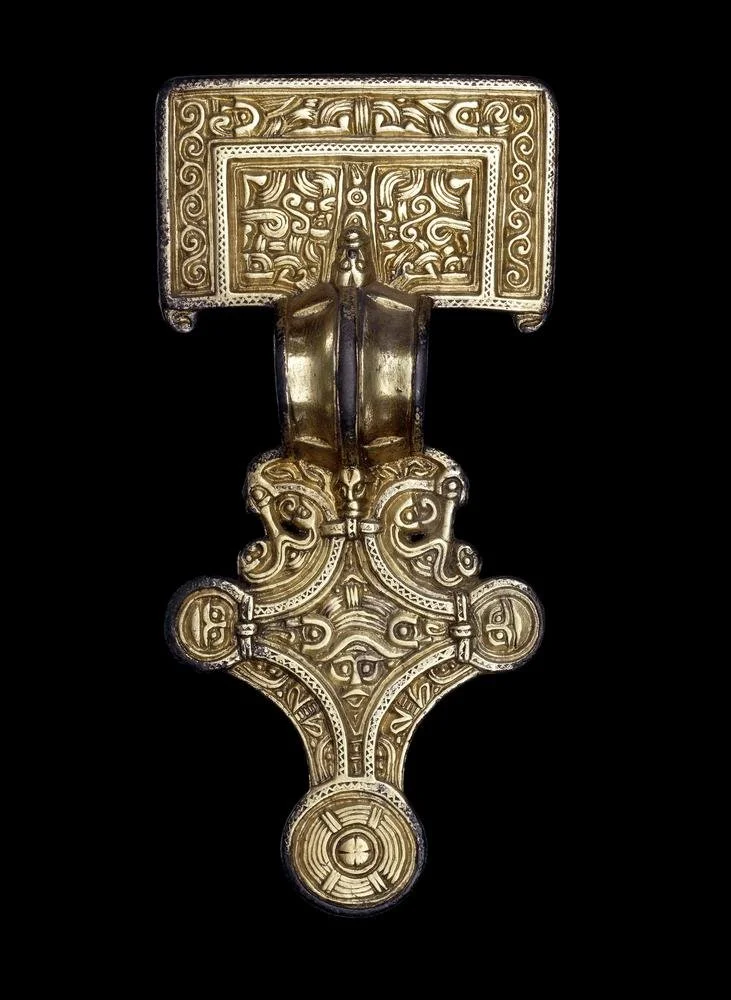
Square-headed brooch, early 6th century, from Grave 22, Chessell Down, Isle of Wight.
Image courtesy of The Trustees of the British Museum.
Nowhere is this clearer than in a square-headed brooch from an Anglo-Saxon woman’s grave at Chessel Down on the Isle of Wight. At its centre, a bearded face flanked by bird-like creatures acts as an apotropaic charm to ward off evil, likely depicting the god Woden with his two ravens. Surrounding him, human, animal, and hybrid forms interlock to mirror a natural world in which humans and beasts are at once adversaries and allies. Beyond offering spiritual protection, such brooches broadcast coded details about the wearer’s social standing and dynastic lineage, compressing complex cultural information into intricate, portable talismans.
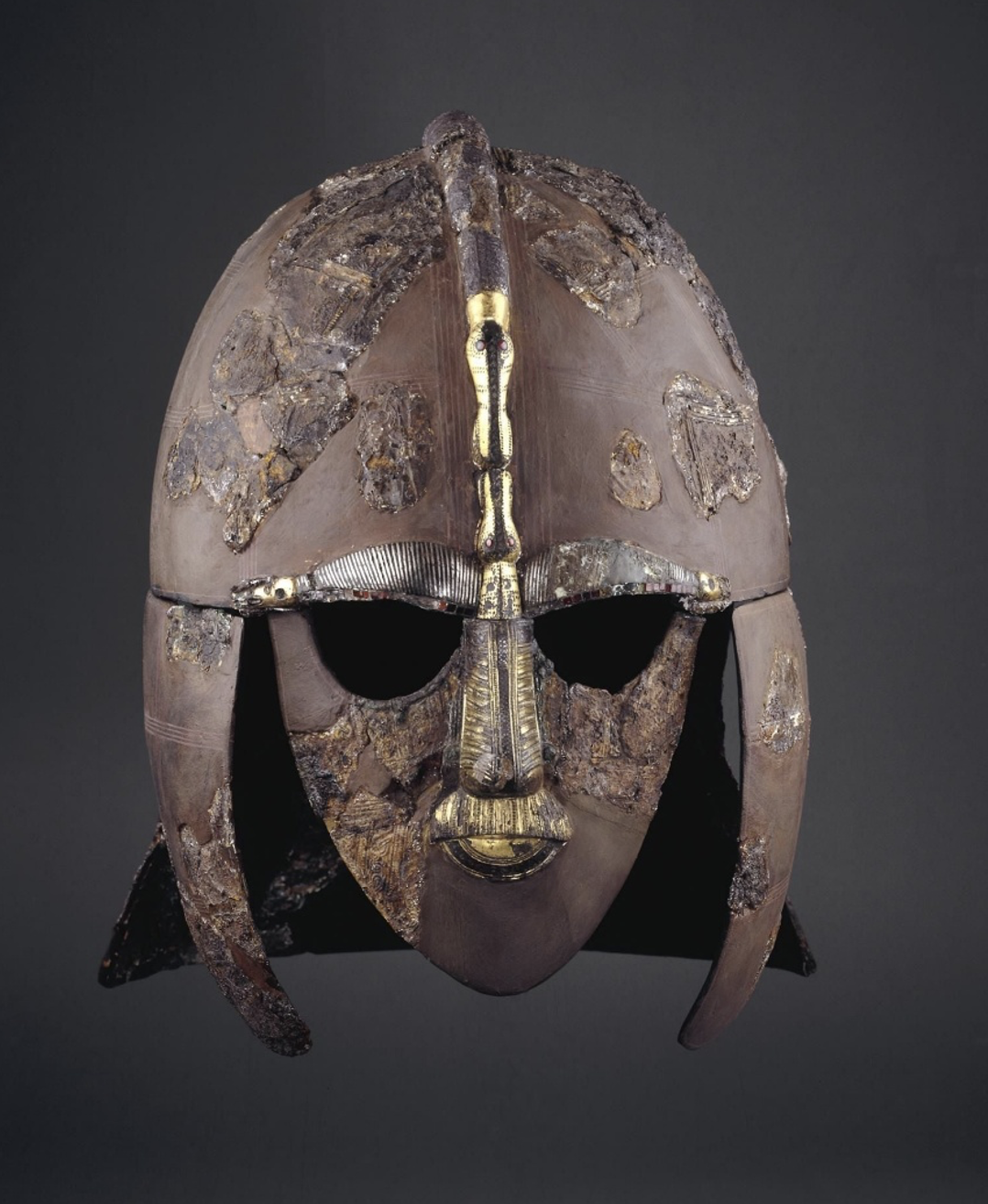
Square-headed brooch, early 6th century, from Grave 22, Chessell Down, Isle of Wight.
Image courtesy of The Trustees of the British Museum.
Early Anglo-Saxon metalwork also revels in visual double entendres, crafting forms that shift depending on how they are viewed. The frowning face of the Sutton Hoo helmet is a masterclass in this: on close inspection, its brows, nose, and moustache become a flying dragon with outspread wings. This guardian was meant to shield its wearer in battle, much like the bearded deity on the Chessel Down brooch. Similarly, an eighth-century silver-gilt sword pommel from Oxfordshire appears unremarkable until inverted, revealing a horned animal mask.
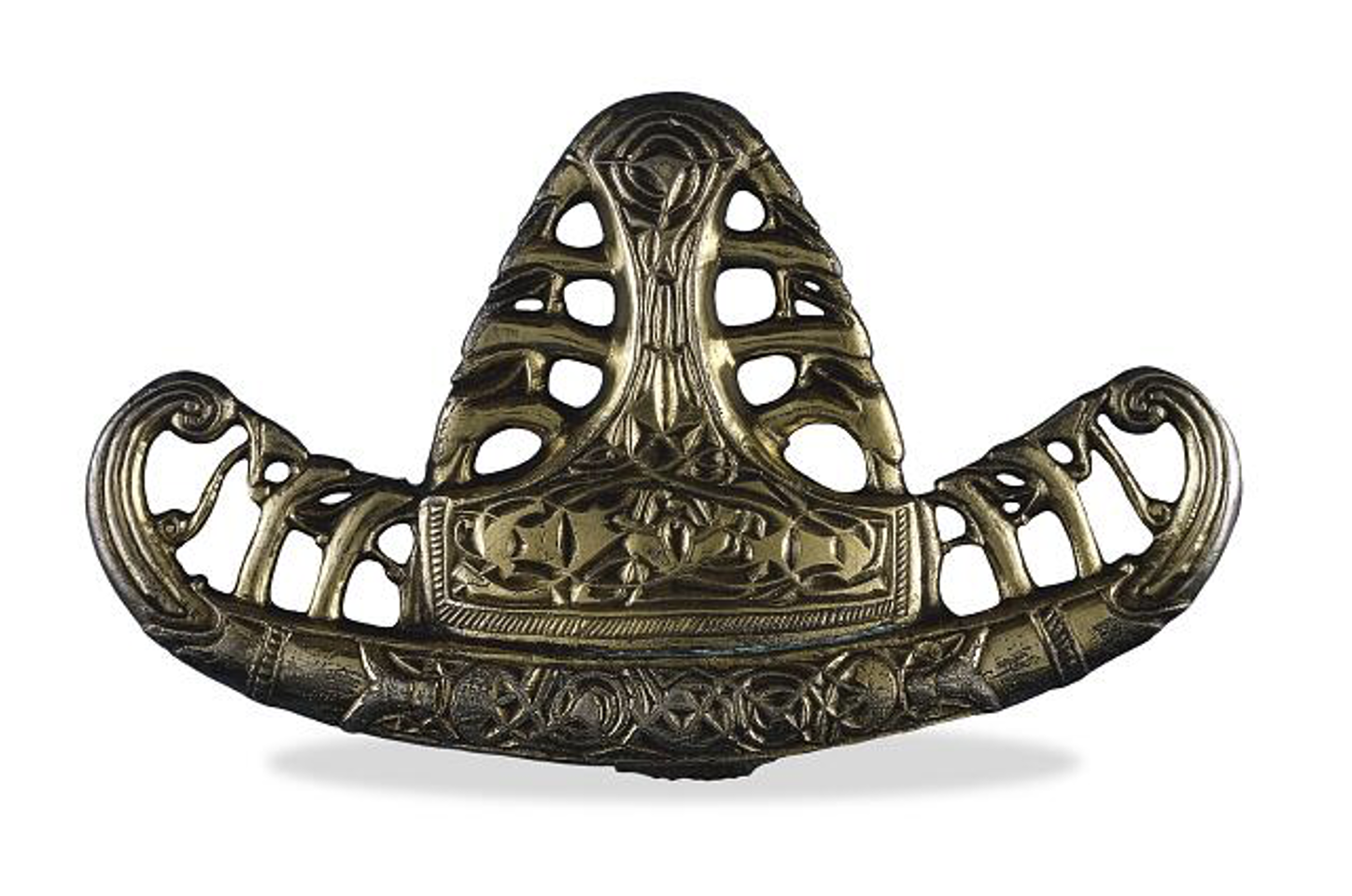
Openwork silver-gilt sword pommel, late 8th century, from Royal Oak Farm, Oxfordshire.
Image courtesy of The Trustees of the British Museum.
Just as these objects conceal wondrous creatures within their physical forms, the Old English riddles of the Exeter Book cloak their subjects in metaphor, often to humorous effect. In Riddle 51, for instance, a quill and a scribe’s fingers are called "wondrous creatures" leaving black tracks as they travel together across a page. By hiding beasts and mythical figures in metal, artisans seemed to animate the inanimate; similarly, the Exeter Book riddles celebrate the life-giving power of poetry by lending voices to silent objects, as in Riddle 5, where a battered shield laments the bruises it endures in battle.
Following the Christian Conversion, illuminated manuscripts absorbed Eastern Mediterranean influences, reflecting the far-reaching networks of cultural exchange connecting Anglo-Saxon Britain to the wider world. Yet their whirls, abstraction, and labyrinths of birds and beasts remain deeply rooted in native metalwork traditions. By echoing the aesthetic of luxury objects like the Chessel Down brooch, these manuscripts foreground their own craftsmanship and proclaim the sacred value of the written word.
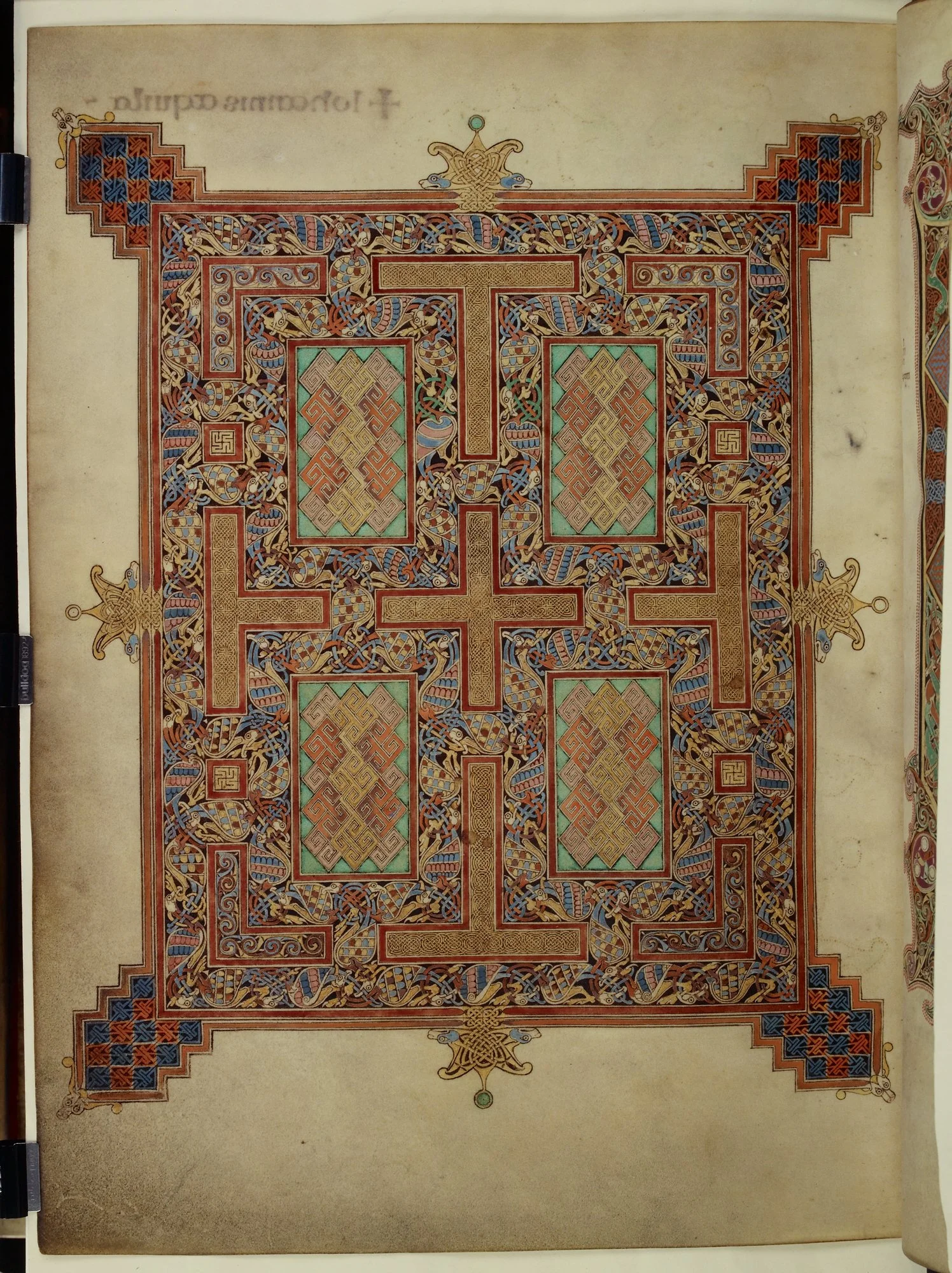
Carpet page for 'Gospel of John’, Lindisfarne Gospel, c. 700.
Image courtesy of British Library Board.
In the carpet pages of the Lindisfarne Gospels, produced at the monastery of Lindisfarne in the early eighth century,linear and zoomorphic interlace, spirals, and key-and-step patterns pulse with spiritual energy. What initially looks like a restless tangle of lines soon resolves into a disciplined geometric framework. Each carpet page is anchored by a rectilinear grid, with the tiny prick marks used to map them out still visible on the parchment. Within this predetermined geometry, ornament swirls into seemingly organic life, staging a visual tension between strict order and unruly energy. Like the metalwork brooches, each carpet page is a microcosm of the Christian universe, mirroring the monastic pursuit to untangle earthly mystery and uncover divine design. Across the manuscript's carpet pages,the cross gradually dissolves into pure ornament until only the ghost of a cruciform shape remains—a visual echo of the Exeter Book riddles, where truth hides behind layers of poetic adornment.
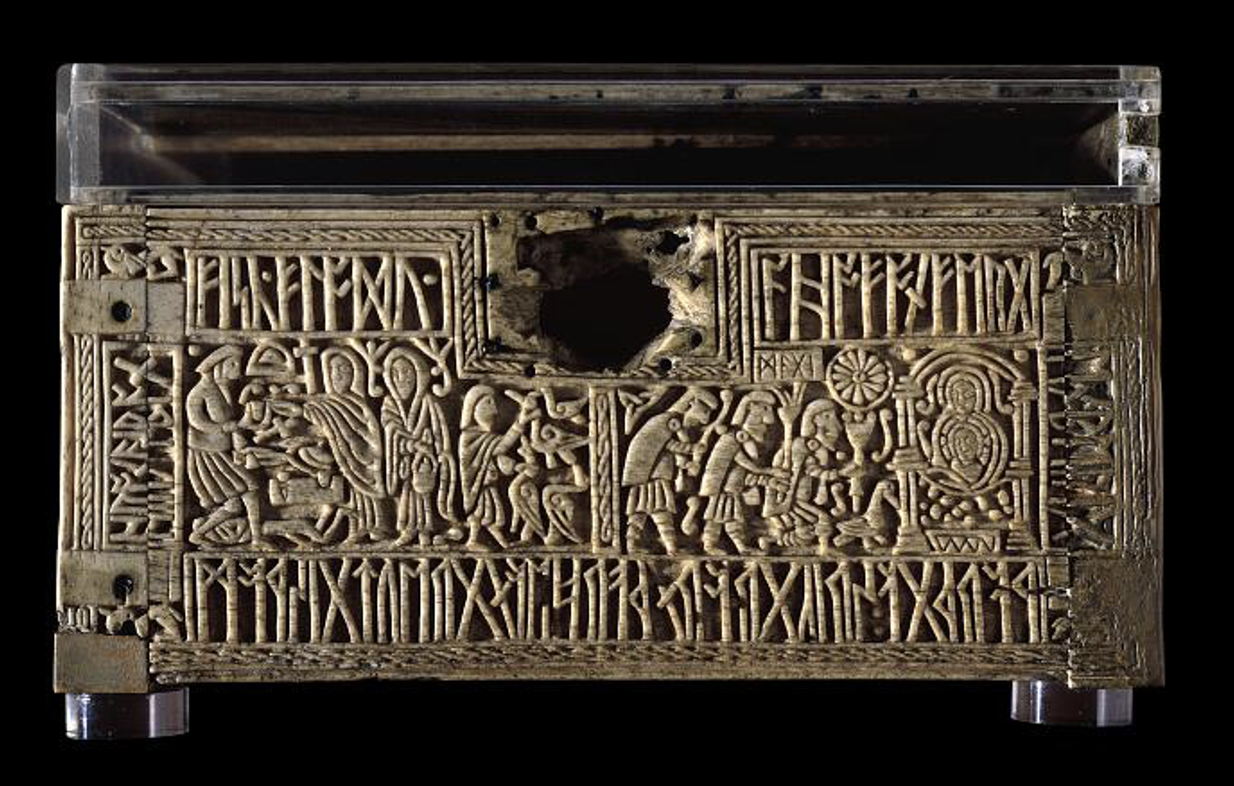
The Franks Casket, early 8th century.
Image courtesy of The Trustees of the British Museum.
The Franks Casket, a whalebone box likely carved in Northumbria in the early eighth century, is a riddle unto itself. Its panels bring together scenes from Germanic, Roman, and Christian tradition: the legend of Weland the Smith, Romulus and Remus, the Adoration of the Magi, and Titus’s sack of Jerusalem. What looks at first like an eclectic medley of pagan and Christian lore is in fact a unified cosmological vision. Drawn likely from a world chronicle, the iconography reflects the Church’s view of universal history, in which all human events culminate in Christ’s incarnation.The carvings are also pointedly paired: on the front panel, the Adoration of the Magi sits directly beside Weland the Smith. Both scenes explore themes of gift-giving and lordship, suggesting the casket may have held a gift from a monastic leader to a secular patron. Inscribed along the front is an Old English riddle describing the stranding of the very whale whose bone forms the box. This is a marrying word and image in a design where, as in metalwork and poetry, clear meaning emerges from an initially mystifying surface.
Ultimately, it is this sly, cunning intelligence that gives Anglo-Saxon art its enduring power. Like the riddles of the Exeter Book, early metalwork and later manuscripts thrive on visual wit, metamorphosis, and hidden structure.Abstract lines resolve into birds and horned masks; a turbulent web of interlace reveals a hidden cross. By compressing layers of meaning into tight visual fields, these works invite the viewer to look closely—turning the act of observation into a mirror of monastic contemplation, where patient study untangles the divinely ordered fabric of the world.
Bibliography
Abels, Richard. “What Has Weland to Do with Christ? The Franks Casket and the Acculturation of Christianity in Early Anglo-Saxon England.” Speculum 84, no. 3 (2009): 549–81.
Guilmain, Jacques. “The Composition of the First Cross Page of the Lindisfarne Gospels: ‘Square Schematism’ and the Hiberno-Saxon Aesthetic.” The Art Bulletin 67, no. 4 (1985): 535–47.
Osborn, Marijane. “The Picture-Poem on the Front of the Franks Casket.” Neuphilologische Mitteilungen 75, no. 1 (1974): 50–65.
Swenson, Inga Christine. “The Symmetry Potentials of the Ornamental Pages of the Lindisfarne Gospels.” Gesta 17, no. 1 (1978): 9–17.
Webster, Leslie. Anglo-Saxon Art. New York: Cornell University Press, 2012.