By Sakura Mogami
Film clip from Damien Chazelle, La La Land, 2016.
Video courtesy of Youtube.
This year celebrates the tenth anniversary of Damien Chazelle’s La La Land (2016) first gracing the silver screen with a fantastical reimagining of Los Angeles and its landscape of technicolor motion pictures and ambitious inhabitants. The film follows the romance and rise of the leads Mia (Emma Stone), an aspiring actress working part-time as a cafe barista, and Seb (Ryan Gosling), a struggling Jazz musician.
An unexplored cinematic subject of analysis is the film’s imagery redolent of past American Modernist art, which unintentionally and esoterically enhance the movie’s emotional impact. Take the opening sequence: overlooking a Los Angeles highway, the music from a car radio crescendos exuberantly, and the viewer is swept into an immersive musical sequence that transforms the mundane reality of traffic into a vibrant theatrical spectacle. As the viewer cruises between the gridlocked vehicles, performers emerge from their cars, engulfing the audience in a constellation of meticulously choreographed dancers in every colour of the rainbow, their vivid clothes juxtaposed against the clear sky. The lyricism of Another Day of Sun establishes the imperative vitality of the youth flocking to LA to pursue their dreams.
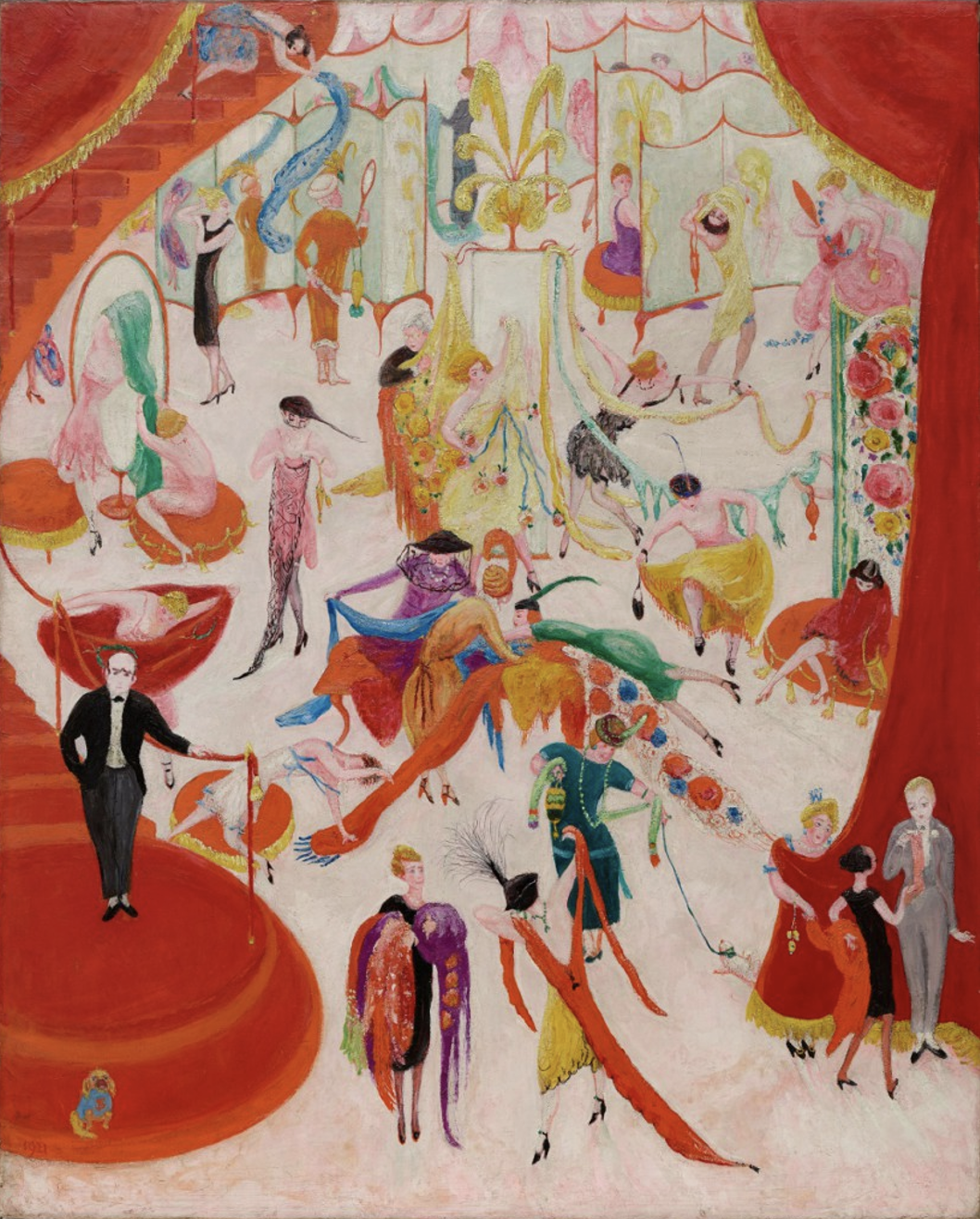
Florine Stettheimer, Spring Sale at Bendel’s, 1921, oil on canvas, 127 × 101.6 cm, Philadelphia Museum of Art (1951-27-1).
Image courtesy of Panorama.
These visuals draw similarities to works of Flourine Stettheimer, who emerged in the 1920s within a landscape of budding modernism, industrial growth, and cultural redefinition. The art world was marked by an influx of unique artistic styles, grouped under the umbrella of American Modernism. Her work Spring Sale at Bendel’s demonstrates her blending of different visual practices, like vibrant use of colour borrowed from the Fauvists and the whimsical subject of the Surrealists that defined her unique artistic identity. Depicting a scattered disarray of colorful department store shoppers, Spring Sale at Bendel’s features animated women leaping and reaching for dresses, dragging and flailing long garments as they fulfil their shopping desires – each figure is rendered with thoughtful detail.
This precision in individual representations draws significant visual parallels to the multi-colored performers of “Another Day of Sun”. Both Stettheimer and Chazelle convey an appreciation for the collective intimacy that can emerge from being anonymous in a crowd where everyone longs for greater purpose. They evoke a sense of sonder — the epiphany that all individuals possess an equally lively inner world of aspirations and anxieties.
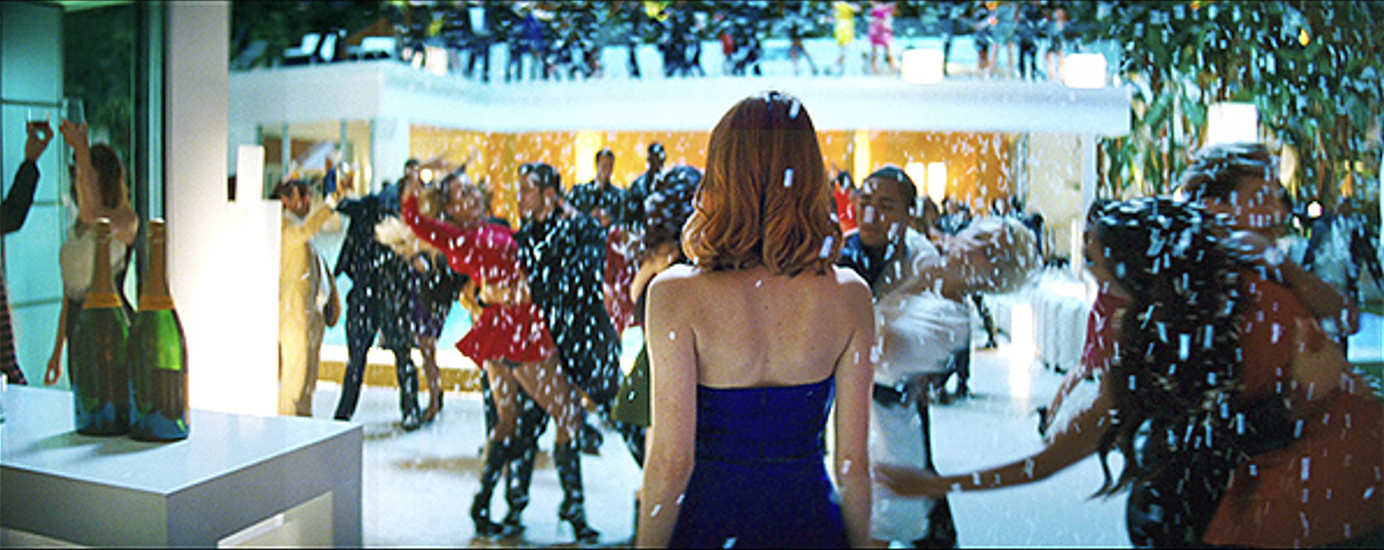
Still from Damien Chazelle La La Land 2016.
Image Courtesy of Seeing Stars.
Spring Sale at Bendel’s is also an inherently culturally critical piece, commenting on the excesses of gilded modernity, and its championing of superficial consumption. Yet, Stettheimer herself grappled with a moral contradiction: despite her critique of material excess, she occupied the upper echelons of New York society as a salonnière and patron of high fashion. She was therefore acutely aware of her own complicity in the consumer culture she satirised, embodying the tension between personal desires and the moral contradictions of participating in capitalist society.
Similarly, later in the film, Mia questions whether attending an upper-crust Christmas party is worth dealing with the ostentatious displays of wealth and the superficial social rituals of Hollywood's elite. Mia ultimately attends the party, and though she recognises that professional success requires navigating these networks, she remains torn between the material promises of the industry and her desire for authentic artistic expression and human connection.
Stettheimer’s multicolored shoppers and La La Land’s partygoers share an almost insect-like appearance, their densely clustered figures seemingly scurrying in pursuit of an elusive ideal. Their diminutive scale and repetitive movements evoke the image of ants, rendering them minuscule yet undeniably determined cogs within the relentless machinery of commercial success. There is an underlying vanity, alongside a pathos, in their collective pursuit of recognition, reinforced by their uniform movements and subordination to the wider social environment. This moral tension mirrors Stettheimer's own contradictory relationship with consumer culture: both works expose the seductive spectacle of social ambition and authentic creative endeavor while questioning what must be compromised in its pursuit. Yet, the bright red curtains framing Stettheimer’s department-store scene, alongside the camerawork following Mia’s physical navigation of the otherwise stagnant party, complicate the viewer’s position as a detached observer. Instead, these visual devices implicate the audience within the very systems being scrutinised.
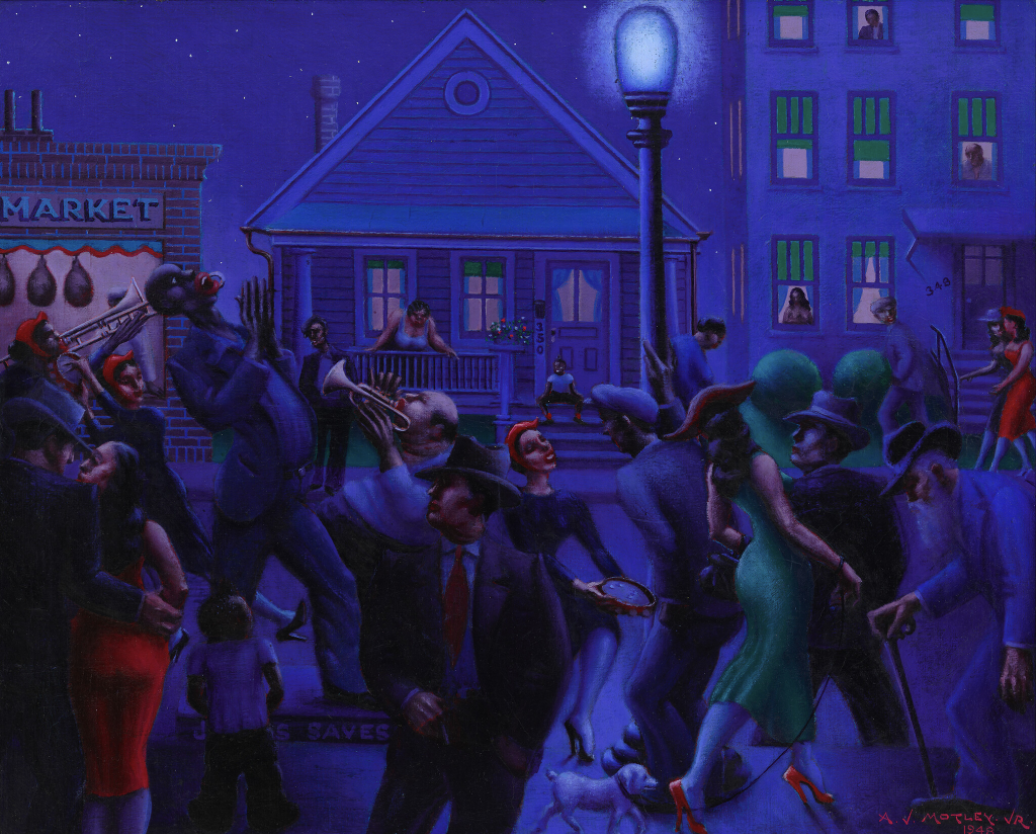
Archibald John Motley Jr., Gettin’ Religion, 1948, oil on linen, 32 × 39 7/16 in. (81.3 × 100.2 cm), Whitney Museum of American Art, New York.
Image courtesy of Whitney Museum of American Art.
American Modernism saw the rise of the Harlem Renaissance movement, reflecting another dimension of 1920s American life celebrating African American artistic expression and cultural identity. Harlem Renaissance art encompassed a diverse range of styles, but frequently featured dynamic geometric compositions, and vibrant colour palettes. Archibald Motley emerged as one of the movement's most celebrated figures, renowned for his evocative portrayals of jazz culture. Given that Seb's passion and devotion to jazz is integral to the film's narrative, it is unsurprising that La La Land draws upon the visual language of this era.
Works like Motley’s Gettin’ Religion honour jazz, capturing its capacity to bring communities together through rhythms that inspire dance and collective musical expression. Bathed in a vivid purple, Gettin’ Religion showcases a lively nighttime scene where diverse townspeople gather to socialise and perform music. The background outlines a compositionally cohesive streetscape, featuring a home, local store, and apartment complex with citizens eagerly overlooking the ensemble below. The calculated uniformity of the surrounding structures is juxtaposed by the energetic musicians and pedestrians in mid-swing and sashay – amplifying the sense of communal unity impassioned by jazz.
Film clip from Damien Chazelle, La La Land, 2016.
Video courtesy of Youtube.
Similarly, in La La Land’s purple-bathed musical number “A Lovely Night”, the Mia and Seb, whose chemistry is conveyed through their fluid theatrical dance, are framed against a compositionally harmonious flat plane, punctuated by a simple rectangular bench, linear tree and streetlight. Likewise, Gettin' Religion’s overall cool-toned palette is punctuated by sporadic bright red accents placed throughout the piece. Keeping the eye jumping from one focal point to the next, this interplay of colour and movement captures the mercurial beauty of the moment. The impulse to find and hold onto fleeting moments persists, even amid the relentless pace and turbulence of the modern world. Meanwhile, in the bustling crowds of the Lighthouse Jazz Club, as Seb plays the piano and Mia dances amongst the other guests, the camera’s back-and-forth pans create a sense of disorientation; yet, recurring red accents of the stained-glass window in the background and Mia’s dress, visually anchor the audience. These recurring red accents provide momentary visual stability amidst the ever-shifting scene, mirroring the pair’s evolving relationship as they brave the hectic Los Angeles landscape to pursue their creative passions. Although the central romance differs from the African American cultural experience underpinning the Harlem Renaissance, the film’s visual references similarly celebrate artistic expression, and the timeless beauty of jazz capable of sparking soulful human connection.
La La Land’s visuals reminiscent of previous American Modernist styles, like the Stettheimer’s musings on sonder and grapplings with social ambivalence; and Motley’s Harlem Renaissance works underscoring the enchanting potency of jazz – deepen the film’s storytelling. These visuals further highlight the intimate alcoves of Mia and Seb’s pendular relationship, within the vivacious yet disorienting kaleidoscope of Hollywood as they pursue their respective dreams in the City of Stars.
Bibliography
Hole, Heather. 2017. “Florine Stettheimer, the Department Store, and the Spaces of Display, New York 1916–1926.” Panorama. https://journalpanorama.org/article/florine-stettheimer/.
MovieClips. 2018. “La La Land (2016) - a Lovely Night Scene (5/11) | Movieclips.” YouTube. YouTube Video. https://www.youtube.com/watch?v=_8w9rOpV3gc.
ScreenWEEK. 2017. Another Day of Sun - La La Land Opening Scene. YouTube. Video. https://www.youtube.com/watch?v=xVVqlm8Fq3Y.
The Lighthouse Cafe. n.d. “La La Land.” The Lighthouse Cafe. https://www.thelighthousecafe.net/la-la-land.
The Whitney Museum of American Art. n.d. “Beyond Documentation: Davarian Baldwin on Archibald Motley’s Gettin’ Religion.” Whitney.Org. https://whitney.org/whitney-stories/archibald-motley-in-the-whitneys-collection.
Www.Seeing-Stars.Com. n.d. “La La Land - Filming Locations: The Pool Party (Someone in the Crowd ).” https://www.seeing-stars.com/Locations/LaLaLand/4-ThePoolParty.shtml.