
Animal Labor Across Oceans: Silk, Camelids, and Transoceanic Textile Economies
By Natalia Ramirez
Between 1500 and 1700, Latin America served as an intensively saturated intercultural contact zone, fostering complex mobility throughout the early modern world. Andean and Mesoamerican artistic textile traditions were layered with Iberian colonial rule and trans-Pacific currents carrying Asian silks across the vast Pacific. Early Modern Central and South American art was composed through the labor of animals and environments that made intercultural and translocal media possible: silkworms’ shimmering threads that bridged oceans and camelids that shaped Andean cloth. These beings did not simply supply materials; they structured how textiles could be created, combined, and understood across regions. Silk and camelid fiber did not travel alone; they traveled with life cycles, climates, adaptations, and vulnerabilities. In this way, textile production emerged through interactions between human intention and animal product and labor, establishing relations between local ecologies and long-distance exchange.
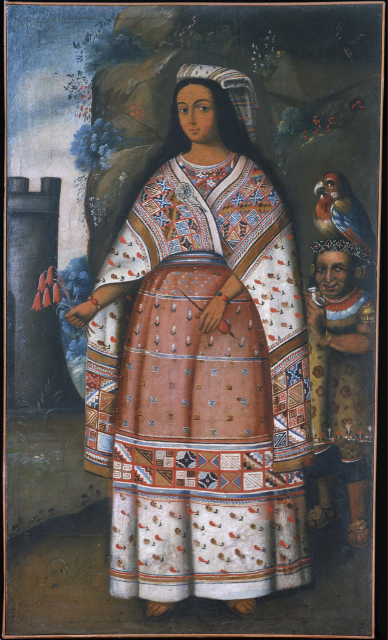
Artist not Currently Known, Portrait of a Nusta (wearing woven garments reflecting pre- and post-conquest elements), 1700-1750, Cuzco, Peru.
Image Courtesy of Fordham University.
Throughout Central and South America, cloth emerged from multispecies interactions. Camelids grazed the high Andes, and their fibers were spun into textiles that offered warmth, conferred status, and sustained cosmology. Across the Pacific, silkworms spun their cocoons in East Asia, yet their threads exerted influence and were integrated throughout the Americas. These beings were not silent resources. Their bodies, behaviors, and vulnerabilities shaped what textiles could become. Materials were not inert; they were alive with memory, relationships, and motion. Textiles in Early Modern Latin America offer profoundly clear views of ecological agency reconfigured for utility, decoration, status, and veneration. Fibers cannot be separated from the animals that grew them, the landscapes that sustained such animals, or the practices that extracted, traded, and transformed their products into textiles. Within enduring Andean weaving traditions, camelid wool and imported silk engaged in dialogue, influencing stylistic adaptations and material blends, thus braiding new ideas with longstanding practices.
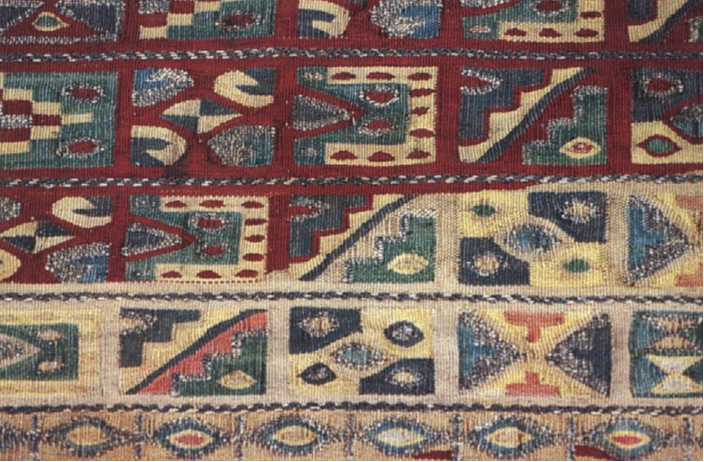
Artist not Currently Known, Front of woman's mantle with tocapu, showing silk and metallic threads (detail, cat. no. 39), 17th century, Peru.
Camelids, namely alpacas, llamas, and vicuñas, who adapted to the high Andes’ often intense climate, produced fibre whose fineness, warmth, and durability defined the structure of Andean cloth. These textiles carried cosmological significance long before colonial intervention, encasing social order and relational knowledge in both structure and pattern. When Asian silks arrived via trans-Pacific routes such as the Manila Galleons, their sheen and delicacy were absorbed by Andean artists and the systems they used to create textiles. Indigenous weavers did not merely apply foreign threads; they re-authored them. The silk’s unique shimmering appearance, known in Spanish as tornasol, appealed to Andean artists and prompted attempts to recreate and reinterpret it into their own camelid-based compositions. Denise Arnold describes their experimentation, stating ‘they observe how silk’s characteristic lustre and iridescence were reworked by these weavers.’ Silk entered tocapu (Incan geometric patterns) grammars and Andean weaving methods, becoming legible within local material languages. In these cloths, animal labor crossed oceans and was translated into new forms of visual culture. Here, agency was spun, stretched, and woven, converging bodies, fibres, and beliefs.
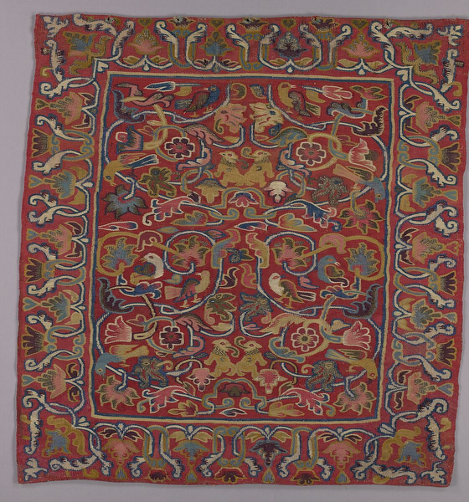
Artist not Currently Known, Seat cover, Tapestry weave: cotton warp and camelid hair, silver gilt, and silk weft, late 17th–early 18th century, 52.5 x 49.5 cm.
Image courtesy of The Metropolitan Museum of Art.
Textiles offer insight into how deeply ecological and interlocal histories are woven together. Long before the Spanish conquest, Andean weavers produced cumbi, the royal cloth of vicuña and alpaca fibre so fine it had its own tornasol-like appearance. These textiles were derived from camelid ecologies, seasonal shearing, and the disciplined labor of sequestered aclla women, who created and refined a range of media productions. Cumbi did not simply clothe bodies; it articulated political order and cosmological belonging, something that the acalla women were revered for sustaining. When Asian (predominantly Chinese) silks began to arrive in the Americas, they were smuggled into what is now Peru by mule-drawn carriages. Wim De Winter argues that the silks’ illegal entry into Peru enabled various social classes to purchase and circulate them through markets and independent trade, ultimately leading to stylistic and material imitation and integration. These material relations among Andean artists provide evidence that cultural transmission and translation were not facilitated solely by colonial power, but by a wider variety of interlocal and interspecies interactions.
Similarly, textile convergences occurred in Mexico with the rebozo (woven garment worn over the shoulders), a wearable piece of ecological conversation. Local cotton (grown from soil, climate, and irrigation) met imported Asian silk delicately melded by silkworms and sericulture. These fibres were dyed with insect and plant derivatives, meticulously organised by hands trained through generations of practice, and worn in daily life. The rebozo did not imitate Europe; it metabolised the Pacific. De Winter notes that Asian silks were often preferred to European textiles when they circulated and were integrated within Central and South American material culture. In this instance, cotton and silk did not compete; they formed a woven dialogue designed to maintain tradition whilst experimenting with the optics of new materials. The result was cloth shimmered from silk and woven through cotton.
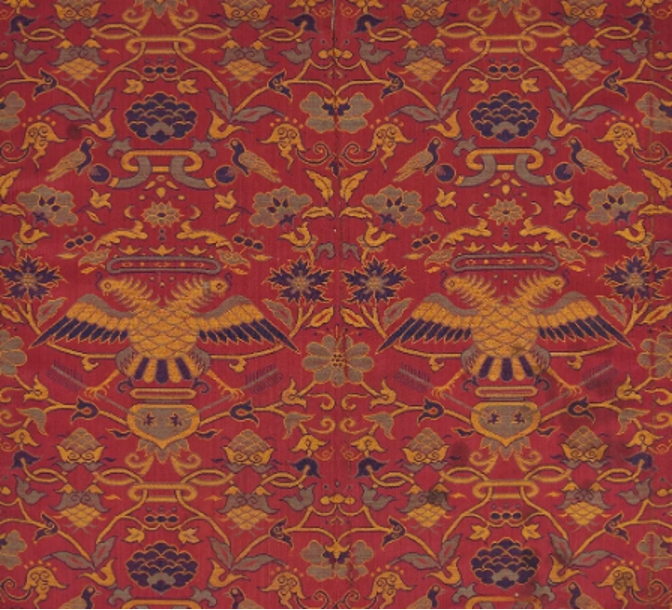
Artist not Currently Known, Textile with Crowned Double-Headed Eagles, Second Half of 16th Century, Macao, China or Iberian Market.
Image courtesy of The Metropolitan Museum of Art.
Similarly, Chinese silks produced in Macao for Iberian markets often did not remain unchanged when they circulated in Peru. In Andean workshops, they were deconstructed, embroidered, rewoven, and brought into dialogue with tocapu designs. Even the ocean altered the silk’s materiality, with humidity softening the threads, salt tarnishing the sheen, and time shifting the texture. These textiles are not mere expressions of culture; they are documents of relations among species, climates, and laborers. Mobility in global art history spans far beyond the spread of styles. Exemplifying Early Modern Latin America, what moved were substances, fibers, feathers, dyes, and clays, each carrying the memory of the environments, hands, and imaginations that produced them.
As these substances entered new ecological systems, their uses and meanings shifted. Cochineal red meant something different in an Andean mantle than in a Venetian painting. Silk refracted light differently in a Peruvian highland climate than in a Chinese court – materials that adapted to shifting environments, just as their multispecies predecessors had done for millennia. To recognise nonhuman agency is not to sensationalise or mythicise nature, but rather to acknowledge that art has been sustained by lives and forces beyond human ideals or manipulations. Insects lived and died for pigment. Animals shed fiber. Winds altered routes. Storms delayed the arrival. Early Modern Latin America demonstrates that art history must listen to the matter by which it is made possible. Objects, as cultural texts, are ecological stories that encompass full cycles of life in their labor. Here, the world did not merely circulate through human hands; it navigated bodies, climates, and seas. Latin America has long been a centre where species meet, materials engage, and art becomes a form of ecological memory.
Bibliography
Arnold, Denise Y. “Tornasol Techniques as Cultural Memory: Andean Colonial Practices of Weaving Shimmering Cloth, and Their Regional Forebears.” In In-Between Textiles, 1400-1800: Weaving Subjectivities and Encounters, edited by Beatriz Marín-Aguilera and Stefan Hanß, 217–238. Amsterdam: Amsterdam University Press, 2023.
Baker, Steve. Artist/Animal. Minneapolis: University of Minnesota Press, 2013.
de Winter, Wim. Silently Smuggled and Invisibly Dyed: The Trans-Pacific Smuggling of Semi-processed Asian Textiles and Peruvian Bullion in the Spanish Colonies and at Sea, 1547-1800. Working Paper No. 35, Commodities of Empire, June 2022.
Gephart, Emily, and Michael Rossi. “Feathered Designs: Ecology, Labor, and Aesthetics.” In A Cultural History of Plants in the Enlightenment, edited by Ann Shteir and Theresa Kelley, 137–55. London: Bloomsbury, 2019.
McHugh, Julia. “Andean Textiles.” Heilbrunn Timeline of Art History, The Metropolitan Museum of Art, June 1, 2020.