The Year of the Horse: On Motion, Myth and the Eternal Gallop
By Hanna Yoon
There is something about a horse that refuses to stay still – even in paint, even in bronze, even frozen in the amber of a cave wall thirty thousand years old. The horse is, perhaps, the first subject art ever truly loved. Long before the Salon, long before the Academy, long before anyone thought to argue about what beauty meant, a human hand pressed pigment into limestone and gave the world its most enduring image: the horse, mid-stride, already leaving.
The Chinese Year of the Horse carries this ancient restlessness in its very bones. To be born under the horse, or to live through its year, is to inherit a certain electricity – an insistence on forward motion, on freedom uncontained by fence or frame. The horse in Chinese cosmology is not merely an animal but a temperament: spirited, charismatic, and magnetic in the way that fire is magnetic – drawing the eye precisely because it cannot be held. In a year governed by the horse, the old Chinese wisdom suggests, the world tilts toward momentum. Beginnings feel more like beginnings. Departure becomes its own kind of arrival.
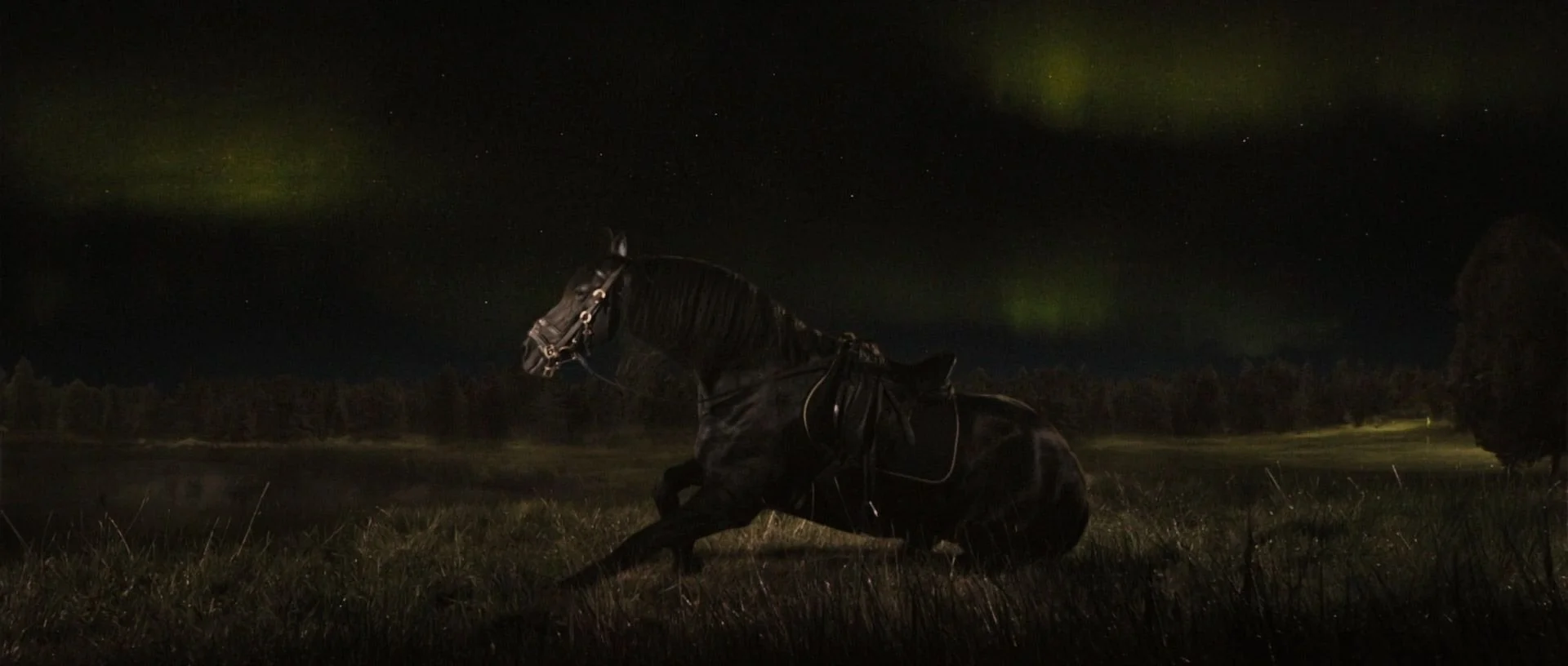
Film still from Lars von Trier’s Melancholia, 2011.
Image courtesy of Diana Marin.
It is no accident that art history's most emotionally charged images so often place a horse at their centre – not as backdrop, not as symbol alone, but as the feeling itself made flesh. Lars von Trier understood this instinctively. The prologue of Melancholia (2011) – a slow-motion sequence set to Wagner's Tristan und Isolde – contains a single breathtaking image: a horse collapsing in extreme slow motion, folding backwards into a grey and lightless world. Von Trier reaches for the horse precisely when he wants to paint the end of forward motion itself. A filmmaker making a work about depression and apocalypse instinctively turning to the falling horse to signal extinction tells you everything about how deep this image runs in the human imagination. The horse has always meant momentum. To show its fall is to show the world stop.
Which is perhaps why the tradition of painting horses in full flight – in terror, in ecstasy, in the pure electricity of becoming – feels less like a genre and more like a counterargument. A refusal. A recurring insistence, across thirty thousand years of image-making, that the horse is still running.
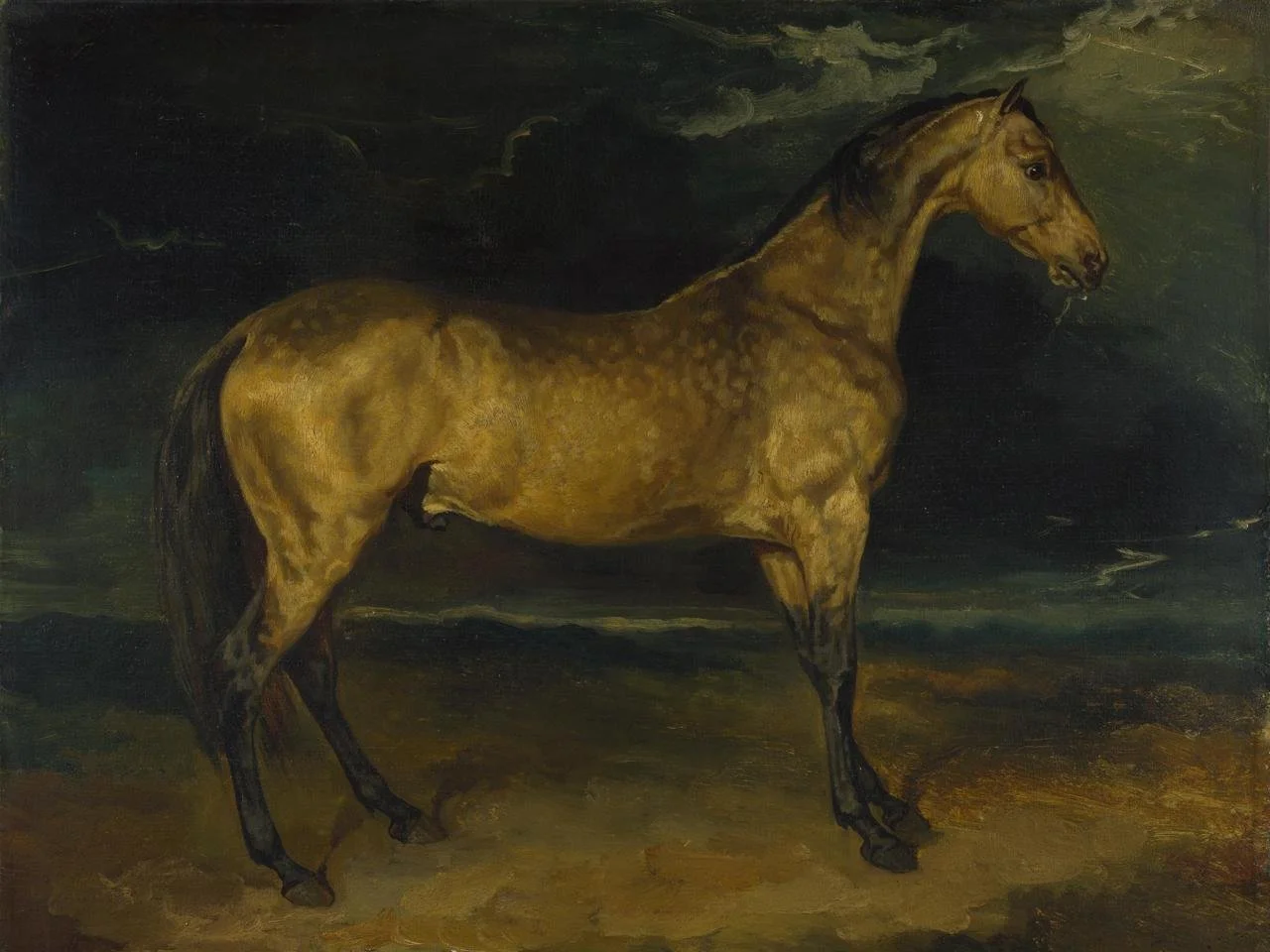
Jean-Louis-André-Théodore Géricault, A Horse frightened by Lightning, Oil on canvas, 48.9 × 60.3 cm.
Image courtesy of The National Gallery.
Consider Théodore Géricault, who spent his short, feverish life in what can only be described as a love affair with the horse. His Horse Frightened by Lightning (c. 1813-14) is less a painting than a confession. The animal rears against a bruised sky, its white coat incandescent with terror and beauty, every muscle a brushstroke of barely contained energy. Géricault understood what the Romantics understood above all else – that beauty lives precisely where control breaks down. The horse, rearing in that storm, is not afraid of the lightning – it is the lightning. To stand before this canvas is to feel the charge pass through the viewer – the voltage of a world on the edge of something new.
Géricault’s obsession was inherited, deepened, and made more lyrical by Eugène Delacroix, who watched his friend ride and painted what he saw – not horses, but freedom with a mane. In Horse Frightened by a Storm and across dozens of North African sketches made during his Moroccan journey, Delacroix gave the horse a quality no sculptor had quite managed – a sense that the animal existed slightly ahead of the moment capturing it, always already in the next second, always becoming. His brushwork mirrored this quality. The paint itself refused stillness. It moved in sympathy with the subject.
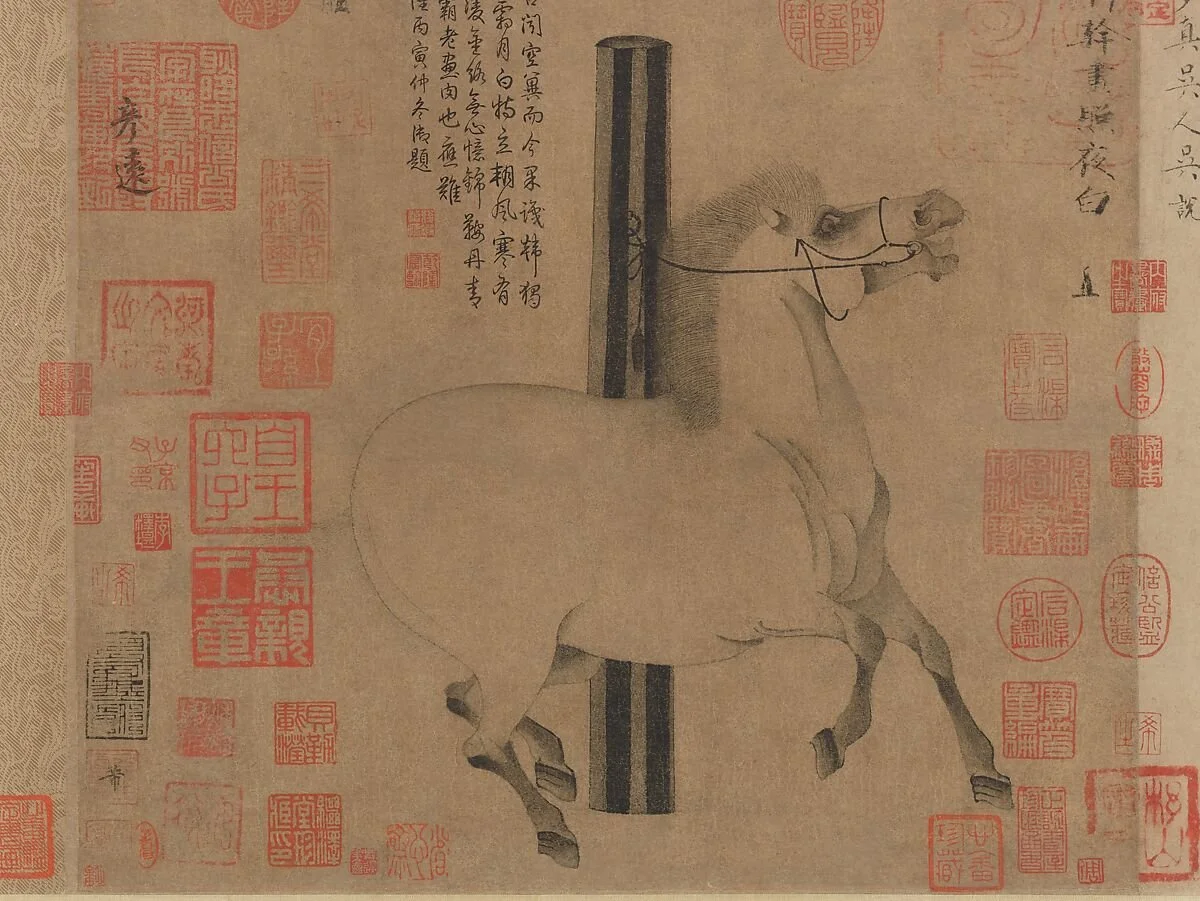
Han Gan, Night-Shining White, ca. 750, Handscroll; ink on paper, 30.8 x 34 cm.
Image courtesy of the Met.
But the horse’s relationship with painting is older than Romanticism, older than the Renaissance, older even than the Christian tradition that would briefly forget it in favour of the lamb. The Chinese painted horses with a reverence approaching the sacred. Han Gan, the Tang Dynasty master, was said by the Emperor to have studied not from earlier paintings but from the imperial stables themselves – learning the animal’s inner spirit, its qi, the life-force that no copying of style could ever transmit. His Night-Shining White (ca. 750), a single horse on a scroll, neck arched in something between pride and wildness, eyes wide with a light that seems to come from inside, remains one of the most intimate portraits ever made of any living creature. The horse looks back at you as it has always looked back.
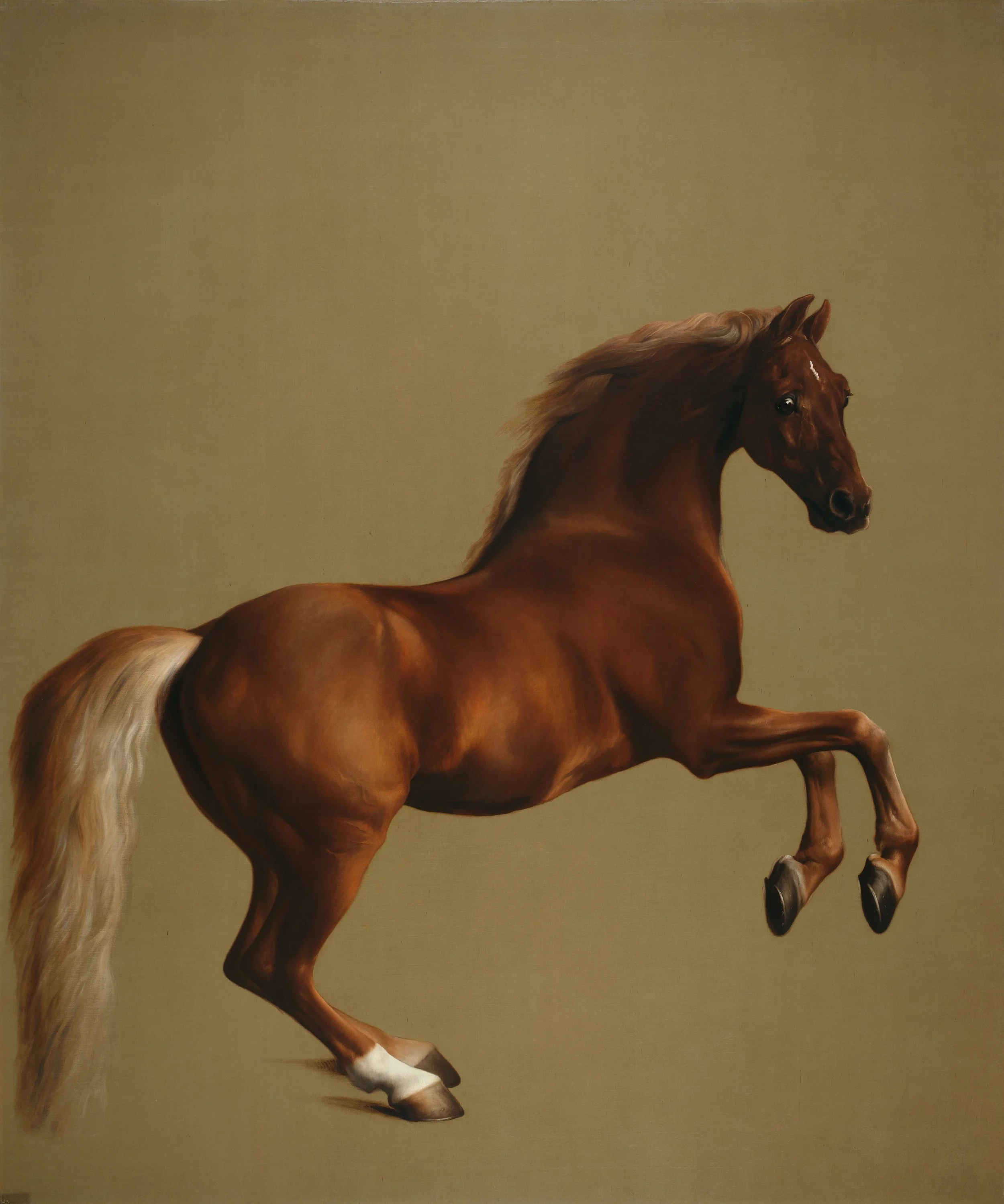
George Stubbs, Whistlejacket, 1762, Oil on canvas, 296.1 × 248 cm.
Image courtesy of the National Gallery.
This quality – of the horse returning the gaze, of the horse refusing pure objecthood – runs like a river through the whole of Western tradition too. George Stubbs, the great English painter of the eighteenth century, dissected horses for years before he painted them, studying the precise architecture beneath the skin. And yet his canvases – Whistlejacket (1762), that enormous chestnut rearing against a ground of pure gold – transcend anatomy entirely. Stubbs removes the landscape, the rider, and every context that might diminish the horse to a possession or a prop. What remains is the animal itself, sovereign and luminous, occupying its own ethos. Whistlejacket is not only a portrait of a racehorse – it is a portrait of becoming.
The Year of the Horse asks something of us that great equestrian painting has always asked: that we look at motion not as something to be stopped, but as something to be entered.
There is a reason the cave painters at Chauvet and Lascaux returned again and again to horses, rendering them in overlapping legs that modern scholars recognise as an attempt to paint movement itself – animation thirty millennia before cinema. The horse was never only an animal – it was the first metaphor for the desire to go further, to cross the ridge, to find what the horizon was hiding. It was the body’s argument against staying put.
In a year coloured by the horse’s energy, this feels less like astrology and more like an invitation. The horse does not wait. It does not ruminate at the fence, considering whether the field is worth running through. It simply runs – with a grace that the greatest painters in history spent their lives trying to catch and never quite could, because the catching was never the point. The point was the chase itself, the brushstroke reaching for something just ahead of it – the painting that is always, in some sense, unfinished.
Baudelaire wrote that romanticism lies neither in subject nor style, but in the way of feeling. The horse, in every era it has been painted, has been the subject artists chose when they wanted to paint feeling in its purest, most kinetic form – desire without object, power with destination, beauty that is inseparable from its own impermanence.
The Year of the Horse arrives, as it always does, suddenly. You look up, and the world has tilted toward momentum. Old hesitations feel heavier than they used to, as new beginnings feel lighter. There is a charge in the air that Romantics would have recognised immediately – that Han Gan would have seen in the eyes of Night-Shining White, that Géricault felt standing in a thunderstorm watching a white horse rear against the sky. It is the feeling of being alive at the start of something – that specific electricity that the horse, in paint and in myth, has always carried.
We have been painting horses since before we had words for what we were doing. Perhaps because the horse has always known something we are still learning – that the only direction worth riding is forward. That the horizon, however far you ride toward it, keeps its beautiful, impossible promise of more.
Bibliography
“George Stubbs | Whistlejacket | NG6569 | National Gallery, London.” n.d. Www.nationalgallery.org.uk. https://www.nationalgallery.org.uk/paintings/george-stubbs-whistlejacket.
Jean-Louis-André-Théodore Géricault. 2016. “A Horse Frightened by Lightning.” Nationalgallery.org.uk. 2016. https://www.nationalgallery.org.uk/paintings/jean-louis-andre-theodore-gericault-a-horse-frightened-by-lightning.
“Melancholia-Film-Horse-Stills.” 2018. DIANA MARIN. September 12, 2018. https://dianamarin.com/2018/09/12/melancholia-2011-the-surreal-overture/melancholia-film-horse-stills/.
“Night-Shining White.” 2021. Metmuseum.org. 2021. https://www.metmuseum.org/art/collection/search/39901.