Stupid or Marvellous? The Divisive Reception of Lucian Freud's Exhibition: Drawing into Painting
By Clara Kenny
Lucian Freud’s ‘Drawing into Painting,’ opened at the National Portrait Gallery London on February 12th. This will be is the largest exhibition to focus on the artist’s paper works, exploring his experimentation with depicting the human face and figure.
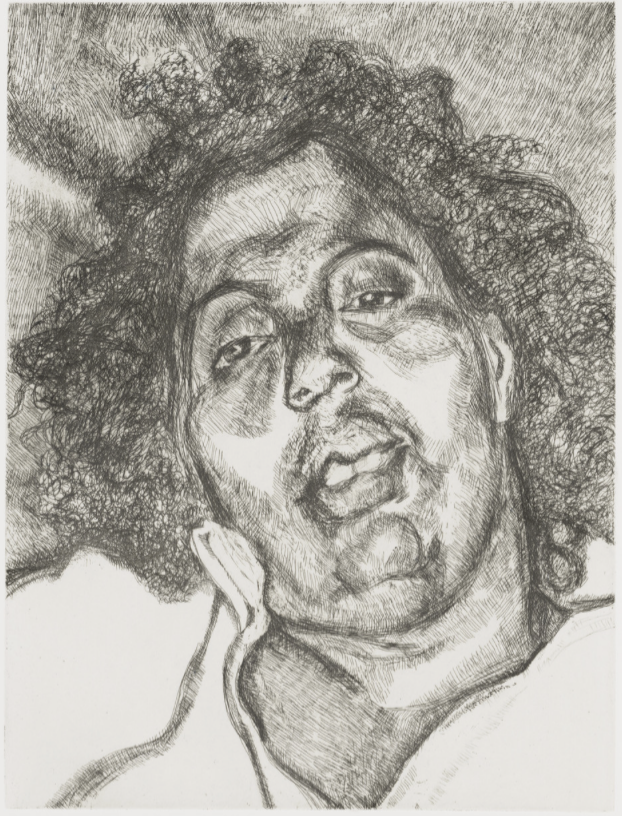
Lucian Freud, Solicitor's Head, 2003, Etching, 36.7 x 27.8 cm, London.
Image courtesy of Smithsonian Magazine.
However, the exhibition has attracted mixed reviews. Whilst the Financial Times declared it a ‘marvel’ that proves Freud’s position as a ‘rare master,’ Sarah Kent of ‘The Arts Desk’ took a different tone, describing leaving the exhibition feeling ‘battered and bruised’ as if ‘hit by a wrecking ball.’ Similarly, the Guardian summed the show as ‘stupid.’
The show displays a wide variety of works from across a fifty-year period – created from a range of medias like chalk, etching, and ink. Three dozen oil paintings are also exhibited, inspired by workings taken from the forty-eight sketchbooks created across Freud’s lifetime. But what is it about Freud’s ‘Drawing into Painting’ that polarises the critic?
Jonathan Jones of The Guardian blames drawing as a medium: ‘If painting is a fast car, drawing is more like taking the bus […] daydreaming until my stop, with the occasional flash of colour and flare when one of the exhibition’s “carefully selected group of important paintings” rolled past.’
Whilst Jones dismisses his drawings and the wider exhibition in favour of Freud’s more mainstream work, I would argue that to disregard the significance of Freud’s drawings is to misread the artist. This sentiment is furthered by the exhibition co-curator, Sarah Howgate, who explains that Freud’s archival materials ‘reveal the thought processes in a way finished paintings cannot.’
Though Freud’s work on paper might lack the immediate drama of his boldly coloured, densely worked canvases, they are unique in that they reveal his working process. The unfinished pages show that he worked from the centre outwards, beginning with the middle details of the face. Furthermore, the fine detail of his early drawings articulates and explain his movement from a more linear style early in his career into his characteristic expressive brushwork of the 1950s.
As argued by Jackie Wullschläger in the Financial Times, Freud’s ‘linear precision has become’ his ‘textured expressiveness,’ suggesting his drawing and painting are intrinsically linked to one another. The exhibition places Freud’s supporting drawings and sketches of his more famous paintings alongside their finished products, allowing us into his thought process and the story behind the universally acclaimed ‘important paintings.’ For example, Benefits Supervisor Sleeping (1995), Freud’s portrait of Sue Tilley, is displayed alongside its original etchings.
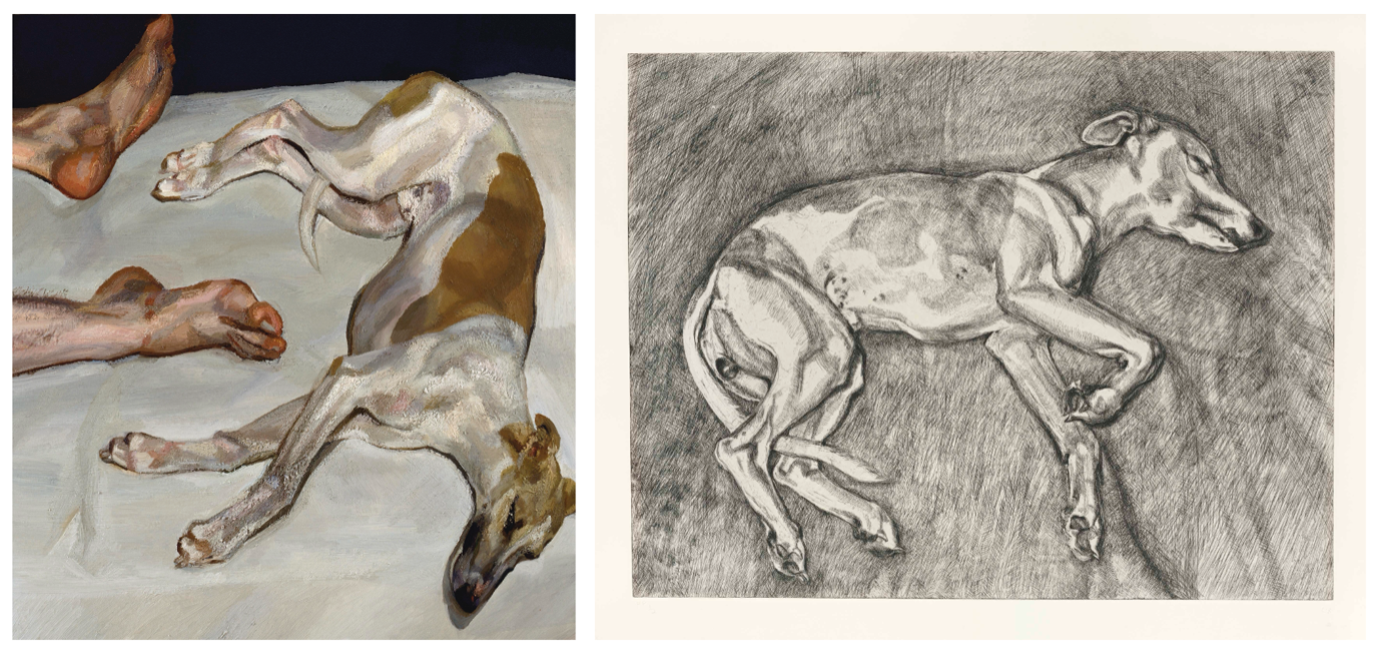
(Left) Related work: Lucian Freud, Eli, 2002, Oil on Canvas, 71.1 x 60.9 cm, London. (Right) Original etching: Lucien Freud, Eli, 2002, Etching on White Paper, 77.5 x 96.0 cm, London.
Image Courtesy of Christie’s.
Being able to view paintings such as the infamous David Hockney (2002) and simple lesser-known etchings like Eli (2002) alongside one another allows us to see the dedication to his subject that threads throughout his works - offering the viewer a unique and detailed insight into his artistic journey that his larger paintings alone are unable to provide.
Bibliography
Anderson, Sonja. “Lucian Freud Is Famous for His Unflinching Portraits. These Rarely Seen Drawings Provide an Intimate Window into His Creative Process.” Smithsonian Magazine, February 17, 2026. https://www.smithsonianmag.com/smart-news/lucian-freud-is-famous-for-his-unflinching-portraits-these-rarely-seen-drawings-provide-an-intimate-window-into-his-creative-process-180988191/.
Jones, Jonathan. “Lucian Freud: Drawing into Painting Review – No, I Don’t Want to Come up and See These Etchings.” The Guardian, February 11, 2026. https://www.theguardian.com/artanddesign/2026/feb/11/lucian-freud-drawing-into-painting-national-portrait-gallery-review.
Kent, Sarah. “Lucian Freud: Drawing into Painting, National Portrait Gallery Review - from Nuanced Lucidity to Dense Opacity.” The Art Desk, February 20, 2026. https://www.theartsdesk.com/visual-arts/lucian-freud-drawing-painting-national-portrait-gallery-review-nuanced-lucidity-dense-opacity.
McDonagh, Melanie. “Lucian Freud: Drawing into Painting — a Crude but Illuminating Treasure Trove.” The Evening Standard, February 11, 2026. https://www.standard.co.uk/culture/exhibitions/lucian-freud-drawing-into-painting-review-b1270532.html.
Wullschläger, Jackie. “Indelicate, Confrontational, Essential — the National Portrait Gallery’s Lucian Freud Show Is a Marvel.” The Financial Times, February 14, 2026. https://www.ft.com/content/4ace1d4b-18cc-4174-a5bc-4ae7171fb6ab.