The Writing on the Wall: Investigation Unmasks Banksy’s True Identity
By Mary Henderson
For over three decades Banksy has satirised consumer culture, mocked political authority, and transformed otherwise nondescript public places into subversive works of art, all while keeping his identity a closely guarded secret.
However, Reuters have published an 8,000-word investigation that claims to confirm the identity of the world’s most famous street artist. Their investigation supports an exclusive from the Mail on Sunday back in 2008 which suggested that Banksy is a 52-year-old Bristol-born man called Robin Gunningham.
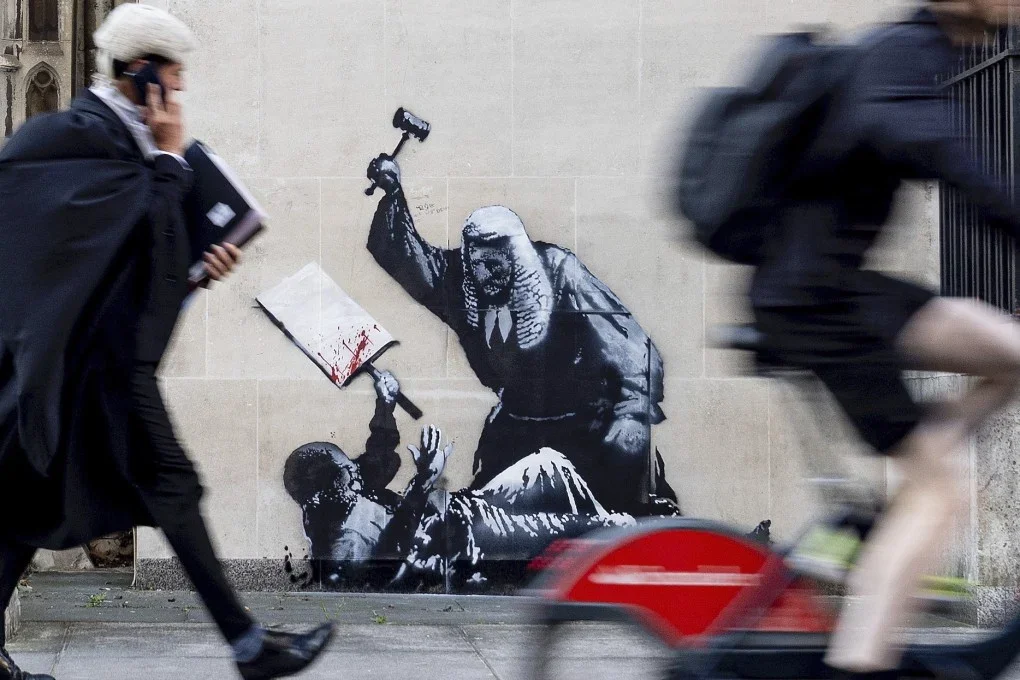
Banksy-attributed mural of a judge beating a protester with a gavel at the Royal Courts of Justice in London
Image Courtesy of Banksy/PA Wire
There had been a number of names circulating as potential ‘unmaskings’, including artist Thierry Guetta and conspiracy-theorist/political satirist Paul Horner. Reports had also suggested that Robert Del Naja, the co-founder of the electronic trip-hop band Massive Attack, was Banksy.
This renewed accusation hinges on a NYPD report Reuters uncovered from 2000, when police caught Banksy painting buck teeth onto a model on a Marc Jacobs poster. He then signed a confession to avoid a felony charge with what is now understood as his real name, Robin Gunningham. It was also found by Reuters that after the 2008 Mail on Sunday report, all evidence of Robin Gunningham’s existence was scrubbed.
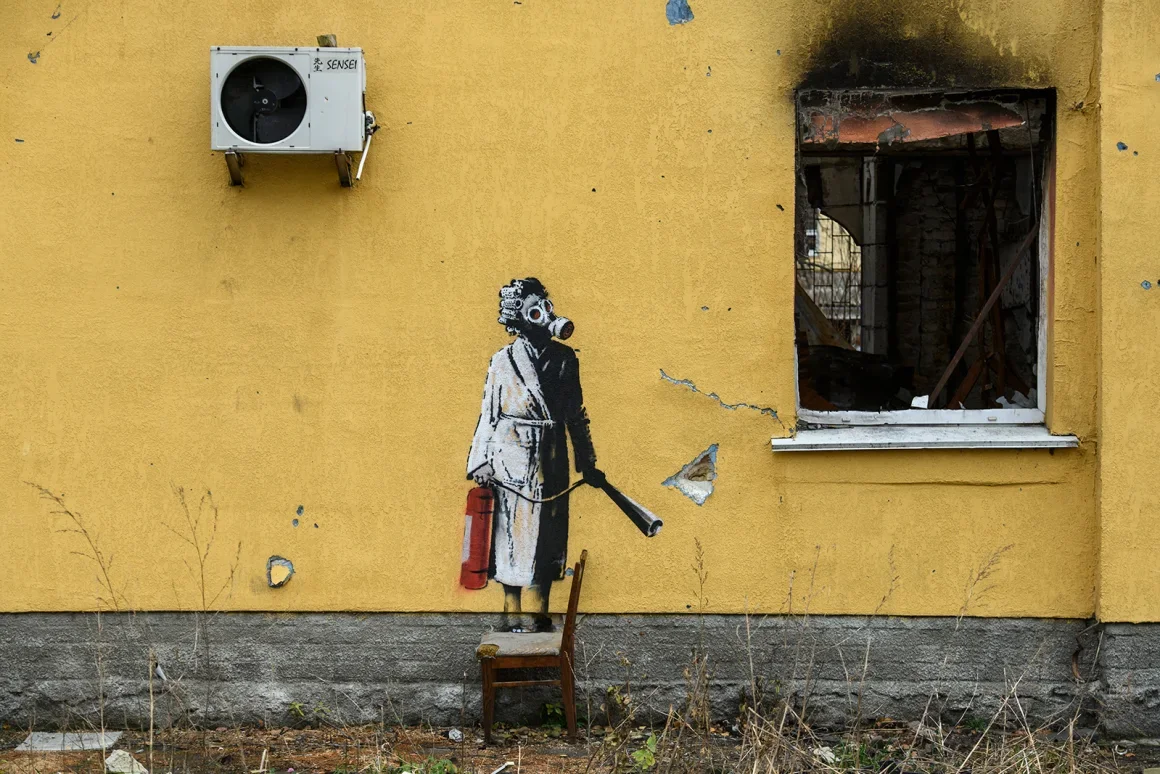
One of seven street murals completed in Ukraine, confirmed to be by Banksy
Image Courtesy of Maxym Marusenko/NurPhoto/Getty Images
Then, in 2022, a series of Banksy artworks began to appear in Ukraine. Reuters checked immigration and border control records and found that Robert Del Naja had entered the country at around that time. When investigated, it happened that a David Jones, who was accompanying Naja, had the same birthday as the date listed for Gunningham on the 2000 New York arrest file. There are over 15,000 David Jones in the UK alone, with the name seemingly a well-chosen cover-up.
Banksy’s long-time lawyer, Mark Stephens, wrote to Reuters that Banksy ‘does not accept that many of the details contained within your enquiry are correct’. He argued that working anonymously ‘protects freedom of expression by allowing creators to speak truth to power without fear of retaliation, censorship or persecution - particularly when addressing sensitive issues such as politics, religion or social justice’.
Reuters however justified their investigation, arguing that it was in the public interest to understand the identity and career of a figure who has had such an impact on the art industry and wider political discourse. They stated that Banksy’s anonymity, which has been a significant profit-making feature of his work, has prevented such adequate scrutiny and accountability.
The unmasking raises questions about how anonymity serves as a value asset. The art market traditionally focuses on documented provenance and authentication as the basis of valuation for blue-chip artists.
However, what distinguishes Banksy from most other living artists is this aura of mystery, serving as the central, marketable narrative at the basis of his popularity. Whether a publicity stunt or self-protection from prosecution (street art remains illegal), his persona as a rebel artist who speaks truth to power is rare in a climate of over-exposure and pursuit of monetary gain. The revelation undermines this, leading some to anticipate the value of Banksy’s work to plummet.
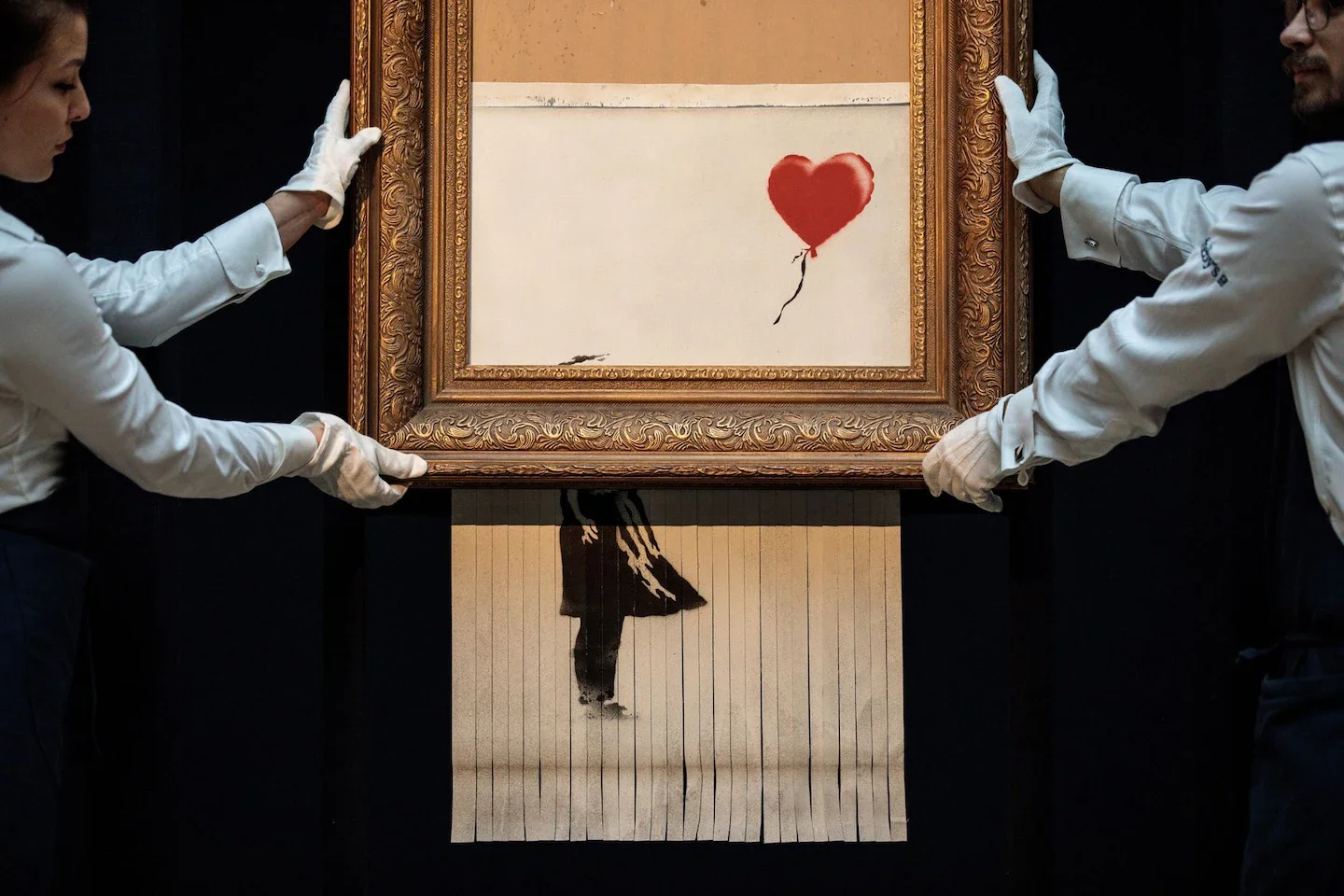
Sotheby’s employees hold up ‘Girl with Balloon’, shredded after auction sale in 2018.
Image Courtesy of Jack Taylor/ Getty Images
Ultimately though, Banksy has already successfully built a long-standing brand based on this tangible persona and scarcity behind his works. Banksy has hitherto guarded his work’s provenance through the Pest Control system, the only official body authorised to authenticate his artworks.
Reuters’ article is just the latest article in a story that has been simmering since the 1990s. This has not prevented a feverish public following and astronomical prices associated with his works. It could even be that having a confirmed name associated with his works will aid collectors in a market that rewards authenticity and provenance, boosting his identity as an artist rather than an anonymous political commentator. Now that one question has been answered, a new one emerges; what will Banksy do next?
Bibliography
Gardner, Simon, James Pearson and Blake Morrison. ‘In Search of Banksy.’ Reuters. March 13, 2026. Available at: https://www.reuters.com/investigates/special-report/global-art-banksy/
Kilgannon, Corey, ‘Inside the Arrest that led to Banksy’s possible unmasking decades later’. The New York Times. March 20, 2026. Available at: https://www.nytimes.com/2026/03/20/nyregion/banksy-identity-robin-gunningham-arrest.html
Miller, Nick. ‘Banksy has been unmasked (again). But does this major Reuters investigation actually tell us something new?’ The Guardian. March 18, 2026. Available at: https://www.theguardian.com/culture/2026/mar/18/banksy-identity-revealed-real-name-bristol-born-man-reuters-investigation
Swallow, Bea. ‘Who is Banksy? Unmasking the elusive street artist’. BBC News. 18 March 2026. Available at: https://www.bbc.co.uk/news/articles/c98q8llqq4po