Presidential Patronage: Trump's Triumphal Arch
By Ian Ziegler
In recent years, coverage of Donald Trump and his relationship to the arts have been overwhelmingly critical, often focusing on his administration’s approach to cultural institutions and historical narratives. Yet beyond policy shifts, which, like many executive actions, are subject to reversal by subsequent administrations, Trump’s most consequential interventions may be material rather than ideological. His imprint on the built environment of Washington, D.C., and, by extension, the symbolic landscape of the United States, suggests a more enduring legacy.
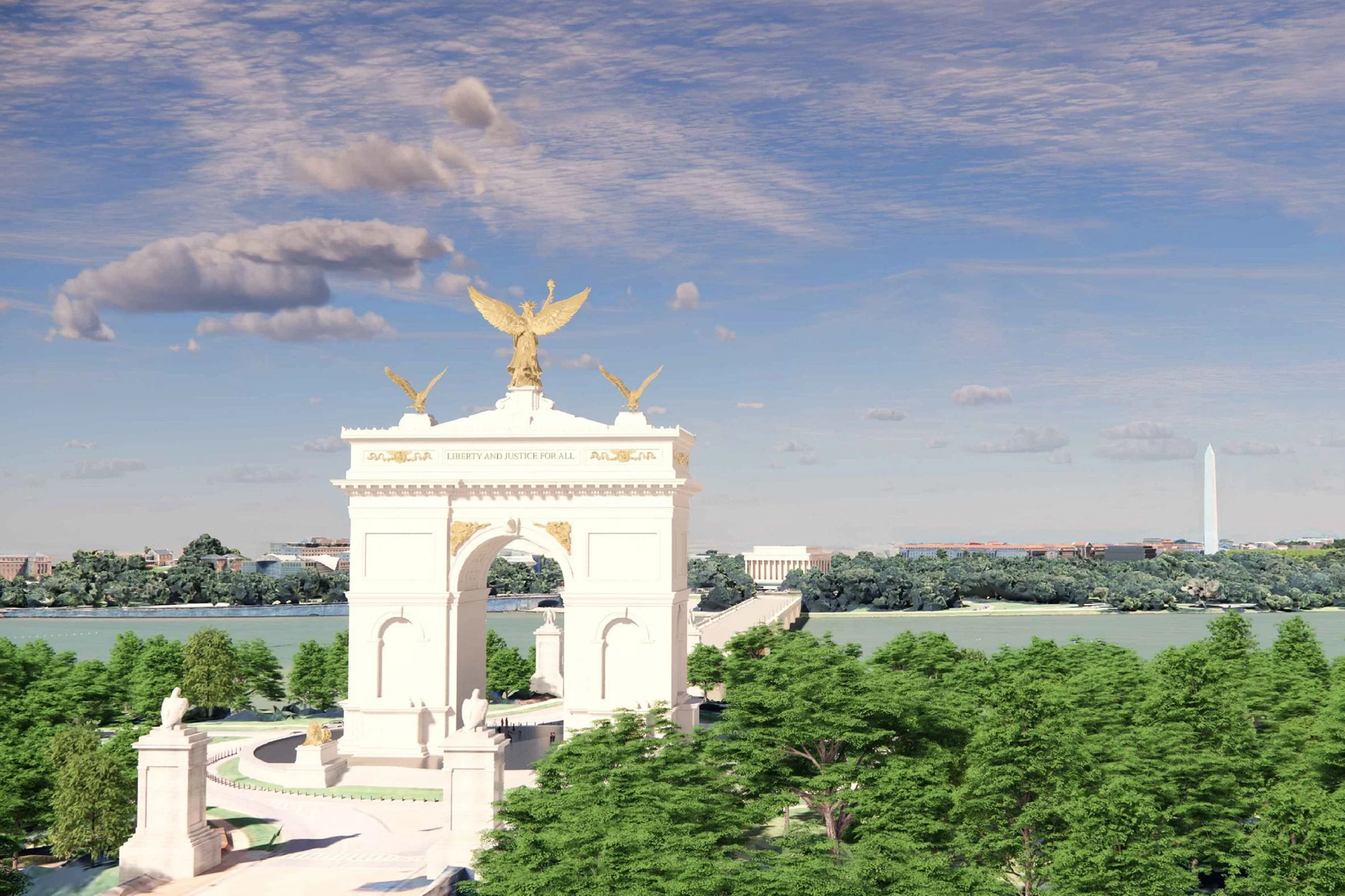
Architectural Renderings of Trump’s Arch.
Image courtesy of Harrison Design.
The most visible of these interventions emerged in late 2025 with the demolition of the White House East Wing and the construction of a vast new ballroom. The project, estimated at roughly 90,000 square feet, effectively replaces a historically layered structure with a monumental expansion that rivals and, in some accounts, overwhelms the scale of the existing White House complex. Legal challenges have underscored the controversy surrounding the project, particularly questions of authority and preservation, yet construction has proceeded intermittently amid court rulings and appeals.
More recently, attention has shifted to an even more ambitious proposal: a 250-foot ‘triumphal arch’ planned for the Washington metropolitan area. Submitted to the U.S. Commission of Fine Arts, whose membership was significantly reshaped during Trump’s administration—the project seeks to commemorate the 250th anniversary of the United States. Renderings suggest a neoclassical structure drawing heavily on European precedents, most notably the Arc de Triomphe, complete with allegorical sculpture and gilded ornamentation.
The choice of a triumphal arch is not merely aesthetic but deeply historical. Originating in ancient Rome, such monuments were erected to commemorate military victories and imperial authority, often incorporating spolia, materials or imagery appropriated from conquered territories. Their revival in early modern Europe, particularly under Napoleon Bonaparte, reinforced their association with state power, conquest, and national mythmaking. In this context, the proposed American arch raises critical questions: what constitutes ‘triumph’ in a contemporary democratic society, and how should it be represented?
Critics, including preservationists, architects, and veterans’ groups, have argued that the monument’s scale and symbolism risk disrupting both the visual coherence and the commemorative intent of the capital’s existing landscape. The proposed site itself, near Arlington National Cemetery, intensifies these concerns, situating the project within a charged terrain of memory, sacrifice, and national identity.
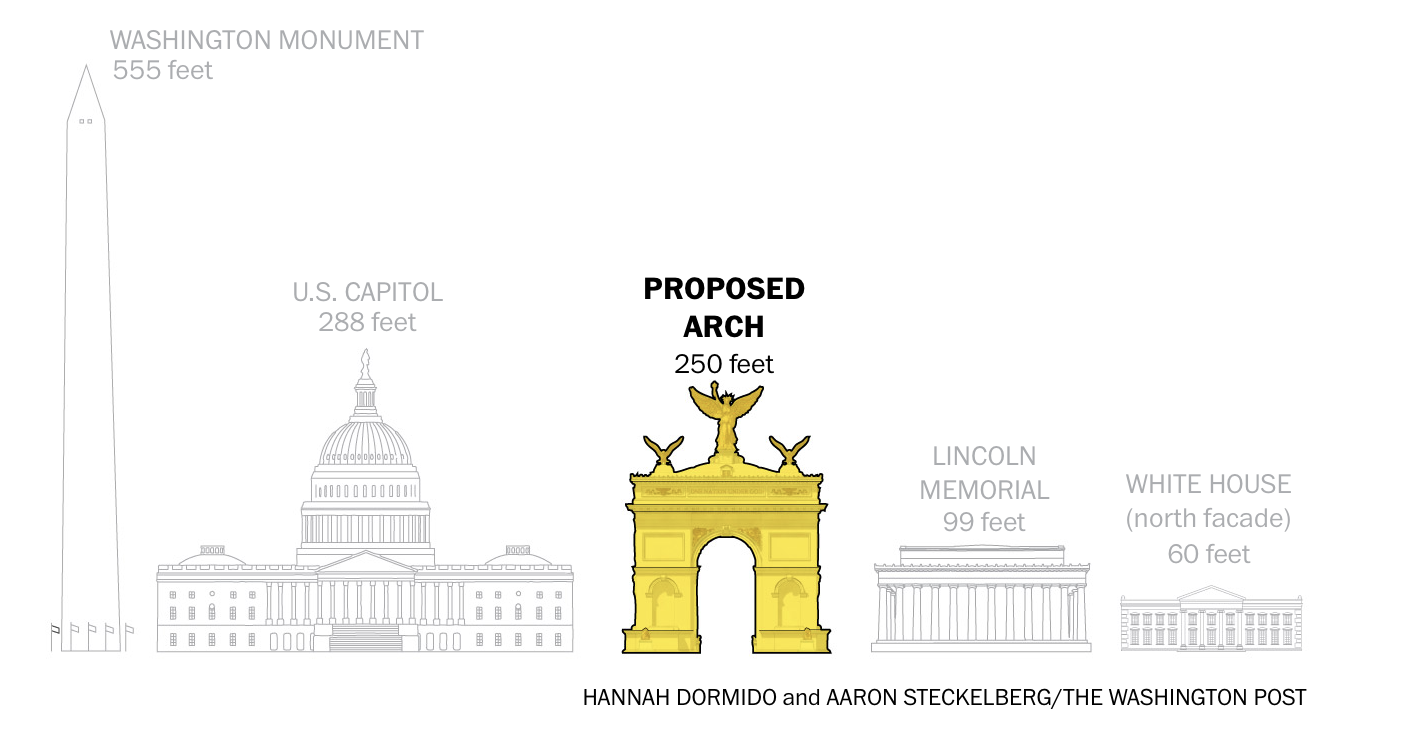
Hannah Dormido and Arron Steckelberg, Proposed Height of Trump’s Arch.
Image courtesy of The Washington Post.
Taken together, these projects reflect a broader pattern: the use of architecture as an instrument of political self-fashioning. Trump’s interventions in Washington’s built environment privilege monumentality, spectacle, and permanence; qualities historically associated with imperial and authoritarian regimes, over the restrained neoclassicism that has traditionally defined the city’s federal core.
For art historians, the significance of these developments lies not only in their aesthetic implications but in their ideological ones. Architecture, as ever, operates as both form and message. Whether these projects will ultimately be realised, and how they will be received over time, remain uncertain. What is clear, however, is that they signal a deliberate attempt to reshape the symbolic vocabulary of American power, one monument at a time.
Bibliography
“Trump Unveils Latest Plans for Proposed 250-Foot-Tall Triumphal Arch.” ARTnews. Accessed April 12, 2026. https://www.artnews.com/art-news/news/trump-unveils-latest-plans-for-proposed-250-foot-tall-triumphal-arch-1234780939/
Diamond, Dan, Hannah Dormido, and Tim Meko. “Trump Officials Unveil Designs for President’s Controversial 250-Foot Arch.” The Washington Post, April 10, 2026. https://www.washingtonpost.com/politics/2026/01/31/trump-arch-memorial-circle/
“The White House.” The White House. Accessed April 12, 2026. https://www.whitehouse.gov
“What Are the Dimensions of the White House?” White House Historical Association. Accessed April 12, 2026. https://www.whitehousehistory.org/questions/how-big-is-the-white-house