Iran's Cultural Heritage Caught in the Crossfire of US-Israel War
By Millie Barker
Amidst escalating air and ground assaults from Israel, Lebanon has made a move to protect its historic architecture by placing blue shields across their thirty-four UNESCO heritage sites. The shields are an internationally recognised signal under the 1954 Hague Convention for the Protection of Cultural Property in the Event of Armed Conflict.
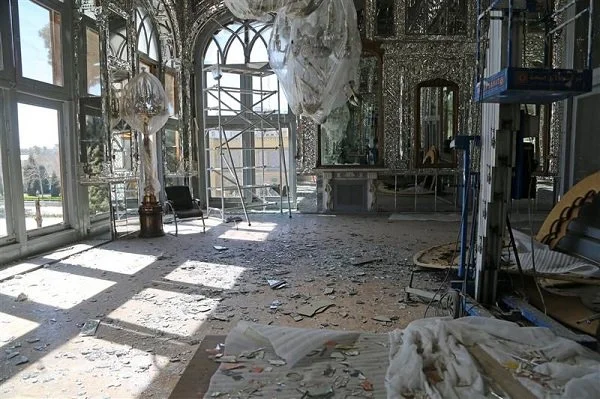
Golestan Palace’s hall of mirrors was damaged with intricate mirrorwork shattered
Image Courtesy of Anadolu/Getty Images
This protection comes as a necessary measure after immeasurable damage to urban fabric, infrastructure, and environment in Iran. Since the war began on February 28th, airstrikes in the historic district of Tehran caused irreparable damage to monuments that have stood for centuries. The list of damage includes the Ayvan-e Takht-e Marmar at Tehran’s Golestan Palace with its extensive mirror-mosaic wall decorations (known as ayeneh-kari), and the Falak-ol-Aflak Castle in Lorestan.
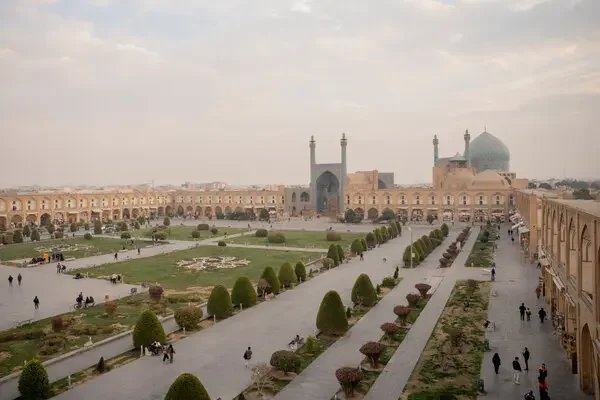
Naqsh-e Jahan Square in Isfahan, Iran
Image Courtesy of Emad Aljumah
The royal precinct of Isfahan also suffered in the March bombings. Built through the late sixteenth to early eighteenth century by the Safavid dynasty (1501-1722), the precinct served as capital during the golden age of art, architecture, and trade. Nearby blasts damaged areas of the Chehel Sotoun Palace, where the Safavid King would host royal feasts and ceremonial gatherings. The forty-columned hall in the palace faces collapse where parts of the painting and gilded wooden coffered ceiling have fallen to the ground as well as the latticework window frames have been shattered and scattered. Several historic buildings, including the Ali Qapu Palace, were also damaged by blast waves in the Naqsh-e Jahan Square. The latter raised particular concern as UNESCO claimed that it had communicated the coordinates of World Heritage sites to all parties concerned.
Indeed, the governor general, Mehdi Jamalinejad, of Isfahan claimed that serious damage was inflicted to heritage sites even after blue shields were put in place. Demonstrating that cultural sites might have been strategically targeted.
While it can be argued that the destruction of heritage sites is insignificant compared to the loss of life, the sites are vital to shaping Iranian cultural life today. Iran has twenty-nine UNESCO sites that span more than two millennia, managed and preserved by the Iranian Cultural Heritage Organisation. These monuments are a symbolic link between the ancient Persian past, the Islamic period, and the modern nation. Beyond the question of who hold moral responsibility for their destruction, it must also be asked who is responsible for restoring the cultural heritage of Iran? Where will the resources and skill come to recover these sites?
Beyond the damage, the turmoil has affected the art world on a broader scale. On March 19th, Art Dubai announced that it will be postponing its twentieth edition until mid-May. This followed some international galleries pulling out of the event and disrupted travel logistics as the Strait of Hormuz remains closed. Despite this, some museums have taken a business-as-usual approach and reopened, such as the Jameel Arts Centre in Dubai and the Arab Museum of Modern art in Qatar. Further afield, London’s art auctions were unaffected with proliferate evening sales at Sotheby’s and Christie’s in March.
It is hard to imagine soaring art sales as the war in the Gulf continues, with devastating loss of life and global reverberations. Global institutions must take responsibility to protect these world heritage sites from destruction, for their damage represents a fragmentation in our cultural memory.
Bibliography
Babaie, Sussan. “In a month of war, Iran’s cultural heritage has suffered huge damage.” The Art Newspaper. April 1st, 2026. https://www.theartnewspaper.com/2026/04/01/in-just-a-few-weeks-irans-cultural-heritage-has-suffered-huge-damage
Brodner, Curtis. “Despite Uncertainty, Gulf Art World Projects Normalcy.” Hypoallergic. March 24th, 2026. https://hyperallergic.com/despite-uncertainty-gulf-art-world-projects-normalcy/
Chow, Vivienne. “Art Dubai Postpones 20th edition as Iran War Rages On.” ArtNet. March 19th, 2026. https://news.artnet.com/market/art-dubai-postpones-20th-edition-as-iran-war-rages-on-2755811
Lawson-Tancred, Jo. “The Cultural Heritage Sites Damaged by the U.S.-Israel War on Iran.” ArtNet. March 19, 2026. https://news.artnet.com/art-world/iran-cultural-heritage-sites-damaged-us-israel-war-2755784
Reyburn, Scott. “Art trade stays buoyant amid global turmoil.” The Art Newspaper. March 30th, 2026. https://www.theartnewspaper.com/2026/03/31/art-trade-stays-buoyant-amid-global-turmoil
Shahandeh, Katayoun. “Iran’s cultural heritage in the crossfire – expert explains what has been damaged and what could be lost.” The Conversation. March 12th, 2026. https://theconversation.com/irans-cultural-heritage-in-the-crossfire-expert-explains-what-has-been-damaged-and-what-could-be-lost-278216
Solomon, Tessa. “Blue Shields Placed at 34 Archaeological Sites Across Lebanon, Signalling Enhanced Protections.” ArtNews. March 16, 2026. https://www.artnews.com/art-news/news/blue-shields-placed-at-34-archaeological-sites-across-lebanon-signaling-enhanced-protections-1234777575/