From Scotland to Vienna: Charles Rennie Mackintosh
by Tessa Rava
Glasgow’s art scene in late nineteenth century was starkly different from how we know it today. Now recognized as one of the United Kingdom's major hubs for art, at the time that Charles Rennie Mackintosh began as an artist, the city was primarily industrial. While aspiring Glaswegian artists would have made their way to London or Edinburgh to pursue their careers, Mackintosh helped to establish Glasgow's art scene.
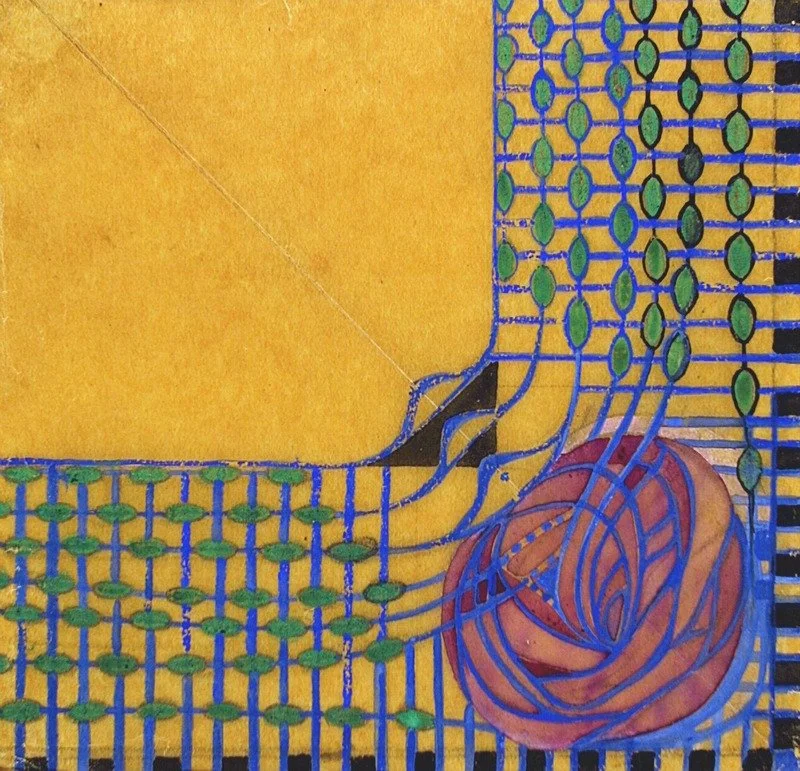
Charles Rennie Mackintosh, Textile Design, 1918, Watercolour, 3.3 x 13.3 cm. Image courtesy of Victoria and Albert Museum, London.
Arguably one of the city’s most celebrated artists, Mackintosh worked as a member of the Glasgow Four. This collective, consisting of Herbert MacNair and sisters Frances Macdonald and Margaret Macdonald, pioneered the Glasgow Style. Yet this unique fashion was not widely accepted at its conception. British critics referred to it as ‘blasphemy against art’, attacking its influences from Symbolism, Arts and Crafts, Art Nouveau, Japonisme, and Celtic and pagan culture.
Mackintosh’s participation in a wider interested in Japanese art is made clear when considering the works of Edward Atkinson Hornel, such as The Brook (1891). Hornel, a member of the Glasgow Boys and working just before Mackintosh, highlights the persistence of Japanese influence throughout Glaswegian art groups. The Brook is rendered with a nature-orientated design, linear pattern, and flattened compositional space: the quintessential traits of Japonisme. This directly impacted Mackintosh in his personal aesthetic development.
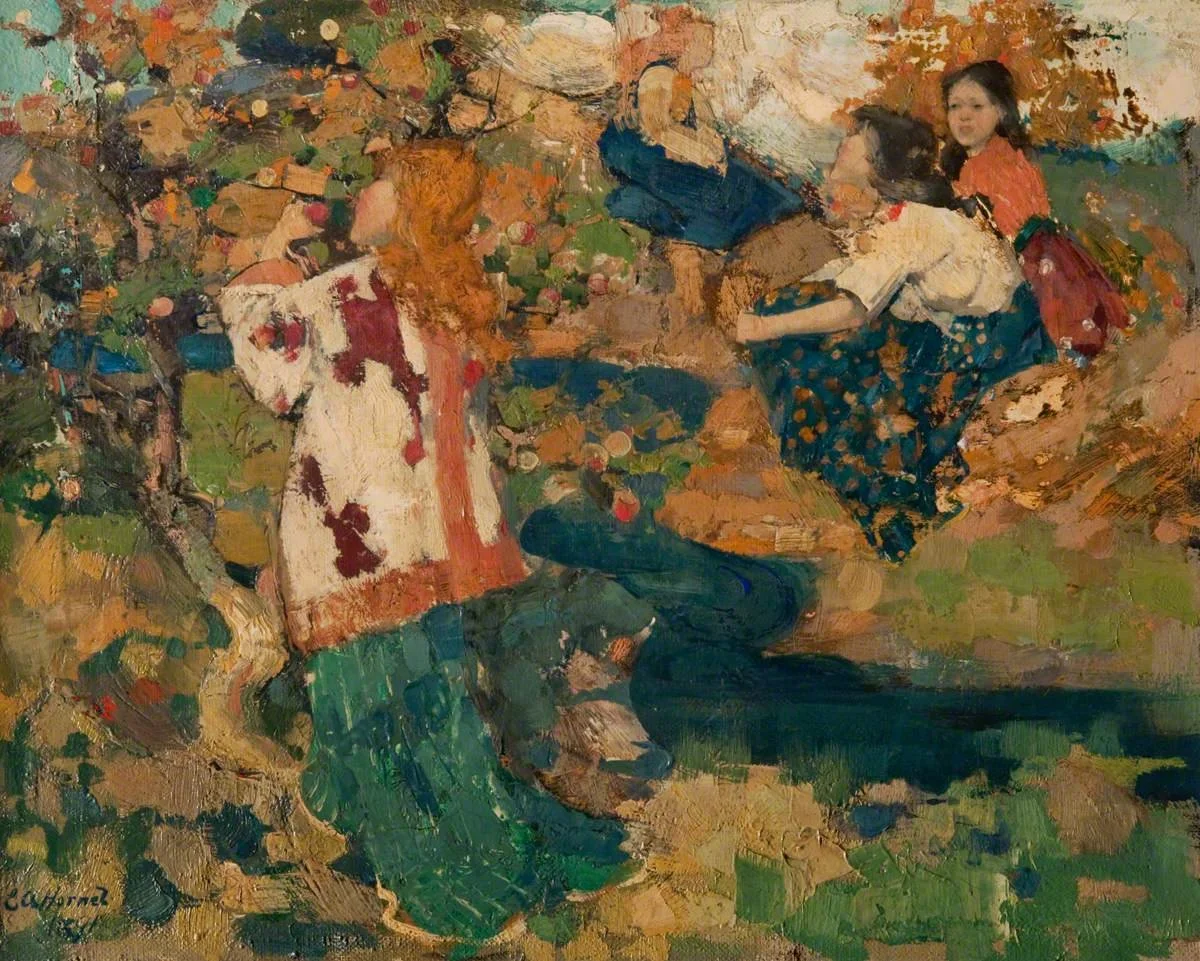
Edward Atkinson Horner, The Brook, 1891, Oil on canvas, 41.1 x 51.3 cm. Image courtesy of University of Glasgow.
However, the inspiration for Mackintosh’s work is multifarious. Tropes from Celtic and Pagan art also make a notable appearance, distinguished by the inclusion of organic motifs, namely flowers, leaves, and trees. Such hybrid embellishments that feature the Four’s work make their designs so recognisable, as one can see in Textile design: rose and teardrop (ca. 1915-1923) with Mackintosh’s stylised stained-glass roses.
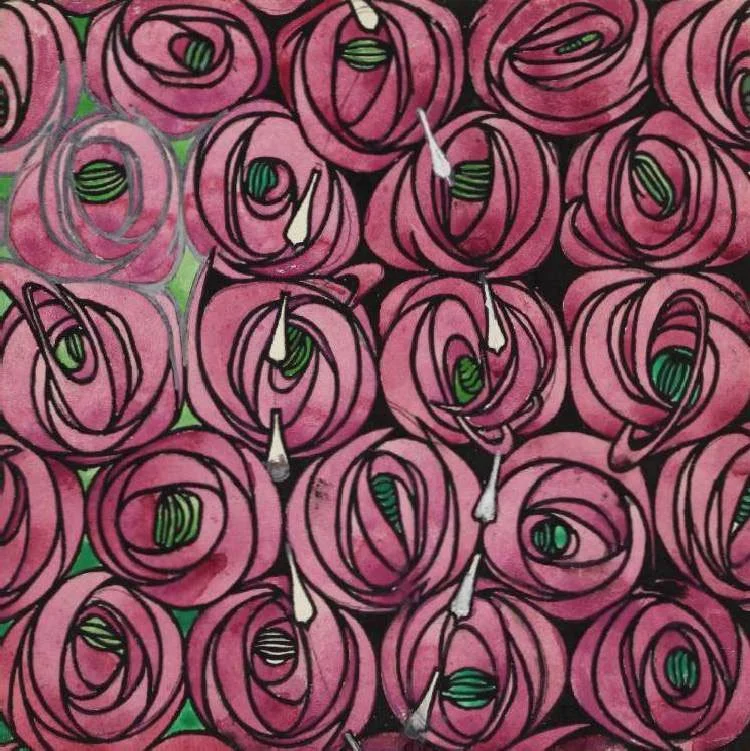
Charles Rennie Mackintosh, Textile design: rose and teardrop, ca. 1915-1923, Pencil, watercolour and gouache on paper (recto) carbon ink (verso), 25.5 x 25.4 cm. Image courtesy of the Hunterian Museum and Art Gallery, University of Glasgow.
Unlike in the United Kingdom, the rest of Europe was far more receptive to the Glasgow style. Its influence spread through various countries, most notably Germany and Austria. In 1900, the eighth exhibition of the Vienna Secession opened, highlighting the style’s vast international transmission. Included in the exhibition space were designs from the four Scottish artists, and each was given a room to curate. Rather than following the same cluttered curatorial styles of the Viennese, they shifted to a simple layout clad with white walls and minimal decoration.
This set a lasting trend, taken up by the first Secession president, Gustav Klimt, who painted Beethoven Frieze (1901-1902) for the fourteenth secession exhibition in 1902. Despite being more widely known for his pioneering role in Symbolist painting, he employed the Glasgow-group mode of separate figurative panels rather than a continuous narrative.
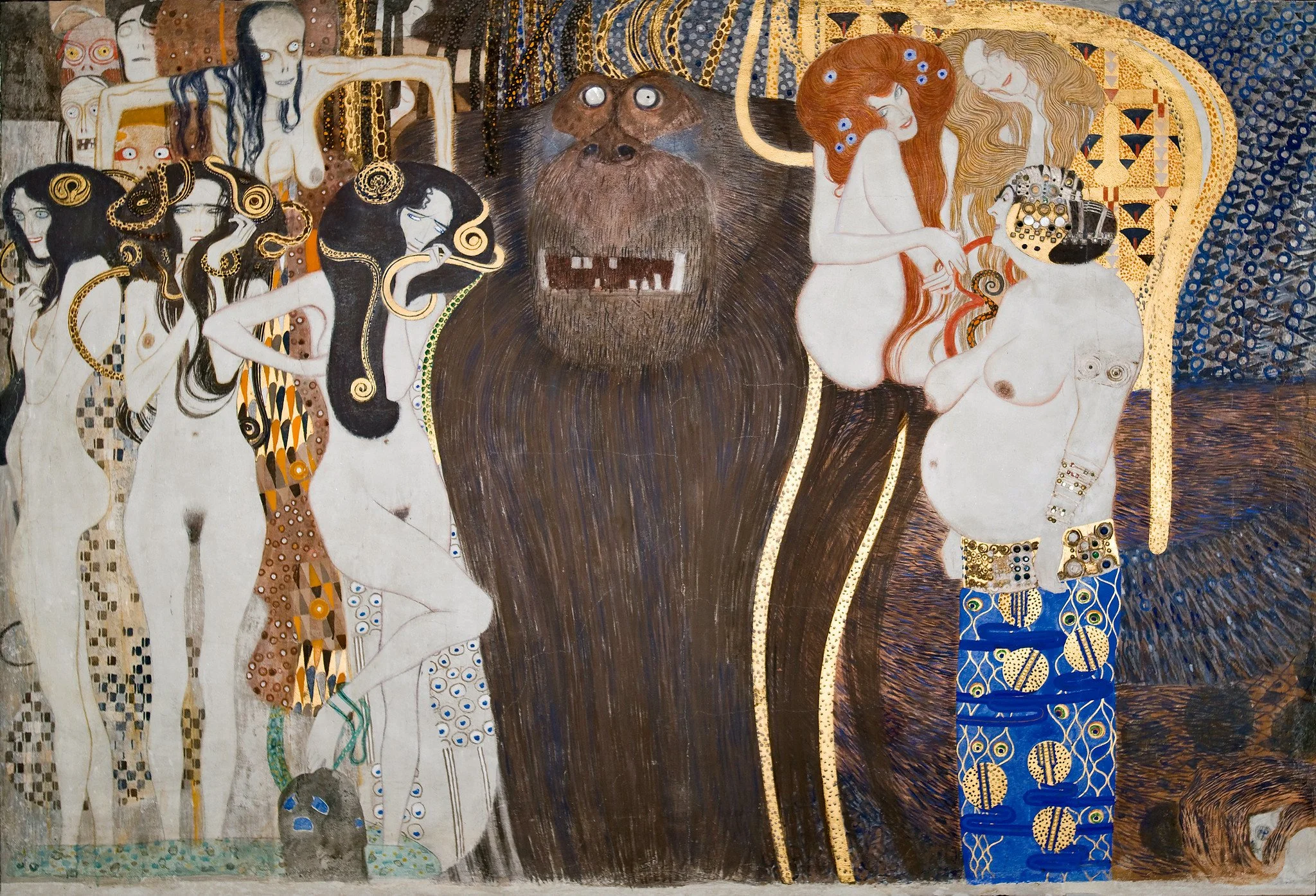
Gustav Klimt, Beethoven Frieze, 1901-1902, Mixed media, 2.15 x 34.14 m, Secession Hall, Vienna, Austria. Image courtesy of Belvedere.
Mackintosh’s art, along with his peers’, continues to hold authority today. His masterpiece, the Mackintosh building at the Glasgow School of Art, has shaped generations of students that followed. Architecture, to Mackintosh, was a way to merge and synthesise all of the arts. His style did not exist in one tradition or medium, but floated between modalities.
Glaswegian art and architecture, and by extension Europe’s as a whole, cannot be properly addressed without mentioning Mackintosh and the Glasgow Four. The influences and influence discussed have not only left a lasting and visible legacy in European art but also helped to place Glasgow in the art world.
Bibliography
Arthur, Elizabeth F. “Glasgow School of Art Embroideries, 1894-1920.” The Journal of the Decorative Arts Society 1890-1940, no. 4 (1980): 18–25. http://www.jstor.org/stable/41806400.
Billcliffe, Roger. “A Brush with Europe: Visual Art in Glasgow 1890-1990.” RSA Journal 139, no. 5417 (1991): 330–42. http://www.jstor.org/stable/41375520
Billcliffe, Roger, and Peter Vergo. “Charles Rennie Mackintosh and the Austrian Art Revival.” The Burlington Magazine119, no. 896 (1977): 739–46. http://www.jstor.org/stable/878930.
Calvert, Robert, and Nicholas Oddy. “Talks & Lectures | Charles Rennie Mackintosh: Architect and Artist”. National Galleries of Scotland, 2018. https://www.nationalgalleries.org/art-and-artists/features/talks-lectures-charles-rennie-mackintosh-architect-and-artist.
Horner, Libby. “Mackintosh and the Glasgow Style: Japonisme.” In Britain & Japan Biographical Portraits Vol X, edited by Hugh Cortazzi. Britain & Japan: Biographical Portraits. Amsterdam University Press, 2016.
Macaulay, James. ‘Charles Rennie Mackintosh’. West 86th: A Journal of Decorative Arts, Design History, and Material Culture18, no. 1 (2011): 103–4. https://doi.org/10.1086/659388.