Sonica Festival at Pollok House
by Megan Waugh
Amid Pollok Park’s rolling greens, past the grazing Highland cows stands one of Glasgow’s most iconic buildings. Pollok House, originally the home of the Maxwell family in the eighteenth century, has been welcoming visitors for 247 years. However, it has not yet hosted an event quite like the 2026 Sonica Festival. The house has been closed for refurbishment for the past few years, but the event opened its doors with music, art, and vivacity.
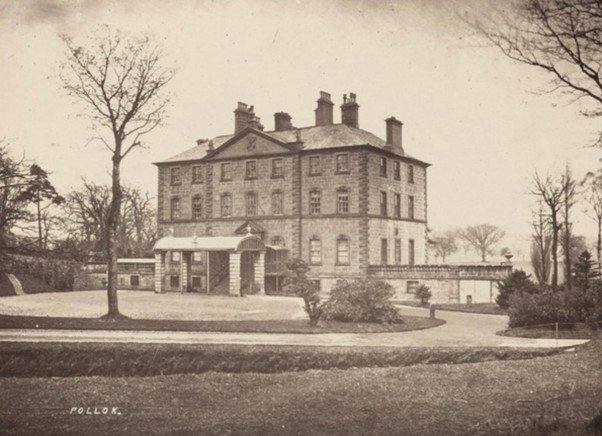
Thomas Annan, Pollok House, 1878, 11.70 x 15.90cm, Photograph, National Galleries of Scotland collection, National Galleries of Scotland.
Sonica promises that “in every corner, experiments and installations explore the intersection of sound, image and architecture. As you move about the house’s gardens and three storeys, opening doors into rooms that haven’t been seen in decades, you might see a flock of mechanical birds twittering, encounter four hundred tinkling bells above you, have a surprising encounter with a titan of science fiction, or witness a world turned upside down.” Such a menagerie of stimulation contrasts sharply with the stately, historic image most often associated with Pollok House’s reputation. In this way, the event lets visitors experience Glasgow’s old, well-known sites in entirely new and complex ways.
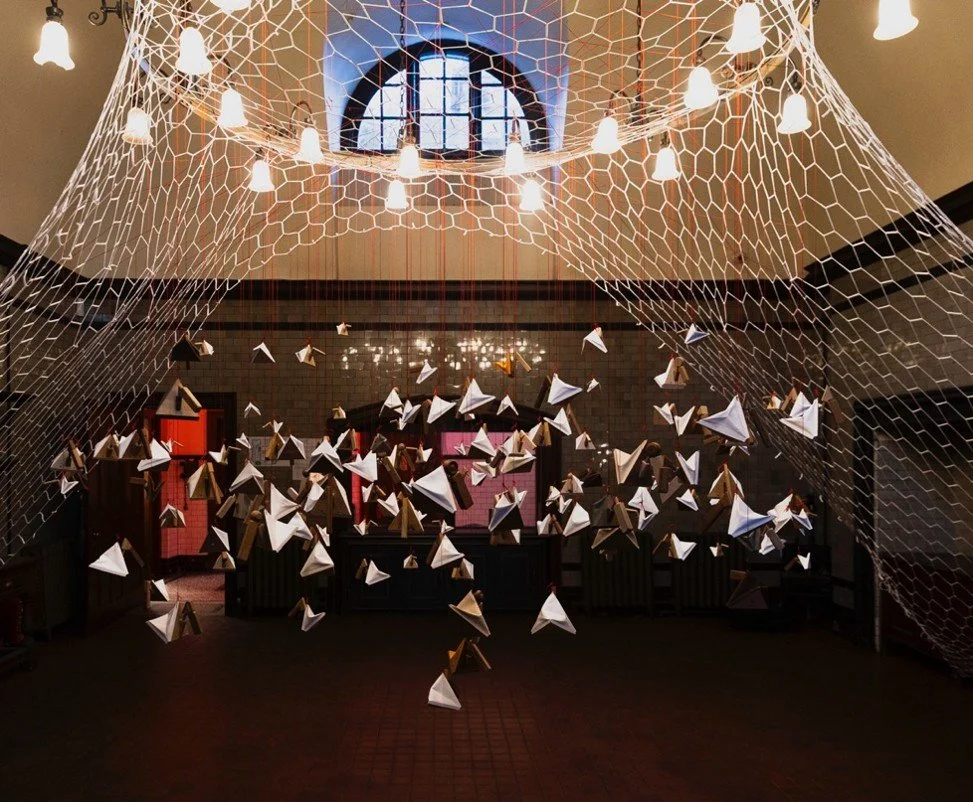
Eoin Carey, Image within Pollok House, 24 September 2026, VisitGlasgow.
The Georgian mansion is not the only Glasgow building to receive this treatment. Cathie Boyd, the artistic director of Sonica, describes the breadth of their project: “The past two editions of Sonica, we have worked with the council on opening up buildings that people don’t have access to. Last time we did the Mercat cross and the clock tower, and afterwards I went to the council and Pollok came up in conversation. I was like—that’s amazing—people haven’t seen this house in years, so how can I turn it into a listening house?” While Glasgow has a host of iconic and beloved architecture, people’s interaction with these buildings typically stops at aesthetic appreciation. However, the Sonica project offers to transform the sites into vessels of excitement and engagement through modern art and entertainment.
Inside The Listening House (2026), phantasmagoric visuals are projected across the walls, weaving enchantment through each room. Paul Russell’s interactive piece, Ricochet (2026), urges visitors to control the lights and pitches which illuminate a dark room. He praises the idea of using Pollok House as a venue: “It feels like one of the main instruments is actually the house itself. It’s amazing working here, somewhere completely different to where I’ve been before.” Having previously lived in Glasgow for over a decade, Pollok House holds a powerful emotional connection for Russell. Thus, the location aids the presentation of the art itself. More than a vacant room or gallery hall, the house offers a powerful backdrop for experiencing the artwork.
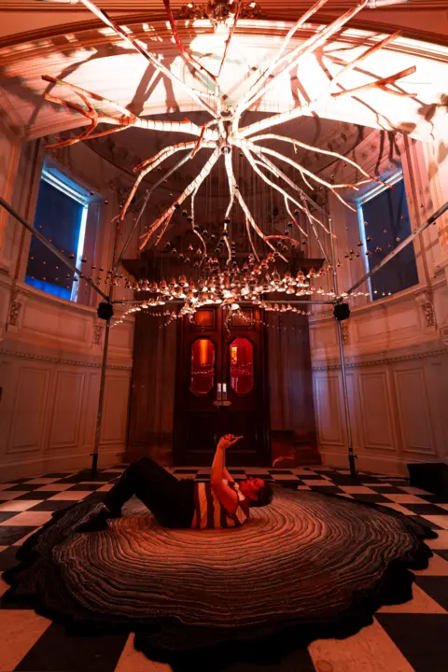
Eoin Carey, Unearthed in Pollok House, 24 September 2026, 480 x 720 cm, BBC Scotland.
In one of the main halls, a rug has been laid across the chequered-tile floor, shaped like the rings of a tree trunk. When guests lie down in this spot, their vision is transfixed by a sprawling fixture of branches and bells that hangs from the ceiling. Formed from a damaged tree, Dutch artist Sara Vrugt’s creation Unearthed (2026) urges visitors to become absorbed within an area of tranquillity. She explains that she wants “people to stop, breathe, let the work wash over you.” Moreover, the festival does more than just cultivate fun and stimulation—it offers moments of meditation that can become exceptionally profound. The tree hanging within the pristine halls offers a unique blend of the natural and man-made, bringing the botanical world that surrounds the House into a unique form of contact.
Indeed, Pollok Park has a special relationship with trees, as outside the house stands a sprawling, swollen beech with pieces of tattered cloth tied to its gnarled branches. An echo of Celtic tradition, this practice marks the beech as a herald of wishes and offerings, as trees were seen as vessels for creating monuments and exploring spirituality.
As this tradition of tying cloth has continued has occurred for hundreds of years, it invites us to consider humans’ relationships with composite art. Pollok House’s architect appreciated the grounds and saw them as a fitting place for a stately home; the Sonica artists saw the House as a beautiful place to host modern artwork; and the wishing folk saw the tree as a place to harbour hope and sentimentality. In this sense, the Sonica Festival becomes part of a wider tradition—exploring and experiencing art within pre-established allure—and one that values promoting interactions between different forms of beauty.
Bibliography
Geddes, Jonathan. “Glasgow’s historic Pollok House transforms for art festival.” BBC News, September 24, 2026, https://www.aol.com/articles/glasgows-historic-pollok-house-transforms-214657000.html
“Glasgow’s Iconic Pollok House Becomes an Immersive ‘Listening House’ at Sonica Festival.” Visit Glasgow, September 24, 2026. https://www.visitglasgow.org.uk/news/sonica-26-the-listening-house/
Sonica. “The Listening House.” Accessed October 22, 2026. https://sonic-a.co.uk/venues/pollok-house