By Tessa Rava
St Andrews is no stranger to a tourist shop, and what tourist shop is complete without the classic image of tweed? Typical jackets and bags made from this fabric decorate the windows of Market Street, a place in St Andrews that gives one an insight into the demands of quintessentially Scottish goods.
Tweed's origins are strongly rooted in domestic traditions. At its conception in the 18th century, the fabric had little to no desirability in the fashion industry. It was seen as purely functional, even occasionally even being accepted for paying rent. However, by the mid 19th century, there was a distinct shift in its utility. Lady Dunmore, the wife of the Earl of Dunmore, saw the potential in this cloth. She began marketing tweed, using her position to spread its influence. Due to its ability to retain warmth while remaining a lightweight, the fabric became extremely popular for outdoor recreation, such as stalking or fishing.
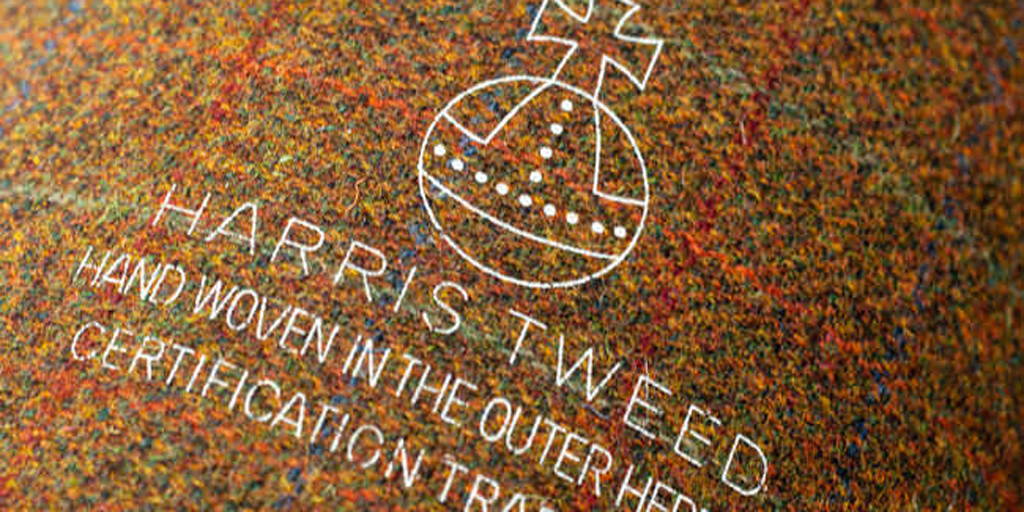
The Harris Tweed Authority. Image courtesy of Harris Tweed.
The most recognisable name in this industry is undeniably Harris Tweed, and its success has arguably come from its strategic marketing. This was largely due to the decision to lean into tweed’s Scottish history, which enabled it to maintain its position as a timeless commodity. This fabric is not exclusively produced on the island of Harris, so this geographically specified representation as a brand sets it apart in a saturated market.
Orkney tweed, for example, had a similarly successful start and developed a strong notoriety as a product. Both tweeds focused on a high quality of production and attention to detail. However, Orkney tweed built a reputation upon the islands’ Viking connections, while Harris capitalised on stereotypical Scottish foundations. Ultimately, what consumers favoured and bought into was the undeniable sense of an idealised and romanticised Scotland.
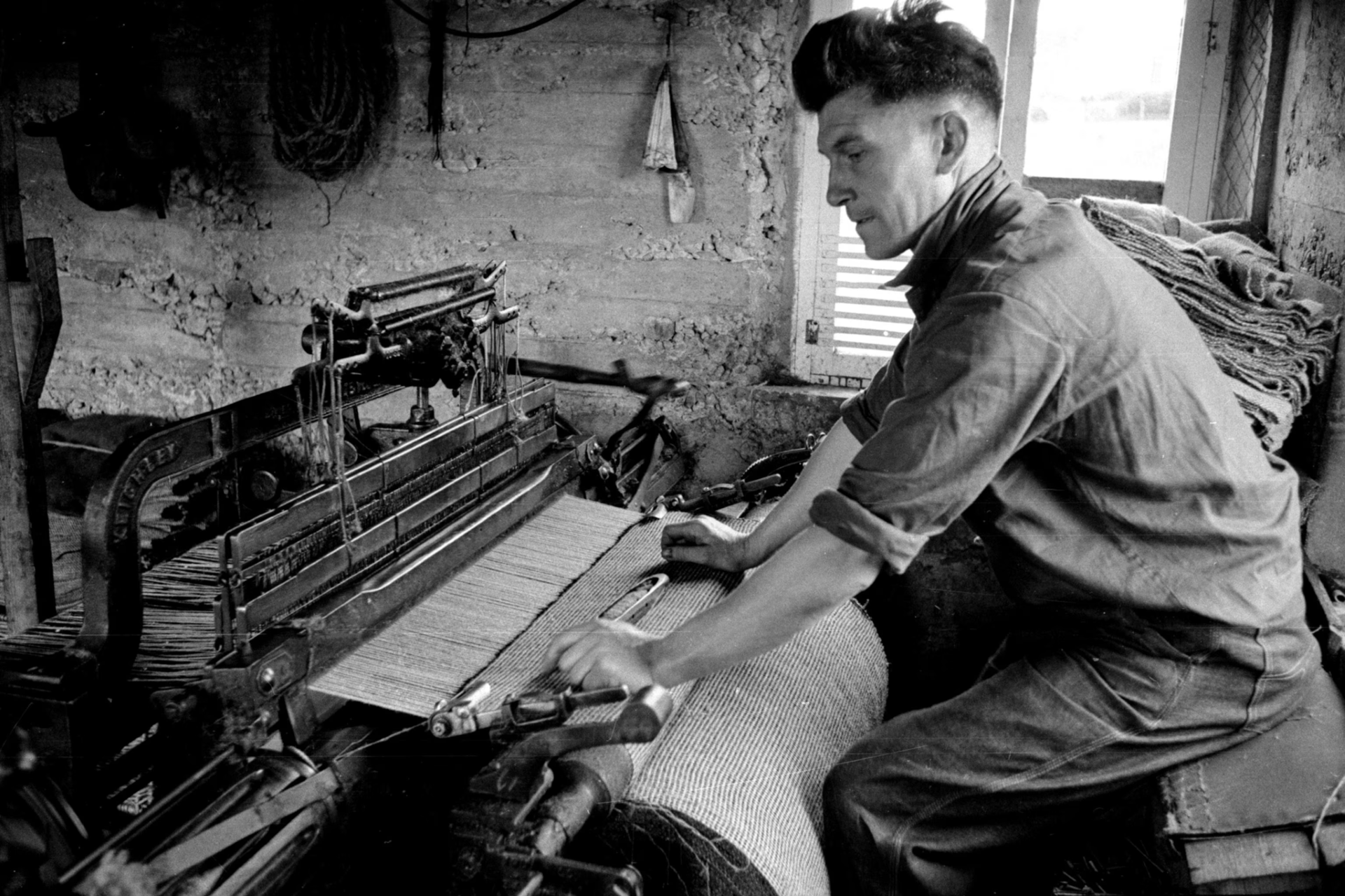
Weaver Producing Harris Tweed, 1955. Image courtesy of National Geographic.
Harris worked to maintain this handmade and rustic quality in the way it was produced and advertised. After developing contacts with London, tweed’s popularity began to grow rapidly, and with it, demand. Mills located elsewhere began producing lower-quality tweed, which resulted in the official Harris Tweed company to trademark its craft. In this way, Harris Tweed upholds the quality of its product, supports the island’s economy, and reinforces its Scottish roots.
The process, of course, is no longer conducted in the modest confines of a remote island cottage, despite being at the forefront of the Harris Tweed brand. Still, it has found a balance between its original provincial background and a mass-produced and globally recognised fabric. The inaugural milling process was very labour-intensive with all aspects being conducted by hand, but has since developed into a modern mechanical procedure. As well as serving as a significant economic factor to the island of Harris, the industry supports many others in the Outer Hebrides.
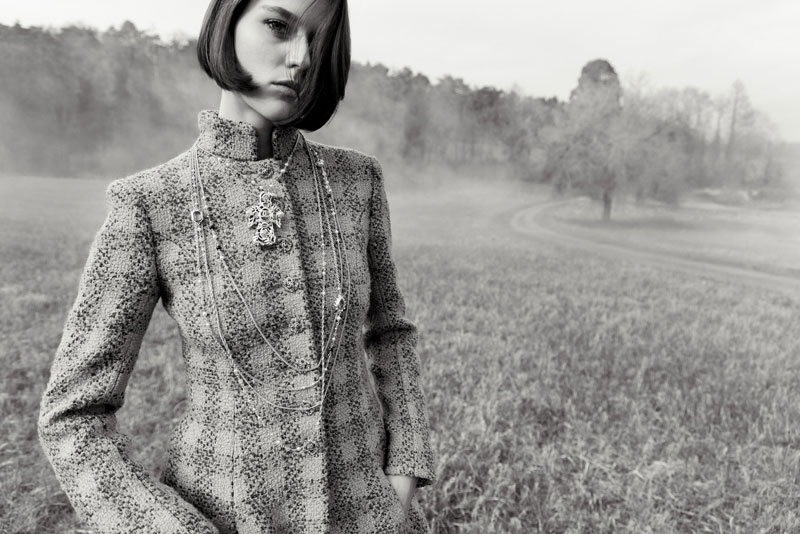
Chanel Tweed in Fall/Winter 2022. Image courtesy of Chanel.
Today, tweed is acknowledged around the world for its exceptional quality. It has been used and adapted perhaps most famously by Chanel, where it has become an iconic and identifiable fabric. Vivienne Westwood, Ralph Lauren, and Alexander McQueen have similarly embraced tweed as a fabric in their designs, drawing upon this recognisably Scottish tradition.
Bibliography
Pedersen, Sarah, and Andrea Peach. “Highland Romance or Viking Saga? The Contradictory Branding of Orkney Tweed in the Twentieth Century.” Journal of Design History 32, no. 3 (2019): 263–79. https://www.jstor.org/stable/48545656.
Moisley, H. A. “Harris Tweed: A Growing Highland Industry.” Economic Geography 37, no. 4 (1961): 353–70. https://doi.org/10.2307/141999.
The Harris Tweed Authority. “The Home of Harris Tweed.” Accessed November 17, 2026. https://www.harristweed.org.