Francis Cadell: The Joy of Colour
By Emma Montague
One of the four renowned Scottish Colourists, Francis Campbell Boileau Cadell (1883–1937) was a leading figure in early 20th-century Scottish painting, known for his sophisticated Edinburgh interiors and vibrant still lifes. Cadell brought consideration and refinement to his bold compositions, combining structure with artistic playfulness, resulting in work that is instantly recognisable and continuously engaging. Cadell’s paintings seem to answer the question: how much can colour do on its own? Looking across five of his bolder works, Cadell shows that colour is not simply a way to detail objects or light, but that it is the primary means of expression.
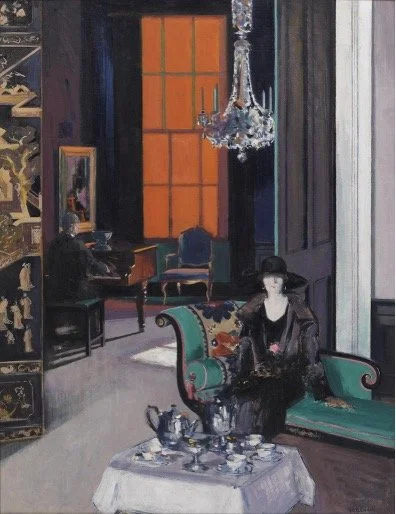
Francis Campbell Boileau Cadell, Interior - The Orange Blind, 1927. Oil on canvas, 111.8 x 86.4 cm. Glasgow, Kelvingrove Art Gallery & Museum. Image courtesy of Art UK.
In Interior - The Orange Blind, Cadell immediately establishes the tall, vivid orange blind as the dominant visual force within the composition. Its warm, saturated hue commands attention, enhanced by the surrounding dark, muted greys and blues, while the complementary teal of the chaise longue further enlivens the scene. The painting derives its impact from the boldness of these colours, functioning independently of narrative or decorative purpose. Cadell’s use of negative space draws the eye towards the female subject’s gaze, reinforcing her position as the central figure, while the male figure at the piano recedes almost imperceptibly into the background, second to the dominance of Cadell’s colour and composition.
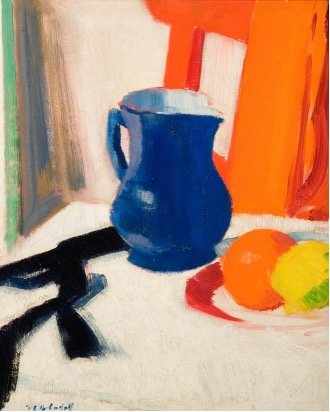
Francis Campbell Boileau Cadell, Blue and Orange, ca. 1925. Oil on panel, 42.5 x 35 cm. Stoke-on-Trent, The Potteries Museum & Art Gallery. Image courtesy of Art UK.
Cadell’s Blue and Orange still life presents a study in contrast and vibrancy, in which the strong complementary colours of the blue and orange interact across the canvas, generating visual energy. The prominent black ribbon does not disrupt the composition, but accentuates these chromatic relationships and introduces a subtle tension that enhances the painting’s overall balance. Cadell organises the hues considerately, allowing each to assert itself while maintaining overall harmony. The joy of Blue and Orange lies in observing these colours as they coexist with confident, playful engagement.
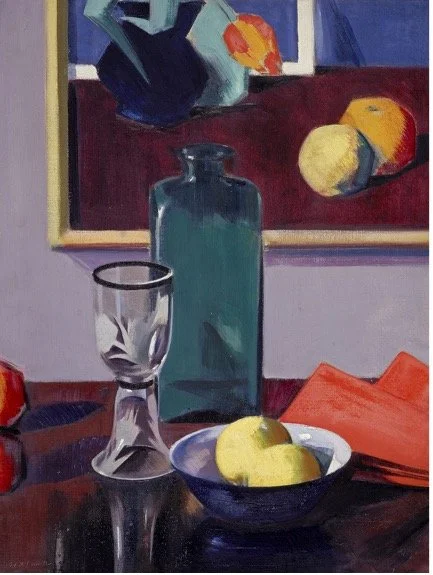
Francis Campbell Boileau Cadell, The Green Bottle, c. 1920s. Oil on canvas, 61 x 46 cm. Edinburgh, National Galleries of Scotland. Image courtesy of National Galleries of Scotland.
In The Green Bottle, the deep green hue of the prime subject stands out against the neutral background wall, serving as a focal point and compositional anchor rather than overwhelming the scene. Although more subdued than the brighter fruits and napkin nearby, the green provides structure, allowing these more vivid elements to assert themselves and enliven the composition. Cadell achieves a sense of rhythm and vitality through the careful interaction of colour, demonstrating how even restrained tones can contribute strength and cohesion. The painting exemplifies his delight in colour relationships, where every note, bold or subtle, carries significant visual weight.
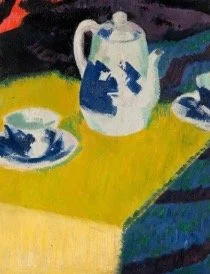
Francis Campbell Boileau Cadell, Blue and White China, n.d. Oil on canvas, 45 x 34 cm. Paisley, Paisley Museum and Art Galleries. Image courtesy of Art UK.
Cadell’s Blue and White China introduces decorative elements in its striped tablecloth and painted tea set, but colour again remains its principal source of energy. The bright pop of red contrasts with the greens in the tablecloth, while the blues of varying intensity play against the bright yellow, creating harmony and visual dynamism.
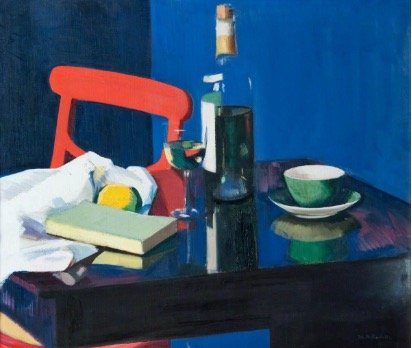
Francis Campbell Boileau Cadell, Still Life and Rosechatel, 1924. Oil on canvas, 63.7 x 76.3 cm. Glasgow, The Hunterian, University of Glasgow. Image courtesy of Art UK.
Still Life and Rosechatel is a celebration of painterly colour and texture. The objects in the scene are simplified in shape, yet the chosen hues give each a distinct presence and vibrancy. Warm reds, muted greens, and deep blues interact across the piece, and the brushwork is bold, yet precise. The painting demonstrates that still life need not be dramatic to be compelling, and that the sheer pleasure of colour and shape is sufficient.
Across these five works, Cadell’s joy in colour is evident. He uses it boldly and playfully, allowing it to guide the eye and carry the composition. These paintings are not exercises in restraint; they celebrate what paint can achieve when an artist fully delights in the act of applying it. In Cadell’s hands, colour is not merely an artistic tool, but the main reason to look.
Bibliography
Art UK. “Blue and Orange | Art UK.” Accessed 8 February, 2026. https://artuk.org/discover/artworks/blue-and-orange-19738
Art UK. “Blue and White China | Art UK.” Accessed 10 February, 2026. https://artuk.org/discover/artworks/blue-and-white-china-189924/search/makers:francis-campbell-boileau-cadell-18831937/page/1/view_as/grid
Art UK. “Interior: The Orange Blind | Art UK.” Accessed 9 February, 2026. https://artuk.org/discover/artworks/interior-the-orange-blind-83443
Art UK. “Still Life and Rosechatel | Art UK.” Accessed 8 February, 2026. https://artuk.org/discover/artworks/still-life-and-rosechatel-13835
National Galleries of Scotland. “The Green Bottle by Francis Campbell Boileau Cadell | National Galleries of Scotland.” Accessed 9 February, 2026. https://www.nationalgalleries.org/art-and-artists/58286