Crossing out Convention: Tartan as Fashion Warrior
By Megan Waugh
In a world increasingly enshrouded in a greyscale, modern nightmare, eccentric fashion feels almost necessary. However, rather than being contested, the daunting domination of technology and inauthenticity seems to be reflected in the fashion industry. The accumulation of machinery has allowed for mass production which can turn over mounds of polyester faster than you can call it cheugy. While this is often attributed to cost-efficiency, even supposedly ‘high-end’ brands are now being criticised for a lack of quality. If fashion is supposed to be a tool of expression, must we all align ourselves with beige and plastic? Or is there more to us than that?
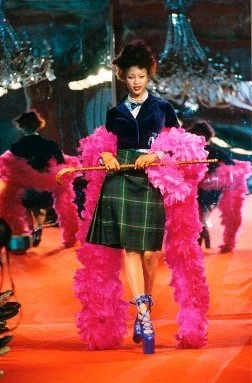
Naomi Campbell Walking Vivienne Westwood Fall 1993. Courtesy of Guy Marineau, Conde Nast, Getty Images.
Amidst the brutality of trend cycles, there appears to be a textile that can never be cast away. A manifestation of intersecting lines and bold colours, the endurance of tartan marks it as a warrior of the fashion industry. While its immediate bold impressions make it unforgettable, it is its symbolic value which makes it meaningful. Although it is not unique to Scotland, it was here that it accumulated the connotations which characterise it in the cultural imagination today.
The pattern emerged here in the sixteenth-century and met controversy in the ‘Disclothing Act’ of 1747. As it had become synonymous with Highland identity, its representation threatened Scotland’s assimilation into greater Britain. While this law aimed to diminish tartan altogether, it paradoxically made it more popular than ever. In the period following this Act, tartan was developed and considerably elaborated into the style of Highland dress we associate it with today. Seemingly, attempts to neutralise identity only led people to more passionately reckon the ties between fashion and personal identity. Furthermore, the importance of fashion as a tool not only of expression, but resistance, was underlined.
These sentiments of individuality and rampant expression persist in how we perceive the pattern today. While its direct battle with government was in the eighteenth century, it has been used as a message of subversion and persistent identity continually since then, taking on new forms and adapting to contexts much broader than the Highland conflicts. A textile with such historic associations surprisingly seems to consistently represent something ‘new’.
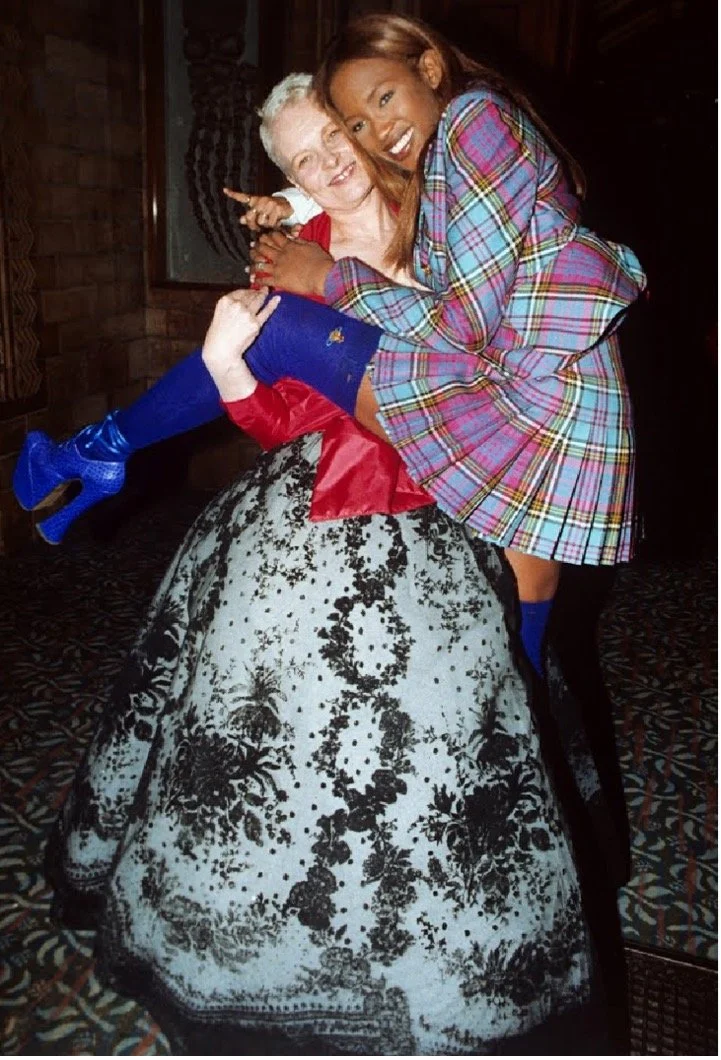
Vivienne Westwood and Naomi Campbell Backstage at London Fashion Week Autumn/Winter 1993. Courtesy of British Fashion Council.
This effect can largely be traced to the 1970s, when Vivienne Westwood incorporated tartan fabrics into her own designs, which stood central to the punk movement. Her pieces sought an equilibrium between tradition and novelty, proving that fashion could borrow from the past to reinterpret it as something new. While tartan had come to be associated with the British upper classes, its striking details now characterised looks which articulated individuality and rebellion. Westwood’s designs featured conventional clothing worn unconventionally, turning them into emblems of anti-establishment rhetoric through tears, folds, and slogans. Most bold of all were the unforgiving checks of vibrant tartan.
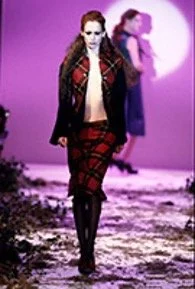
Alexander McQueen, Suit, Highland Rape, Autumn/Winter 1995–96. Image courtesy of MET Museum.
While its reach and meaning has expanded far beyond its regional roots, tartan’s ties to Scotland remain incredibly strong. The textile’s representation of national identity has also been considered through fashion. As a nation which has had to continually fight suppression, its history and cultural identity echo wider arguments for independent expression. Alexander McQueen’s ‘Highland Rape’ collection demonstrates this relationship, as McQueen intended to reflect upon England’s ‘assaults’ upon Scotland. Violence was evident not only in the tears of garments, but in the stark contrast between ephemeral, translucent fabrics and imposing red tartan. This sequence conjured a visual metaphor which resonated far beyond just clothing. The contrast between the two styles created a sense of uncanny which provoked a stark realisation: that strength of personal expression is imperative to one’s survival. And so, once again, it was the fiery red cuts of tartan which embossed and executed this message.
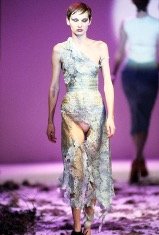
Alexander McQueen, Dress, Highland Rape, Autumn/Winter 1995–96. Image courtesy of MET Museum.
Thus, the tartan textile stands out as an exemplary messenger in the world of fashion. More than just an emblem of Highland dress, it has come to represent a potent signal of boldness and transgression. That its unique semblance has been beloved by eighteenth-century Jacobites, the 1970s punk movement, and 2010s grunge culture, suggests that even across vastly changing times and trends, there remains an indispensable value: authentic expression. Furthermore, if you find yourself de-spirited by the modern labyrinth of lacklustre clothing racks, know that you are not alone. Just look for those checkered bright lines, and you will recognise a pattern which transcends time. Authentic individual expression seems under crisis, but it has been this way before. Like tartan, if you exert yourself with unforgiving boldness, perhaps your own transgression will meet similar praise.
Bibliography
‘Thou Shall Kilt: The Story Of A Scottish Symbol Turned Cult Fashion Icon’. Westwood World. Vivienne Westwood. September 4th, 2021. https://www.viviennewestwood.com/en-gb/westwood-world/heritage/thou-shall-kilt--the-story-of-a-scottish-symbol-turned-cult-fashion-icon/.
Brown, Ian. From Tartan to Tartanry: Scottish Culture, History and Myth. Edinburgh University Press, 2010.